
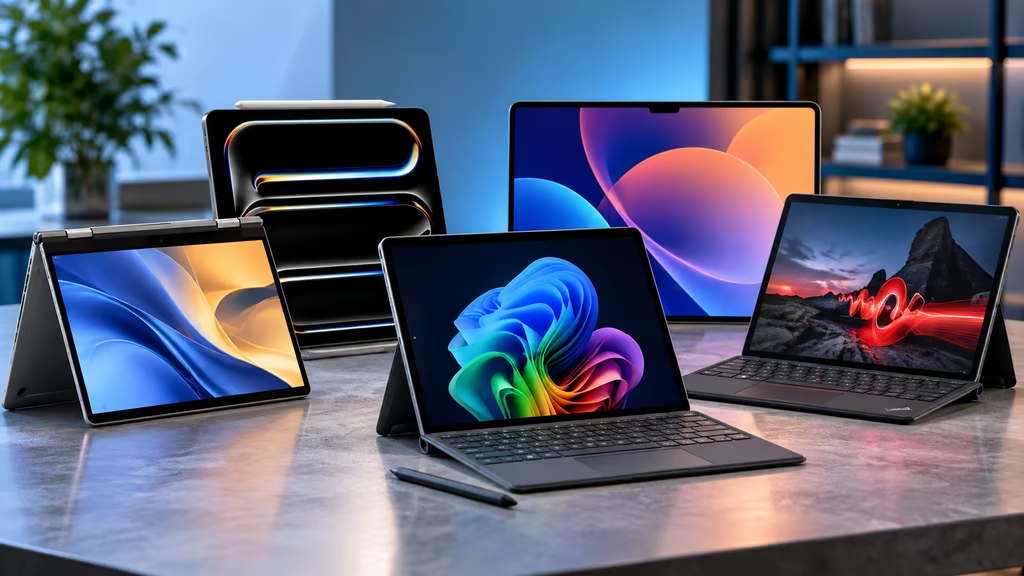


The Surface Pro has plenty of competition in 2026. ASUS and Lenovo now offer Windows devices built around similar detachable or convertible designs, while Apple and Samsung give tablet-first buyers strong alternatives outside Windows.
The right choice depends on more than performance. A detachable keyboard, pen support, operating system, ports, screen size, and total setup cost can all determine whether a device works as a genuine Surface Pro replacement.
Microsoft’s latest Surface Pro lineup remains the baseline for this category, but these five alternatives cover a wider range of priorities, from creative work and Android integration to enterprise deployment and large-screen value.
- Best Surface Pro alternatives at a glance
- How we chose the best Surface Pro alternatives
- 1. ASUS ProArt PZ14: Best overall Surface Pro alternative
- 2. Apple iPad Pro 13-Inch M5: Best for performance and creative work
- 3. Samsung Galaxy Tab S11 Ultra: Best Android alternative
- 4. Lenovo ThinkPad X13 Detachable: Best for business and enterprise use
- 5. ASUS Vivobook 16 Flip: Best large-screen value
- Which Surface Pro alternative should you buy?
Best Surface Pro alternatives at a glance
| Model | Official US price | Form factor | OS | Keyboard and pen |
|---|---|---|---|---|
| ASUS ProArt PZ14 | $2,499.99 | Detachable | Windows 11 Home | Detachable keyboard and stand cover; pen support |
| Apple iPad Pro 13-inch M5 | $1,499 | Tablet | iPadOS | Keyboard and Apple Pencil sold separately |
| Samsung Galaxy Tab S11 Ultra | $1,299.99, 256GB | Tablet | Android | S Pen included; keyboard optional |
| Lenovo ThinkPad X13 Detachable | $3,039 | Detachable | Windows 11 Pro | Folio keyboard and Slim Pen included |
| ASUS Vivobook 16 Flip | From $1,099.99 | 360-degree convertible | Windows 11 | Keyboard built in; stylus support |
Prices were checked on Sept. 28, 2026, and may vary by configuration, retailer, promotion, or region.
How we chose the best Surface Pro alternatives
We compared each device on the features that determine whether it can realistically replace a Surface Pro:
- Design: Detachable tablet versus 360-degree convertible and how practical each is in tablet and laptop modes.
- Performance: Processor, memory, storage, and independent test results where available.
- Battery life: Real-world runtime from independent testing where comparable results were available.
- Software: Windows, iPadOS, or Android and the effect that choice has on desktop applications and management.
- Keyboard and pen: Whether the accessories are included, optional, or required for laptop-style use.
- Connectivity: Ports, wireless support, docking, and peripheral compatibility.
- Price: The official cost of the device and any essential accessories needed for a laptop-style setup.
Windows users looking for the closest possible replacement will naturally lean toward ASUS or Lenovo. The iPad Pro and Galaxy Tab S11 Ultra make more sense when tablet apps and ecosystem integration matter more than traditional Windows software.
1. ASUS ProArt PZ14: Best overall Surface Pro alternative
The ASUS ProArt PZ14 is the closest direct Surface Pro alternative in this group. ASUS lists it at $2,499.99 in the US.
It combines a detachable Bluetooth keyboard and stand cover with a 14-inch 2880-by-1800 OLED touchscreen, 144Hz refresh rate, Snapdragon X2 Elite processor, up to 32GB of memory, and up to 1TB of storage.
The Snapdragon X2 Elite includes an NPU rated at up to 80 TOPS, giving the PZ14 plenty of headroom for Copilot+ PC features and supported on-device AI workloads.
Notebookcheck recorded 13 hours and 44 minutes in its Wi-Fi battery test at 150 nits. The review also praised the OLED display, system performance, keyboard, and build quality, while noting audible fans under load, soldered memory, no headphone jack, and no cellular option.
Windows on Arm is the main compatibility consideration. Most mainstream applications now run natively or through emulation, but businesses using older Windows software, specialist drivers, or uncommon peripherals should test them before committing to a wider rollout.
The PZ14 is expensive, but its large OLED display, detachable design, included keyboard, and Windows software support make it the closest overall match to the Surface Pro experience.
2. Apple iPad Pro 13-Inch M5: Best for performance and creative work
The 13-inch iPad Pro with M5 starts at $1,499 with 256GB of storage and 12GB of memory.
Apple’s M5 chip gives the iPad Pro considerably more performance than most tablets. The base configuration uses a nine-core CPU and 10-core GPU, while higher-storage models move to a 10-core CPU and 16GB of memory.
Tom’s Guide recorded 13 hours and 16 minutes of battery life in its web-browsing test and found the M5 significantly faster than the Galaxy Tab S11 Ultra in its CPU and graphics benchmarks.
The main limitation is software rather than hardware. iPadOS offers capable multitasking and a strong library of creative apps, but it still cannot replace every Windows desktop application or peripheral workflow.
The keyboard and Apple Pencil are also separate purchases, so buyers planning to use the iPad primarily as a laptop should account for those accessories when comparing total cost.
For creative apps, tablet-first workflows, and raw performance, the iPad Pro is one of the strongest choices here. Businesses that depend on Windows-only applications should stick with a Windows alternative.
3. Samsung Galaxy Tab S11 Ultra: Best Android alternative
The Samsung Galaxy Tab S11 Ultra starts at $1,299.99 for the 256GB Wi-Fi model. Samsung also offers 512GB and 1TB configurations.
Its 14.6-inch Dynamic AMOLED 2X display gives it the largest screen in this group, while the included S Pen adds writing and drawing support without another accessory purchase.
Samsung DeX provides a more desktop-like interface for multitasking, external displays, keyboards, and mice. That makes the tablet easier to use for productivity than a conventional Android tablet, particularly for buyers already using Samsung phones and services.
Samsung’s Galaxy Tab S11 series also introduced a redesigned S Pen and updated DeX experience.
Tom’s Guide recorded 12 hours and 3 minutes in its Wi-Fi battery test. Its benchmark results showed strong Android performance, although the Dimensity 9400+ remained well behind Apple’s M5 in CPU and graphics tests.
The biggest limitation is still Android. DeX improves multitasking, but it does not turn Android applications into full Windows desktop software. Buyers who depend on traditional Windows applications should not treat the Tab S11 Ultra as a direct software replacement.
For Samsung and Android users, however, the combination of a large AMOLED display, included S Pen, DeX, and strong ecosystem integration makes it the best Android alternative to Surface Pro.
4. Lenovo ThinkPad X13 Detachable: Best for business and enterprise use
The Lenovo ThinkPad X13 Detachable is the most business-focused device in this group. Lenovo lists the 21U60003US configuration at $3,039.
That configuration pairs an Intel Core Ultra 7 365 vPro processor with 32GB of memory, a 512GB SSD, and Windows 11 Pro.
The 13-inch 2880-by-1920 IPS touchscreen runs at 120Hz and reaches a claimed 500 nits. Lenovo also includes the detachable folio keyboard and Slim Pen.
Unlike the Arm-based PZ14, the X13 uses an Intel processor, which can make it easier to introduce into environments built around traditional Windows applications, peripherals, and enterprise management tools.
The keyboard carries familiar ThinkPad features, including a TrackPoint and physical buttons, while the tablet includes two Thunderbolt 4 ports. The complete setup weighs about 2.76 pounds.
Its biggest drawback is obvious: price. At $3,039, the X13 Detachable sits well above mainstream Surface Pro configurations and makes the most sense for organizations that specifically need features such as Intel vPro, Windows 11 Pro, ThinkPad hardware, and enterprise support.
Independent testing is also still limited because the model only recently reached the US market, so organizations considering larger deployments should test battery life, thermals, docking, and application compatibility on the exact configuration they intend to buy.
5. ASUS Vivobook 16 Flip: Best large-screen value
The ASUS Vivobook 16 Flip starts at $1,099.99 in the US, making it the least expensive Windows option in this list.
It is not a detachable. Instead, the permanently attached keyboard folds behind the display using a 360-degree hinge, allowing laptop, tent, stand, and tablet modes.
The Vivobook 16 Flip offers up to a 16-inch 3K 120Hz OLED touchscreen, Intel Core Ultra processors, up to 32GB of memory, a 75Wh battery, Thunderbolt 4, HDMI 2.1, USB-A, USB-C, and a microSD card reader.
That larger chassis gives it an advantage over tablet-style alternatives when ports and screen space matter more than handheld use.
PCWorld found strong overall performance and integrated graphics in its testing. Its video-loop battery test ran for more than 14 hours.
The tradeoff is portability. At roughly 4 pounds, the Vivobook is considerably heavier than the detachable models and less comfortable to hold in tablet mode.
For buyers who mainly want a Windows laptop with touch, pen support, a large OLED display, and occasional tablet use, that compromise is reasonable. The $1,099.99 starting price also gives it a significant cost advantage over the other Windows alternatives here.
Which Surface Pro alternative should you buy?
| Best for | Pick | Reason |
|---|---|---|
| Closest overall Surface Pro replacement | ASUS ProArt PZ14 | Windows detachable design, large OLED display, and included keyboard |
| Performance and creative work | iPad Pro 13-inch M5 | Powerful M5 chip, excellent display, strong battery life, and mature creative apps |
| Android and Samsung users | Galaxy Tab S11 Ultra | Large AMOLED display, included S Pen, DeX, and Galaxy integration |
| Enterprise deployments | Lenovo ThinkPad X13 Detachable | Windows 11 Pro, Intel vPro, Thunderbolt 4, and bundled keyboard and pen |
| Large-screen value | ASUS Vivobook 16 Flip | $1,099.99 starting price, OLED display, Windows, and built-in keyboard |
The ASUS ProArt PZ14 is the closest overall Surface Pro alternative because it keeps the detachable Windows design while offering a larger OLED display and an included keyboard.
The iPad Pro is the stronger choice for buyers prioritizing performance and creative apps, while the Galaxy Tab S11 Ultra fits Android and Samsung users who want a large tablet that can handle desktop-style multitasking.
The ThinkPad X13 Detachable targets business deployments where Intel vPro, Windows 11 Pro, and enterprise support justify the higher price. The Vivobook 16 Flip goes in the other direction, trading the detachable design for a larger screen, more ports, and a much lower starting price.
Also read: The best laptops for Android users compare Windows, Chromebook, and Googlebook options for buyers who prioritize phone integration over a detachable design.