
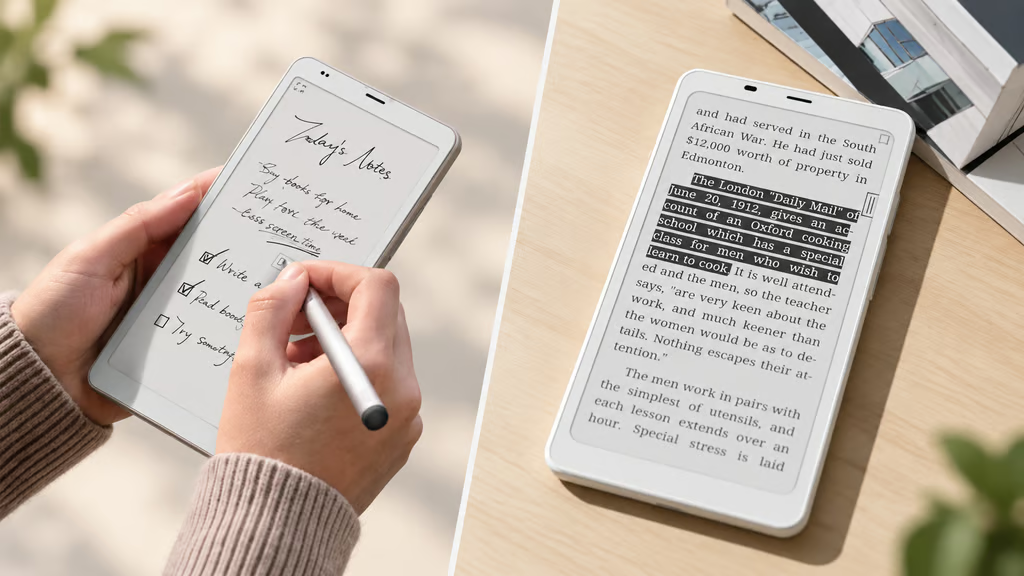


BOOX did not reinvent the Palma with its third generation. Instead, it gave the pocket-sized E Ink reader something its predecessor could not do: write.
Announced on Sept. 16, 2026, the Palma 3 adds active stylus support, Android 16, and a new aluminum-and-fiberglass body while keeping the same 6.13-inch monochrome E Ink display. BOOX currently lists the new model at $339.99, while the Palma 2 is $249.99, putting more pressure on the new features to earn their keep.
How we compared them: This comparison uses BOOX’s published specifications and current US pricing, supplemented by independent launch reporting where BOOX has not yet documented a feature in detail. Because the Palma 3 is still listed as “Available Soon,” recommendations are based on confirmed specifications and pricing, not untested battery life, performance, or writing feel.
Palma 3 changes the tools, not the screen
Both devices use a 6.13-inch, 824-by-1,648 E Ink display at 300 ppi. The Palma 3 specifications also list 6GB of RAM, 128GB of storage, microSD expansion, a 3,950mAh battery, and a 16-megapixel rear camera.
| Specification | Palma 2 | Palma 3 |
| Display | 6.13-inch, 300 ppi | 6.13-inch, 300 ppi |
| RAM/storage | 6GB/128GB | 6GB/128GB |
| OS | Android 13 | Android 16 |
| Battery | 3,950mAh | 3,950mAh |
| Weight | About 170g | About 195g |
| Active stylus | No | Yes |
The real changes happen around that familiar reading hardware. Palma 3 moves to Android 16 and an anodized aluminum frame with a fiberglass back, while the Palma 2 specifications show Android 13 and a weight of about 170 grams. Palma 3 is slightly narrower and thinner but roughly 25 grams heavier.
The newer OS gives Palma 3 a more current software baseline, but Android support policies vary by manufacturer and device. Recent phones also show how OS upgrades and security support can follow different timelines, so Android 16 alone does not establish how long BOOX will keep the device current.
Stylus support is where the upgrade gets interesting
Independent launch reporting says Palma 3 supports BOOX’s InkSense Plus active stylus, while the standard Palma 2 does not support an equivalent active pen.
The pen is sold separately. BOOX’s accessories catalog lists InkSense Plus at $45.99, with 4,096 pressure levels, tilt sensitivity, USB-C charging, a shortcut button, and a replaceable tip.
That extra hardware pushes the total higher. At $339.99 for Palma 3, adding the stylus brings the setup to about $385.98 before tax and shipping.
For reading-focused use, Palma 2 still gives buyers the same display resolution, memory, storage, and battery capacity for less. BOOX’s open Android approach also remains a draw among recent Kindle alternatives, since compatible reading apps from several ebook ecosystems can live on the same device.
Palma 3 makes the stronger case for buyers who plan to take handwritten notes or want Android 16 and the redesigned chassis. For reading-focused use, the Palma 2 still delivers much of the same core experience for less.
The remaining question is not what the Palma 3 adds, but how well its biggest new feature performs. Independent testing still needs to establish handwriting comfort and latency on the 6.13-inch screen, but the buying split is already clear: readers gain little from upgrading, while note-takers have the strongest reason to consider it.
Let us teach you How to Talk to AI for free! Try our six-minute course at The Neuron Academy and learn a few simple ways to write better prompts and get more useful results from AI, or browse our other AI course for free for seven days. Check out all the lessons here →