


Humanoid robots have spent years learning to walk, lift, and work alongside humans. Now, they’re making their Wall Street debut.
Nvidia-backed Agility Robotics began trading on Nasdaq on Nov. 5 under the ticker AGLT, becoming what the company describes as the first US-listed, pure-play humanoid robotics business with proven commercial deployments. Its debut follows a $2.5 billion pre-money transaction valuation and approximately $465 million in gross capital from its merger and related financings.
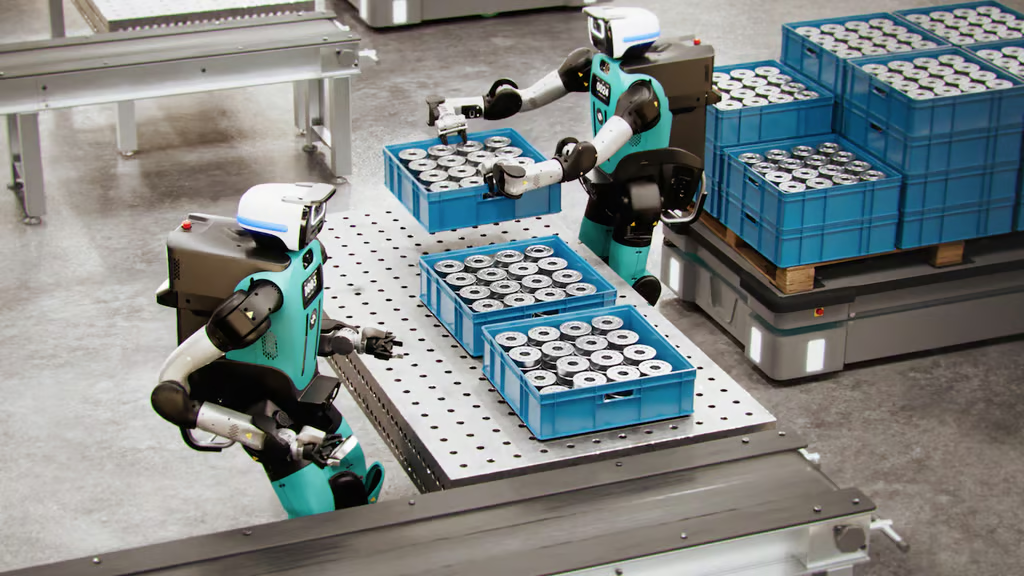
Unlike many humanoid robots still confined to research labs and demonstrations, Agility’s Digit robots are already moving materials inside warehouses and manufacturing facilities. The company’s public listing marks a significant milestone for an industry racing to make advanced robotics commercially sustainable.
- Agility Robotics makes history with $465 million deal
- Meet Digit: The humanoid robot already working in warehouses
- Digit 5 brings new capabilities to workplace robotics
- A growing market attracts Tesla, Figure AI, and other rivals
- The financial challenge behind Agility’s growth plans
- What Agility’s public debut means for businesses considering humanoid robots
- What comes next for Agility Robotics?
Agility Robotics makes history with $465 million deal
Agility completed its merger with Churchill Capital Corp XI on Nov. 4, clearing the way for its Nasdaq debut the following day.
The transaction valued Agility’s existing equity at approximately $2.5 billion, according to Bloomberg’s reporting. That pre-money transaction valuation should not be confused with the company’s market capitalization, which can fluctuate as its shares trade.
Rather than pursuing a traditional initial public offering, Agility used a special purpose acquisition company (SPAC), a publicly traded entity created to merge with a private business and take it public.
According to Agility’s financing announcement, the merger and related financings provided approximately $465 million in gross capital before transaction expenses.
That total consisted of:
- $164 million: Proceeds from Churchill Capital Corp XI’s trust account.
- $201 million: A private investment in public equity (PIPE) led by Foxconn.
- $100 million: Equity funding Agility had already received before the merger closed.
Because the $100 million was received earlier, the full $465 million should not be interpreted as new funding delivered on Nov. 5.
Agility plans to use the capital to expand manufacturing, increase commercial deployments, fulfill customer orders, and continue developing its humanoid robots.
Here’s a snapshot of the transaction:
| Category | Details |
|---|---|
| Company | Agility Robotics |
| Stock ticker | AGLT (Nasdaq) |
| Trading debut | Nov. 5, 2026 |
| Transaction | Merger with Churchill Capital Corp XI |
| Pre-money equity valuation | Approximately $2.5 billion |
| Gross capital from merger and related financings | Approximately $465 million |
| Flagship product | Digit humanoid robot |
| Next-generation model | Digit 5 |
| Digit 5 committed orders | More than $300 million, subject to contractual conditions |
| Planned Digit 5 availability | 2027 |
Agility’s strategic investors and partners include Nvidia, Amazon, SoftBank, and Foxconn.
As TechCrunch reported, the listing gives public-market investors an opportunity to evaluate a company focused specifically on commercial humanoid robotics, an industry where many prominent competitors remain privately held.
Meet Digit: The humanoid robot already working in warehouses
While many humanoid robot manufacturers attract attention with demonstrations of dancing, running, or acrobatics, Agility has taken a more practical approach.
Its flagship robot, Digit, is designed to perform repetitive physical tasks in warehouses, manufacturing facilities, and other industrial environments. The company says its robots have accumulated more than 65,000 hours of real-world operation, with deployments involving businesses such as GXO, Toyota Motor Manufacturing Canada, and Schaeffler.
At a GXO logistics facility in Georgia, Digit robots have moved more than 100,000 totes, demonstrating how humanoid machines can support existing warehouse operations.
Agility also announced an expansion of its partnership with GXO, with plans to deploy Digit at two additional US logistics facilities beginning in early 2027.
The company’s commercial strategy focuses on tasks that are physically demanding, repetitive, or difficult to staff consistently.
Potential applications include:
- Warehouse operations: Moving containers, transporting inventory, and transferring materials between workstations.
- Manufacturing: Handling parts and materials within production environments.
- Logistics: Supporting fulfillment operations and repetitive material movement.
- Industrial automation: Performing tasks in facilities originally designed for human workers.
Agility’s approach could appeal to businesses looking to introduce automation without completely redesigning their facilities.
The company has also signed a commercial agreement with agricultural equipment manufacturer AGCO for a manufacturing pilot expected to begin in 2027. Three additional manufacturing customers are participating in paid programs, according to Agility.
These relationships suggest growing commercial interest, although pilot programs do not necessarily translate into large-scale orders.
Digit 5 brings new capabilities to workplace robotics
Agility’s next major step is Digit 5, the latest generation of its humanoid robot.
Unveiled in September 2026, the updated machine is designed to perform a wider range of industrial tasks while operating more closely alongside human workers. According to Agility’s announcement, Digit 5 incorporates improvements in lifting, manipulation, safety, and battery technology.
Key capabilities and development targets include:
| Feature | Digit 5 capability or target |
|---|---|
| Lifting | Repetitive handling of loads up to 50 pounds |
| Charging | Nine-minute recharge target |
| Productivity | More than 20 productive hours per 24-hour period |
| Safety | Systems being developed for operation closer to people |
| Computing | Planned Nvidia IGX Thor integration |
| Early customer access | First half of 2027 |
| General availability | End of 2027 |
The charging and productivity figures are development targets rather than independently verified results across large commercial fleets.
Agility is working with Nvidia and FORT Robotics on safety technologies intended to allow Digit 5 to operate closer to employees.
Some safety features remain under development, and Agility cautions that preliminary specifications and capabilities may change as the company continues to test and validate the platform.
The company has also partnered with Nyobolt on fast-charging battery technology intended to support longer operating periods.
What the $300 million in Digit 5 orders actually means
Agility reports more than $300 million in committed multiyear orders for Digit 5. However, those commitments are conditional and should not be confused with completed sales or guaranteed revenue.
According to Agility’s SEC-filed investor presentation, the company’s earlier disclosures linked more than $300 million in committed orders to a three-year agreement for 1,000 Digit 5 robots with a single customer.
The company’s SEC prospectus identifies the customer involved in the May 2026 warrant arrangement as a related party. Under that arrangement, Agility agreed to issue warrants tied to the number of robots sourced, subject to the customer meeting a minimum commitment of 1,000 robots.
This distinction matters because transactions involving related parties can require additional scrutiny when assessing a company’s commercial traction and the independence of customer demand.
Agility repeated the $300 million-plus order figure in its announcement without providing an updated customer-by-customer breakdown. The commitments remain subject to contractual milestones and product requirements, meaning they should not be treated as guaranteed revenue.
The earlier disclosure also highlights the company’s reliance on a major customer agreement as it works to commercialize Digit 5.
Realizing the potential revenue will depend on Agility meeting contractual milestones, product features, specifications, and deployment requirements.
The company cautions in its SEC materials that committed orders may not ultimately convert into recognized revenue.
Agility expects to begin delivering Digit 5 to early-access customers in the first half of 2027, with broader availability targeted for the end of the year.
A growing market attracts Tesla, Figure AI, and other rivals
Agility’s public debut comes as competition in humanoid robotics accelerates.
Tesla is developing its Optimus robot, Figure AI is pursuing industrial applications, and Boston Dynamics continues advancing its Atlas platform. Other companies, including Apptronik and several Chinese robotics manufacturers, are also working to commercialize humanoid machines.
The growing competition reflects expectations that humanoid robots could eventually become a major category of industrial automation. However, companies are pursuing different approaches to bringing the technology to market.
Some manufacturers emphasize advanced mobility, dexterity, and general-purpose capabilities. Others focus on narrower industrial applications that could generate revenue sooner. Agility has concentrated on the latter strategy, prioritizing repetitive workplace tasks that its robots can perform with existing technology.
Its commercial deployments may provide an advantage as businesses begin evaluating humanoid robots based on reliability, productivity, and cost rather than demonstrations alone.
The company’s Nasdaq listing also creates a new public-market reference point for the industry.
Unlike privately held competitors, Agility will face regular public financial reporting requirements, giving investors and industry observers greater visibility into its commercial progress.
The financial challenge behind Agility’s growth plans
Despite its commercial momentum, Agility remains in the early stages of building a sustainable business.
According to financial disclosures examined by Business Insider, the company generated approximately $1.8 million in revenue during 2025 while reporting a net loss of $138.1 million. More recent disclosures show that Agility generated approximately $174,000 in revenue during the first six months of 2026, compared with $625,000 during the same period in 2025.
According to MarketWatch, Agility reported an operating loss of approximately $362.7 million during the first half of 2026.
The figures illustrate the financial challenge facing a company investing heavily in technology and manufacturing while generating relatively limited commercial revenue.
Here’s how Agility’s reported financial performance compares across periods:
| Financial metric | Reported figure |
|---|---|
| 2025 revenue | Approximately $1.8 million |
| 2025 net loss | Approximately $138.1 million |
| First-half 2025 revenue | Approximately $625,000 |
| First-half 2026 revenue | Approximately $174,000 |
| First-half 2026 operating loss | Approximately $362.7 million |
| Cash and equivalents, June 30, 2026 | Approximately $14.7 million |
Because the figures cover different reporting periods, the full-year 2025 net loss and first-half 2026 operating loss should not be interpreted as a direct year-over-year comparison. They also represent different accounting measures.
The first-half revenue figures show a substantial year-over-year decline. However, the company’s early-stage sales remain uneven, and individual robot sales or deployments can significantly affect results.
Agility’s reported operating loss also reflects substantial spending on research, development, and business operations, including noncash accounting expenses.
SEC filings reveal earlier concerns about Agility’s financial position
Agility’s pre-merger SEC prospectus included a going-concern warning, indicating substantial doubt about the company’s ability to continue operating without additional financing.
The warning reflected Agility’s history of operating losses, negative cash flow, and insufficient existing resources to fund its planned operations for at least one year from the date of the financial statements.
Its independent auditor also included a going-concern explanatory paragraph in the report accompanying Agility’s audited 2025 and 2024 financial statements. Importantly, those assessments were made without assuming completion of the proposed business combination.
Agility has since completed the transaction, which provided access to substantial additional capital. However, the company must still demonstrate that it can convert customer commitments into recurring revenue while managing development and manufacturing costs.
The earlier going-concern warning should therefore be understood in the context of the company’s pre-transaction financial position, rather than as a new assessment of its financial condition following the Nov. 5 listing. The company’s June 30 cash balance also predates the financing associated with its public-market debut and should not be interpreted as its cash position after the transaction.
Those financial results help explain why the approximately $465 million financing package matters.
The capital gives Agility additional resources to fund robot development, expand manufacturing, and support commercial deployments as it works toward a sustainable business.
However, access to more capital does not eliminate the underlying challenges. Agility must continue spending on engineering, artificial intelligence, manufacturing infrastructure, safety testing, and customer support while expanding its commercial operations.
The company also faces the challenge of reducing production costs as it moves from relatively small deployments toward larger customer orders.
Agility has invested in RoboFab, its 70,000-square-foot manufacturing facility in Salem, Oregon, which is designed for an annual production capacity of up to 10,000 robots. That figure represents the facility’s intended capacity, rather than its current production output.
The company is also expanding its operations in Pittsburgh and maintaining development facilities in Fremont, California.
Profitability will ultimately depend on whether Agility can manufacture robots efficiently, fulfill customer commitments, and demonstrate that its machines deliver measurable economic value.
What Agility’s public debut means for businesses considering humanoid robots
Agility’s move onto the stock market matters beyond investors.
For manufacturers, warehouse operators, and IT leaders evaluating automation, the company’s progress offers an early look at how humanoid robots could become practical tools in the workplace.
Unlike traditional industrial robots, which often operate in fixed positions or specially designed environments, humanoid robots are intended to navigate spaces built for people. That flexibility could make them useful for businesses seeking to automate tasks without undertaking major facility modifications.
However, businesses considering humanoid robots should evaluate several factors before investing:
- Total cost of ownership: How much will robots cost to acquire, deploy, maintain, and operate?
- Operational reliability: Can the machines perform useful tasks consistently across multiple shifts?
- Workplace safety: What safeguards and training are necessary before robots can operate near employees?
- System integration: Can the robots connect with existing warehouse management systems and manufacturing software?
- Vendor support: Will manufacturers provide reliable maintenance, replacement parts, and software updates?
- Return on investment: Will humanoid robots deliver measurable productivity improvements compared with traditional automation?
How much could Digit cost businesses?
In its SEC-filed investor presentation, Agility outlined an illustrative pricing model for Digit 5.
| Pricing component | Illustrative cost |
|---|---|
| Robot-as-a-service deployment fee | Approximately $25,000 |
| Monthly robot-as-a-service fee | Approximately $8,500 |
| Outright robot purchase | Approximately $200,000 |
| Deployment fee for purchased robot | Approximately $20,000 |
| Annual software and maintenance for purchased robot | Approximately $36,000 |
These figures are company modeling assumptions, not a publicly available price list or independently confirmed customer-paid prices.
Under Agility’s illustrative financial model, businesses could potentially save approximately $100,000 annually per robot compared with the labor costs assumed in its analysis. The model compares approximately $200,000 in annual labor costs with roughly $100,000 in annual robot-as-a-service costs, assuming substantial robot utilization across multiple shifts.
However, those savings are projections, not independently verified results from existing deployments. Actual financial benefits will depend on labor costs, robot uptime, productivity, maintenance, deployment expenses, and integration with existing operations.
For businesses exploring the technology, limited pilot programs and measurable productivity targets will be important in determining whether humanoid robots make financial sense.
What comes next for Agility Robotics?
Agility’s public debut provides additional funding as the company prepares to expand commercial deployments and introduce Digit 5.
Several developments will help determine its progress over the next year:
- Digit 5 demonstrations: Agility plans to showcase its next-generation robot at CES 2027.
- Customer deliveries: Early-access Digit 5 deployments are expected to begin in the first half of 2027.
- Expanded warehouse operations: GXO plans to introduce Digit at two additional US facilities.
- Manufacturing growth: Agility intends to increase production capacity to support larger commercial orders.
- Broader availability: General availability of Digit 5 is targeted for late 2027.
The company’s ability to meet those milestones could influence how quickly other businesses adopt humanoid robots.
Agility’s Nasdaq debut represents a significant step forward for an industry that has spent years demonstrating what humanoid robots can do.
With fresh capital, established industrial customers, and a new generation of Digit robots approaching commercial availability, the company has an opportunity to bring humanoid robotics into more mainstream business operations.
Questions remain about manufacturing costs, profitability, and how quickly businesses will adopt the technology. But Agility’s public listing offers something the industry has largely lacked: a publicly traded humanoid robotics specialist whose financial performance and commercial progress can be closely tracked.
For businesses considering workplace automation, the coming years could provide a clearer picture of where humanoid robots make practical and financial sense.
Also read: For another look at the future of humanoid robotics, read how Figure AI’s Figure 03 robot reportedly walked 348 miles in nine days, putting its mechanical endurance to the test as the industry pushes toward commercial deployment.