


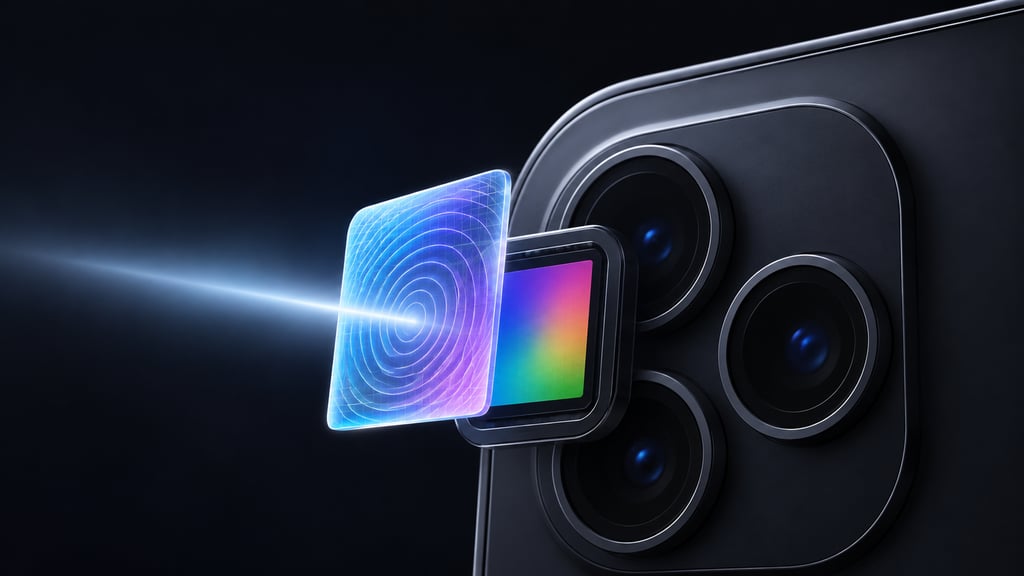
Your smartphone camera may be throwing away the very thing it needs most in night photography: light.
Smartphone cameras have for years relied on several components and technologies to produce the images we see. One of them is the color filter. Despite its importance, those filters come with a trade-off: they block a significant portion of incoming light before it reaches the image sensor.
Now, Metalenz is betting that a new technology called HoloCoder can change that, potentially delivering up to 2.5 times more light to the sensor without requiring larger camera sensors.
WIRED says the technology comes from Israeli startup PxE Holographic Imaging, and has been acquired by Metalenz — a semiconductor optics company.
A look inside HoloCoder’s promise
To understand what HoloCoder wants to do, we need to first look at how smartphone cameras capture light and color.
Most smartphone cameras use color filters arranged over their image sensors to separate incoming light into red, green, and blue information. A common design, known as a Bayer filter array, lets each pixel measure a particular color while blocking much of the remaining light.
According to Metalenz, conventional Bayer filters absorb roughly 60% of incoming light. That’s particularly limiting in low-light conditions, when cameras have less light available to produce a clear image.
HoloCoder takes a different approach. Instead of filtering out unwanted wavelengths, it uses diffraction to redirect incoming light toward the appropriate sensor pixels, potentially allowing more of that light to contribute to the final image.
Metalenz claims HoloCoder can deliver up to 2.5 times more light to a standard image sensor. That could mean cleaner night photos, better video, and less motion blur, since cameras may have more light available when using shorter exposure times.
Of course, there’s a difference between a promising optical design and a camera that actually takes better photographs. We still need real-world smartphone tests, but the idea is compelling: rather than asking software to recover light the sensor never received, HoloCoder aims to capture more of it from the start.
Comes with bonuses
Better low-light photography isn’t only what HoloCoder would bring to the table. WIRED says the technology can also capture better depth information alongside color in a single exposure.
That would mean a camera that could produce more accurate depth maps without relying on software to estimate how far objects are from the camera. This could improve portrait photography, background separation, and other features that depend on understanding the distance between objects.
There’s also a potential hardware benefit, too. Combining color and depth capture could reduce the need for additional depth-sensing components, making camera assemblies smaller and potentially cheaper to manufacture.
The potential applications extend beyond smartphones. Digital Trends points to robotics and autonomous vehicles as other areas where the technology could shine. A smaller sensing system that captures color and depth together could be useful here, although the benefits in that area aren’t established yet.
Who gets to benefit the most?
Mobile photography professionals and content creators could have the strongest incentive to welcome HoloCoder. Many already spend heavily on high-end smartphones and editing software to produce professional-quality photos and videos.
Better light capture could give them cleaner source images, preserve more detail in difficult lighting, and reduce the amount of post-shutter correction that’s needed. For journalists, social media professionals, and independent creators who rely on their phones as primary cameras, that’s a meaningful upgrade.
Smartphone manufacturers stand to benefit, too. HoloCoder could help them improve camera performance without continually increasing sensor sizes or adding more components.
Beyond smartphones, robotics and industrial businesses could find applications in machine vision, where systems need to identify objects and understand their surroundings. However, these remain potential applications rather than confirmed commercial deployments.
For now, HoloCoder offers an intriguing alternative to the industry’s reliance on computational photography. The real test will be whether redirecting more light produces better images when it matters most.
Motorola’s $1,599.99 Signature 27 takes on Google’s $1,299 Pixel 11 Pro XL with a larger 7,000mAh battery, faster 90W charging, and a 200MP periscope camera, leaving buyers to decide whether the hardware upgrades justify the $300 premium.