


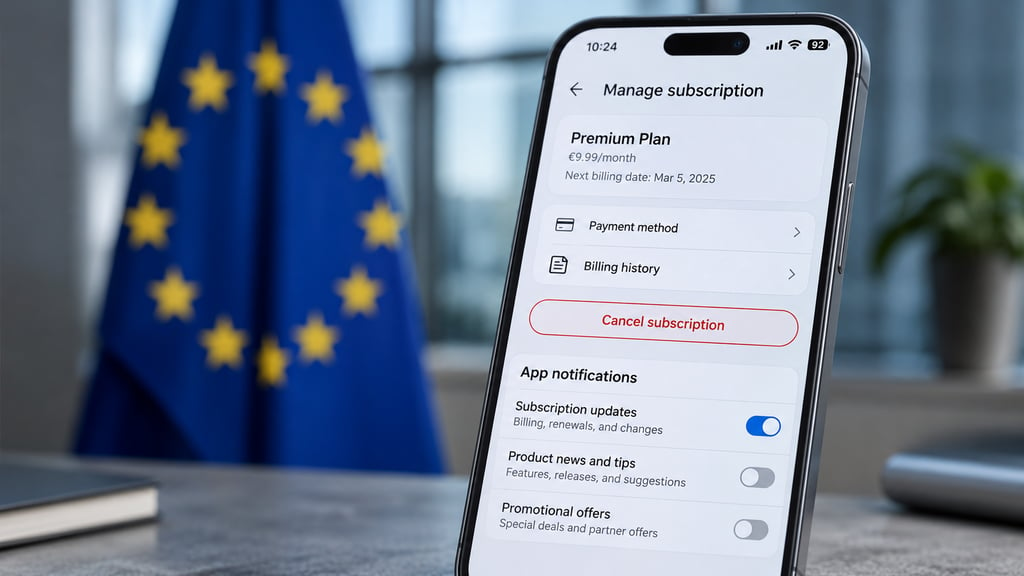
Signing up for a subscription takes a few clicks. Canceling it can feel like solving a puzzle, and the EU wants to change that.
On Nov. 11, the European Commission proposed the Digital Fairness Act, which would tighten free-trial and cancellation rules while giving users more control over potentially addictive app features. If adopted, the law could affect streaming services, games, online retailers, and other apps selling directly to EU consumers, including those run by companies outside the bloc.
The measures remain proposals, not new rights consumers can claim today.
Free trials and cancellation pages face tougher rules
The Commission’s announcement targeted subscription traps, misleading prices, and manipulative “dark patterns,” including fake low-stock warnings. It estimated the wider package could save EU consumers up to €13.7 billion annually.
Under the draft legislation, businesses would have to remind users before free trials end and obtain express agreement before starting paid contracts. Online contract providers would also need prominent termination functions, alongside reminders before certain automatic renewals.
Which addictive app features could users switch off?
The proposed rules would require covered digital products to offer accessible controls for features encouraging compulsive or excessive use. Adults could disable these individually or together, rather than see them banned outright.
| App feature | Proposed control |
|---|---|
| Autoplay and endless content | Stop automatic playback and uninterrupted consumption without meaningful breaks. |
| Unrelated notifications | Disable alerts unconnected to user activity. |
| Engagement streaks | Turn off incentives or penalties for not returning frequently. |
| Persistent chatbot prompts | Disable prompts that simulate relationships to prolong engagement. |
Separate measures would restrict paid random rewards and pay-to-win mechanisms for minors, subject to the proposal’s scope.
The EU has already challenged Meta’s addictive app design and TikTok’s recommendation system under the existing Digital Services Act. Those proceedings are separate from the proposed law.
EU’s proposed rules could reshape subscriptions and app design
For European consumers, the proposed changes could mean fewer unexpected charges, easier cancellations, and greater control over app features. Businesses serving EU customers, meanwhile, may need to review their subscription processes and engagement features to prepare for potential new requirements.
Consumers can prepare for clearer billing and cancellation rights
Someone in France trying to cancel an app subscription, or a German customer nearing the end of a free trial, could eventually benefit from clearer notices and easier cancellation. Under the draft, a French streaming service would need express agreement before converting a free trial into a paid contract.
For now, check trial deadlines and renewal terms, save receipts and cancellation confirmations, and use existing consumer-protection channels when necessary. The proposed controls and cancellation functions are not yet enforceable.
App developers may need to rethink billing and engagement features
Teams serving EU consumers should examine whether trial-to-paid charges require clear consent, whether renewal reminders reach customers, and whether online cancellation works on both mobile and desktop. Product teams should also check autoplay, notification triggers, streaks, and chatbot prompts against the proposed controls.
A useful audit would test the entire process, from signing up for a trial to receiving renewal notices and requesting cancellation. Developers should also check whether disabling an engagement feature actually stops it.
These changes touch engineering, customer support, marketing, and compliance. As the subscription-commerce model illustrates, recurring billing connects pricing, retention, and customer service, not just a checkout page.
UK and other non-EU businesses could also face restrictions
A UK-based app selling to Spanish consumers could still be covered by EU business-to-consumer rules. The proposal does not automatically apply across the UK or all of EMEA, nor to every negotiated business software contract.
The EU also proposed stronger cross-border enforcement, potentially including fines of up to 6% of worldwide turnover in major EU-wide cases.
The European Parliament and EU member states must still negotiate the legislation before any new requirements take effect. Businesses serving EU consumers should monitor the proposal and assess potentially affected features rather than treat the measures as existing obligations.
For consumers, the eventual test will be whether the rules make subscriptions easier to cancel and unwanted engagement features easier to disable.
Keep up with Europe’s latest technology, AI, and cybersecurity developments. Subscribe to Tech Insider Europe for essential coverage of the region’s evolving technology landscape.