


That flawless product photo may not be as real as it looks—and Google now wants to tell you when AI helped create it.
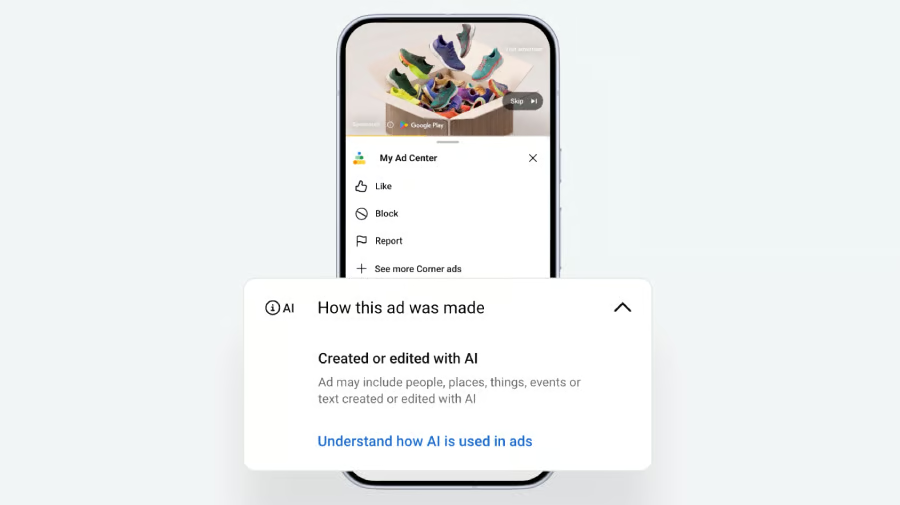
Google added a “How this ad was made” section to its global My Ad Center panel. Users can access this information across Google Search, YouTube, and Google Discover by clicking the familiar three-dot menu or info icon on any ad.
According to Keerat Sharma, Google’s VP & General Manager of Ads Privacy and Safety, the update introduces “additional transparency features across our advertising products” to “help people easily understand when generative AI was used to create or alter an ad.”
Users can access this feature by clicking the three-dot menu or info icon on ads across Search, YouTube, and Discover. This new tab will display a label reading “Created or edited with AI” when applicable.
The automation loophole
The new tracking system features a split mechanism based entirely on what software the advertiser chooses to use:
- Google AI tools: If a business builds an ad using Google’s own generative AI advertising tools, the system will “automatically add a disclosure to each ad’s My Ad Center panel.”
- Third-party tools: If an ad is created outside of Google’s ecosystem, the tech giant is introducing a manual control for advertisers.
Crucially, Google will not run independent checks to verify if outside AI was used. Instead, the company expects brands to self-report. However, in certain markets with strict regulatory frameworks, such as the EU AI Act or local laws in New York and the UK, labels may appear directly on the ad itself rather than be hidden in a menu.
More Google coverage
- New Google Search AI Mode is ‘Total Reimagining,’ Says CEO Sundar Pichai
- In Major Ruling, Judge Finds Google ‘Willfully Acquired and Maintained Monopoly Power’ Over Digital Ad Market
- Google’s Big Bet on Nuclear Energy: ‘The Race to Power AI-Driven Data Centers is Accelerating’
- Computer History Museum Releases Original AlexNet Code: Why It Matters
The illusion of total transparency
While Google described this update as a major step forward for consumer awareness, the implementation relies heavily on an honor system for third-party content. By forcing advertisers to self-disclose their use of AI outside of automated detection, such as the C2PA metadata scanning used by rivals Meta and TikTok, Google creates a clear asymmetry in enforcement.
Bad actors looking to pass off fully synthetic products as genuine real-world items face almost no friction to simply leave the disclosure box unchecked. Consequently, this update may inadvertently give users a false sense of security, assuming an unlabelled ad is entirely authentic when it might just be an undisclosed third-party generation.
What this means for brands and shoppers
For businesses, the new system offers a streamlined way to meet tightening global legal requirements, including the EU AI Act’s upcoming compliance deadlines. It can lower disclosure friction for brands using AI to create or edit ad assets.
For everyday consumers, the change provides a helpful new investigative tool, but one that must be used with caution. While it easily exposes ads built directly inside Google’s network, shoppers must remain vigilant. Because third-party disclosure depends on advertiser reporting, an ad without an AI tag is no guarantee of a real photo.
Also read: Google Search uploads may be used to train AI unless users opt out, raising fresh privacy and data governance questions for businesses.