


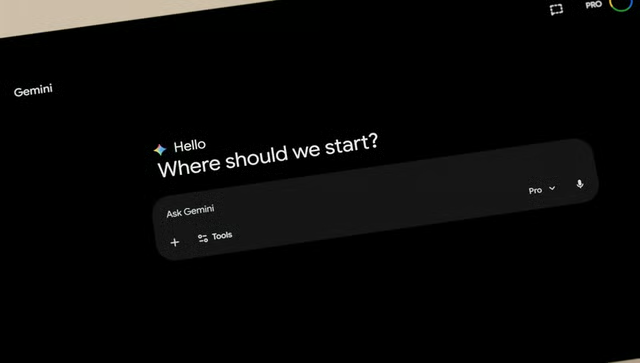
Google has launched Gemini 4 Argon, but the company is not opening the doors to everyone just yet. Trusted cyber defenders are getting first access to the model’s full security capabilities.
The company introduced Gemini 4 Argon on Sept. 30 and is giving a select group of trusted cyber defenders early access through its Fairwind Program before a wider release. Argon is designed for complex software engineering, enterprise knowledge work, and cybersecurity tasks.
For IT and security teams, the rollout offers an early look at how Google plans to put more autonomous AI into defensive security while keeping its most capable cyber tools under tighter control.
Why cyber defenders are getting Argon first
Google said it trained Argon specifically for defensive cybersecurity, including the ability to autonomously find, validate, and patch critical software vulnerabilities.
Trusted defenders and Google’s internal teams will receive the model without its normal cyber guardrails, allowing them to test its full defensive capabilities. Google also said broader access will eventually begin with paid API customers and Google AI Ultra subscribers, with introductory API pricing of $2 per million input tokens and $10 per million output tokens.
The arrangement gives selected security teams more room to test Argon against real software and systems while Google gathers feedback before expanding access. It also keeps capabilities such as vulnerability discovery and proof-of-concept generation within a smaller group while the company evaluates the risks of wider availability.
| Vulnerability discovery | Argon can find, validate, and patch critical software flaws | Could automate more stages of vulnerability research and remediation |
| Black-box testing | Google said Argon beat Gemini 3.8 Flash Cyber at mapping attack surfaces and finding flaws without source code | Could help defenders assess live systems when source code is unavailable |
| Vulnerability remediation | Argon scored 68% on CWE-bench v1, tying for first place | Tests whether the model can move from finding weaknesses to helping fix them |
| Real-world testing | Wiz used Argon to uncover a critical healthcare software vulnerability previous models missed | Gives the rollout a real-world example beyond benchmark testing |
One early test involved Wiz’s Scan for Good initiative. The Hacker News reported that Argon uncovered a previously unknown critical vulnerability exposing sensitive personal information in healthcare software used by hospitals worldwide. Google did not disclose which software contained the flaw.
Argon is built for longer, more autonomous work
Cybersecurity is only one part of Argon’s design. TechCrunch noted that Google employees have already been using the model for daily engineering work, including debugging and codebase migrations. The model is also designed for coding, research, writing, and visual analysis, giving it a broader role than a dedicated security model.
Long-running workflows could be especially useful in vulnerability research. Security work often requires moving between source code, documentation, live-system behavior, exploit validation, and remediation. A model that can stay with a problem across those steps could reduce handoffs between separate tools and manual tasks, although early benchmark performance does not show how reliably Argon will handle that process in production environments.
Google’s performance claims also come with caveats. According to Reuters, Argon posted stronger results than OpenAI Astra and Anthropic Opus on several benchmarks included in Google’s release, but it remained behind on two of the four coding benchmarks. Reuters also reported that Google has not provided a timeline for the model’s public release.
More Google coverage
- New Google Search AI Mode is ‘Total Reimagining,’ Says CEO Sundar Pichai
- In Major Ruling, Judge Finds Google ‘Willfully Acquired and Maintained Monopoly Power’ Over Digital Ad Market
- Google’s Big Bet on Nuclear Energy: ‘The Race to Power AI-Driven Data Centers is Accelerating’
- Computer History Museum Releases Original AlexNet Code: Why It Matters
Why Google is keeping the wider rollout controlled
The same capabilities that make Argon useful to defenders could pose risks if turned toward offensive activity. Google is therefore using a phased rollout rather than making the model broadly available at launch.
Gemini model product lead Tulsee Doshi told CNBC that putting Argon in defenders’ hands first gives Google more confidence in the rollout while making its defensive capabilities available sooner.
CNBC also reported that Google is strengthening safeguards around areas including misuse and prompt injection and is working with the US government on pre-release safety evaluations.
For enterprise security teams, the important question is what Argon will look like after that controlled testing period. Early results suggest AI models may take on more of the vulnerability research process. Still, adoption will depend on how reliably those systems work outside benchmarks and on the permissions, oversight, and safeguards Google puts around them as access expands.
Google is also changing how Gemini users customize the platform, with Gems moving to Skills on Nov. 17 along with updates to files, sharing, supported tools, and account settings.