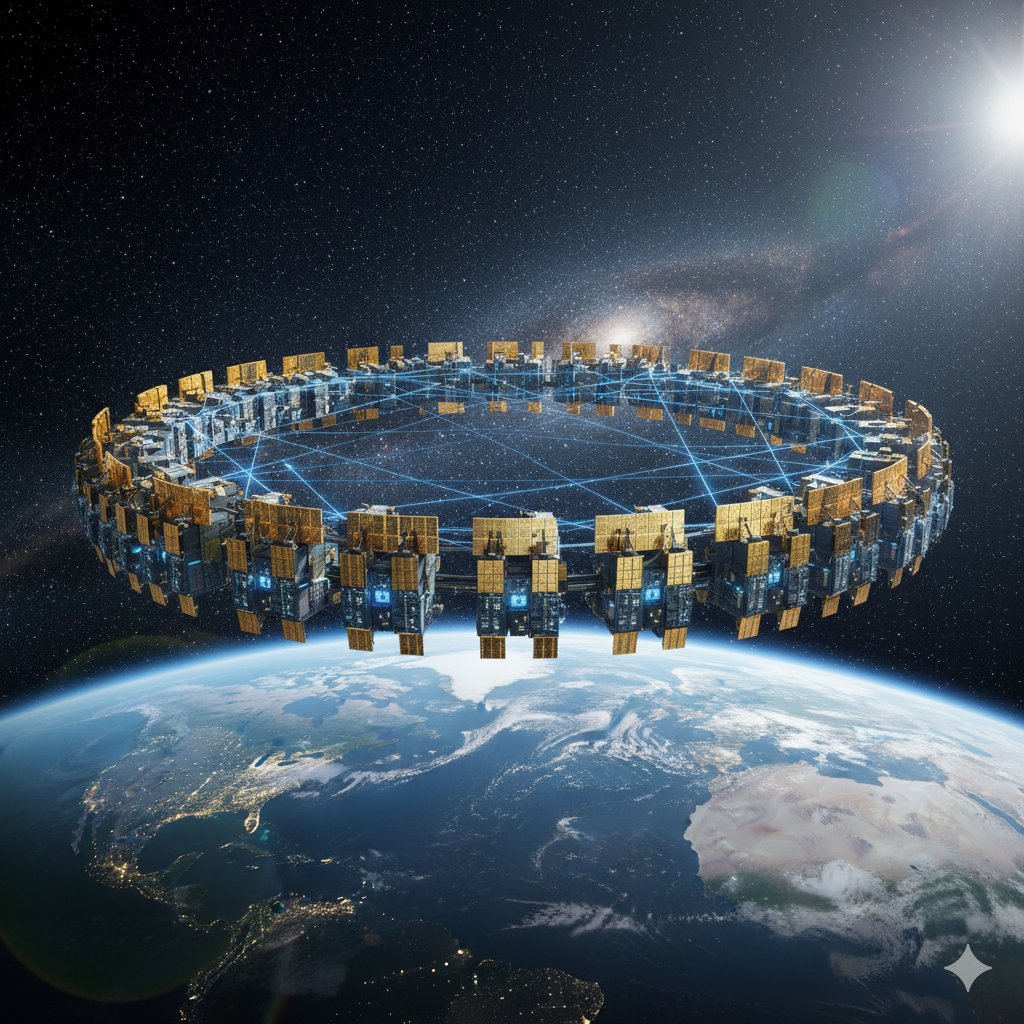
Image: Google Gemini
Google’s Project Suncatcher aims to power AI data centers from space using solar satellites — a bold new step in the future of computing and energy.

Google is taking its “moonshot” reputation to new heights by moving its data centers… to space?
The tech giant has announced Project Suncatcher, an ambitious research initiative aimed at testing whether AI computing could one day be powered by solar satellites orbiting the Earth.
Introduced through a blog post by Travis Beals, Google’s senior director of Paradigms of Intelligence, the project aims to “scale machine-learning compute in space,” powered directly by the sun.
“Our new research moonshot, Project Suncatcher, envisions compact constellations of solar-powered satellites, carrying Google TPUs and connected by free-space optical links,” Beals wrote..
The concept behind Project Suncatcher is both simple and revolutionary: take Google’s powerful Tensor Processing Units (TPUs) — the chips that power its AI systems — and launch them into orbit. Once there, they’d operate as a floating network of data centers, powered by near-continuous sunlight.
In space, solar panels can generate up to eight times more energy than on Earth, with minimal downtime and no need for large batteries. This could help Google meet the growing demand for AI compute while easing pressure on Earth’s already strained energy grid. As Beals put it, “space may be the best place to scale AI compute.”
The company’s research outlines several major engineering hurdles and some promising early breakthroughs.
To match the performance of data centers on Earth, Google’s engineers designed a network of tightly packed satellites that communicate via high-speed optical links. These links, tested in the lab, have already achieved transmission speeds of 1.6 Tbps, a key milestone for inter-satellite communication.
But flying satellites so close together requires precise control to maintain stable formations in orbit. Google used advanced physics models to test how these clusters could move and maintain their position.
Radiation is another challenge. Space exposes hardware to intense solar activity that can damage electronics. To prepare, Google tested its Trillium v6e TPUs using a 67 MeV proton beam, and the results were “surprisingly radiation-hard,” according to the blog. The chips remained functional even after receiving nearly three times the expected five-year mission dose.
One of the biggest obstacles to any space project has always been cost. However, Google’s analysis suggests that launch prices could drop below $200 per kilogram by the mid-2030s, thanks largely to reusable rockets and private space companies like SpaceX.
If that happens, the economics of space computing could become surprisingly competitive. Running data centers in orbit could one day cost about the same as operating them on Earth, with the added benefit of being entirely solar-powered.
Google’s next big step will come in partnership with Planet Labs. The two companies plan to launch two prototype satellites by early 2027. Each will carry multiple TPUs and test how well Google’s technology performs in low-Earth orbit.
“More testing and breakthroughs will be needed as we count down to launch two prototype satellites with @planet by early 2027, our next milestone of many,” said Google CEO Sundar Pichai in a post on X.
Pichai added that Project Suncatcher draws from Google’s long history of bold experiments, ”from quantum computing to autonomous driving,” and continues the company’s tradition of tackling the near-impossible.
This is still very much a research project. As Pichai noted, “Like any moonshot, it’s going to require us to solve a lot of complex engineering challenges.”
Explore how Google Maps is gearing up to save your battery when you’re navigating with no charger in sight: “Google Maps Tests Ultra-Minimal ‘Power-Saving Mode’ for Emergencies.”
Aminu Abdullahi is a B2C and B2B technology and finance writer with more than six years of experience covering enterprise IT, cybersecurity, cloud computing, artificial intelligence, fintech, business software, and emerging technologies. His work has appeared in publications including TechRepublic, eWEEK, Channel Insider, Geekflare, Enterprise Networking Planet, eSecurity Planet, CIO Insight, and Webopedia. With a technical background in computer science, he specializes in translating complex technology topics into clear, accessible content for business leaders and decision-makers.

