


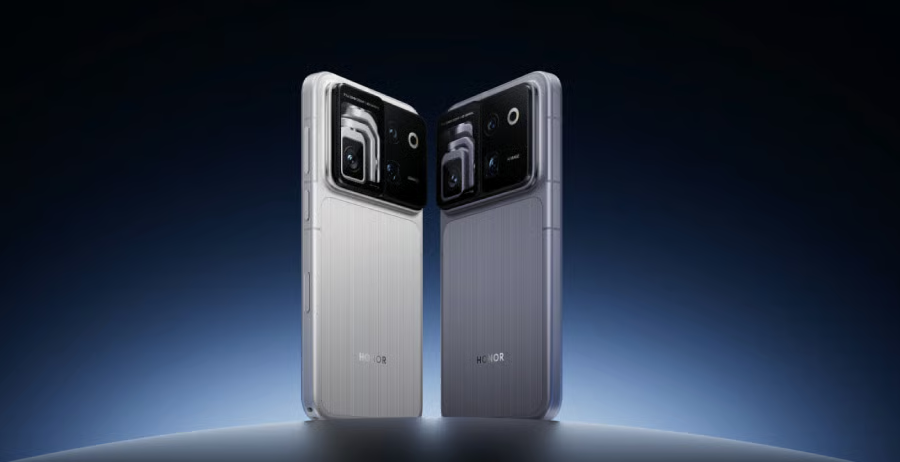
It’s a phone, it’s a gimbal, it’s a dancing robot companion, and for about $1,500, it’s the most delightfully absurd piece of consumer tech to hit the market in years.
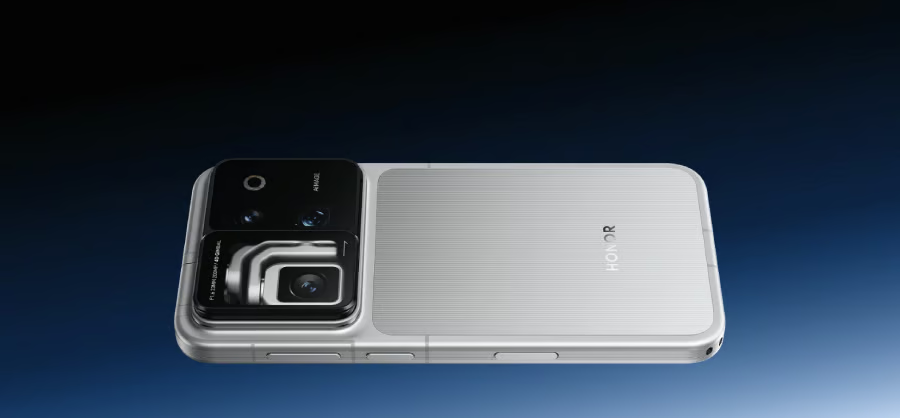
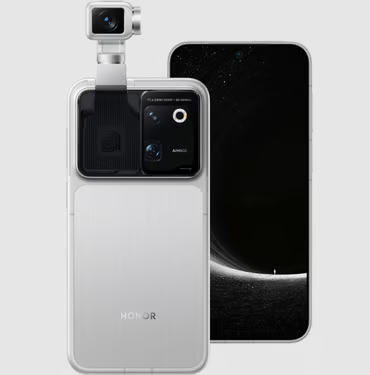
The Honor Robot Phone is not a robot in the traditional sense. It is an Android flagship with a motorized, three-axis gimbal built directly into the rear camera system.
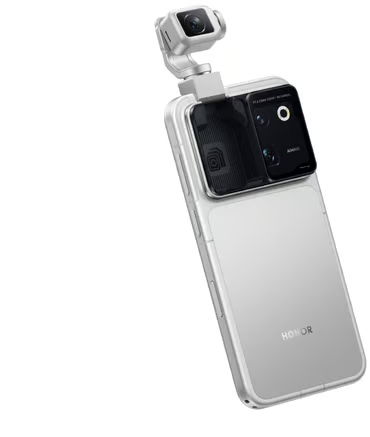
Instead of attaching a DJI Osmo Pocket or a smartphone gimbal to the phone, Honor has squeezed the stabilization hardware into the device itself. The main 200-megapixel camera can physically rise out of the phone, rotate and follow subjects while the phone remains relatively still.
That makes the Robot Phone less of a conventional smartphone upgrade and more of a technology showcase.
Honor first teased the concept in late 2025 before showing a prototype at MWC 2026. It has now gone on sale in China, but the company is treating it as a limited, enthusiast-focused product rather than a mainstream global flagship.
The starting price is 9,999 yuan, or approximately $1,480, for the 12GB RAM and 512GB storage model. A 16GB/1TB version costs 12,999 yuan, or approximately $1,930. For most buyers, that price alone makes the Robot Phone a difficult recommendation. But for people who shoot a lot of video, the hardware is much more interesting.
- Honor Robot Phone: Key specs at a glance
- The gimbal is the whole point
- It can move without moving the phone
- ARRI partnership makes this more than a vlogger phone
- What about the ‘robot’ part?
- It is surprisingly powerful underneath
- The battery is massive — and it needs to be
- The price is harder to justify
- The big compromise: Size and weight
- Water resistance is another trade-off
- China-only availability changes the verdict
- Who should buy the robot phone?
- Honor robot phone vs. a conventional flagship
- Robot phone vs. a separate gimbal
- Bottom line
Honor Robot Phone: Key specs at a glance
| Feature | Honor Robot Phone |
|---|---|
| Display | 6.31-inch OLED |
| Resolution | 1216 x 2640 |
| Refresh rate | Up to 120Hz |
| HDR peak brightness | 6,800 nits |
| Processor | Snapdragon 8 Elite Gen 5 |
| RAM | 12GB or 16GB |
| Storage | 512GB or 1TB |
| Main camera | 200MP gimbal camera, 1/1.28-inch sensor, f/1.6, OIS |
| Telephoto | 200MP periscope, 1/1.4-inch sensor, f/2.6, OIS |
| Ultrawide | 50MP, 122-degree field of view |
| Dimensions | 151.43 x 72.86 x 9.59 mm |
| Selfie camera | 50MP |
| Optical zoom | 2.7x |
| Digital zoom | Up to 200x |
| Video | Up to 4K |
| Battery | 7,060mAh |
| Wired charging | 120W |
| Wireless charging | 50W |
| Software | MagicOS 10 based on Android 16 |
| Water/dust resistance | IP54 |
| Weight | About 248 grams |
| Thickness | 9.59mm |
| Colors | Silver, gray |
| China price | ¥9,999 and up |
The gimbal is the whole point
The Robot Phone’s defining feature is a miniature mechanical gimbal that folds into the rear camera housing when it is not being used.
Honor says the gimbal contains more than 100 components and is about 65% smaller than conventional gimbal systems. The company developed its own 2.6-gram titanium-alloy motor to make the mechanism small enough to fit inside a phone.

The gimbal is about 6mm thick, which Honor describes as the world’s most compact phone gimbal.
The camera itself uses a 200MP sensor measuring 1/1.28 inch, paired with an f/1.6 aperture. It also has optical image stabilization. That combination matters because the stabilization isn’t coming only from software.
It can move without moving the phone
The gimbal’s biggest advantage is not simply stabilization. The camera can move independently of the phone, allowing users to pan, tilt and track subjects while keeping the phone itself relatively stationary.
Honor includes several automated shooting modes, including spin shots, super-steady shooting, tracking and tilt-locked movements. The exact collection of modes varies by the source and software experience, but the common theme is that the phone can perform camera movements that would normally require a handheld gimbal.
The gimbal can also rotate around the phone, allowing the main camera to be used for selfies. That means users can take selfies with the much larger 200MP main sensor rather than relying exclusively on the 50MP front-facing camera.
There is also a panoramic selfie mode. Instead of taking a conventional selfie, the gimbal captures multiple frames from different positions and combines them into a wider image. For solo creators, this could be one of the phone’s genuinely useful tricks.
The camera can rotate nearly 360 degrees, depending on the mode and movement being used. That opens up several possibilities that a conventional fixed smartphone camera cannot easily handle.
You can:
- Shoot smoother walking and running video.
- Pan without physically moving the phone.
- Keep the phone pointed in one direction while changing the camera angle.
- Track people and, according to some hands-on testing, objects.
- Shoot unusual angles while keeping the phone’s screen facing you.
- Take selfies with the main 200MP camera.
- Create automated 90- and 180-degree spinning shots.
- Use an onscreen joystick for manual movement.
- Adjust tracking speed and gimbal sensitivity.
- Use the camera during video calls with subject tracking.
ARRI partnership makes this more than a vlogger phone
Honor clearly wants the Robot Phone to appeal to serious video creators. The company partnered with ARRI, the professional cinema equipment maker, to bring cinema-focused tools to the phone.
The Robot Phone supports ARRI LogC3 recording, ARRI Looks and a dedicated cinema mode. The phone also offers LUT previews and extensive manual controls for video.
According to TechRadar, the phone processes image data in 14-bit 4:4:4 and outputs 10-bit LogC3 and 4:2:2 video. ARRI LogC3 and ARRI Wide Gamut 3 are designed to preserve more image information for post-production. For a casual smartphone user, much of that will mean very little. For someone who understands color grading and video workflows, however, it is potentially much more important than the gimbal itself.
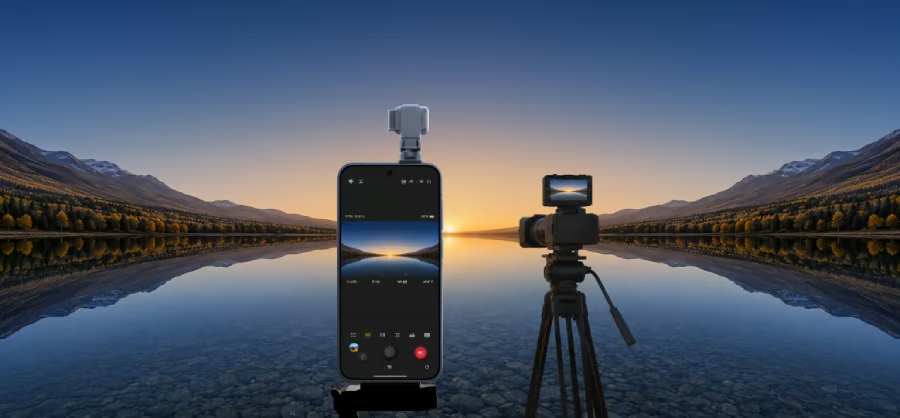
The ability to shoot stabilized footage and then immediately edit it on the same device is also a major advantage of the all-in-one approach. With a separate gimbal camera, footage has to be moved between devices before it can be edited, shared or uploaded.
CNET’s experience also revealed a limitation: when shooting in vertical mode, the main camera cropped rather than physically flipping, resulting in reduced resolution from standard 4K recording.
So the Robot Phone is not automatically a professional cinema camera in your pocket. It is better understood as a smartphone with unusually serious video tools.
What about the ‘robot’ part?
This is where the Robot Phone gets considerably sillier. Honor’s Yoyo AI assistant can interact with the gimbal physically. The camera can nod, shake its “head,” dance to music and perform other expressive movements. The display can simultaneously show more than 100 facial expressions or emoji-style reactions.
It is undeniably entertaining. It is also mostly a gimmick. TechRadar called the physical gestures and expressions gimmicky, although it found natural-language gimbal commands genuinely useful. Trusted Reviews reached a similar conclusion, describing the AI and robot elements as gimmicks rather than reasons to buy the phone.

That distinction matters because the mechanical camera itself is far more interesting than the anthropomorphic behavior. There are practical commands. TechRadar tested natural-language instructions such as “turn left 45 degrees” and “turn around for five seconds.” But making the camera dance is not what makes this phone special. The useful part is being able to tell it where to point.
It is surprisingly powerful underneath
The Robot Phone uses Qualcomm’s Snapdragon 8 Elite Gen 5, putting it firmly in flagship territory. Honor offers configurations with 12GB or 16GB of RAM and 512GB or 1TB of storage.
The official specifications also list the HONOR H1 image chip. That means buyers are not trading flagship performance for the mechanical camera. The unusual hardware is sitting on top of a high-end smartphone platform.
The 6.31-inch OLED display has a 1216 x 2640 resolution, supports up to 120Hz and can reach a claimed HDR peak brightness of 6,800 nits. The phone also supports Wi-Fi 7, Bluetooth 6.0, NFC, USB 3.2 Gen 1 and DisplayPort 1.2 over USB-C.
In other words, the Robot Phone is much closer to a conventional premium flagship underneath its unusual camera system than the “robot” branding might suggest.
Mobility must-reads
- Big Apple OS Makeover: Here’s What to Expect & When
- MWC 2025: Nothing Shows Off (3A) Phones With AI Organization Tool
- Bad News for App Developers: Most Apps Fail to Hit $1,000 Monthly Revenue Within Two Years
- Mobile Device Computing Policy
The battery is massive — and it needs to be
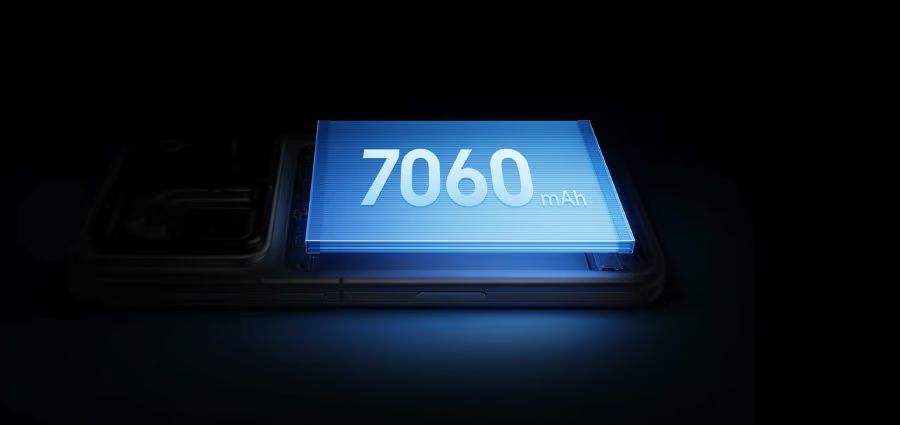
Honor fitted the Robot Phone with a 7,060mAh battery. That is a substantial battery for a phone of this size, and the capacity makes sense given that the mechanical gimbal introduces another potential source of power consumption.
Charging is equally aggressive: the phone supports up to 120W wired charging and 50W wireless charging. The official specification lists the battery as lithium polymer.
The price is harder to justify
The Robot Phone starts at ¥9,999 in China, or roughly $1,480-$1,500. A higher-end 16GB version is priced at ¥12,999, or about $1,923.
That puts the phone firmly in expensive-experiment territory. The problem is that a buyer can purchase a conventional flagship and a dedicated pocket gimbal separately. Depending on the products chosen, that combination could cost less than the Robot Phone while offering greater flexibility.
The Robot Phone’s argument is convenience. One device replaces two. The camera is always attached. There is no separate gimbal to remember, charge, pack or connect. You can shoot, edit and upload from the same phone. That could make the premium worthwhile for certain creators. For everyone else, the economics are much less compelling.
The big compromise: Size and weight
The Robot Phone is not exactly a featherweight. It measures 151.43 by 72.86 by 9.59 mm and weighs approximately 248 grams. For comparison, Apple’s iPhone 17 Pro weighs 206 grams.
That extra weight is understandable. There is a gimbal mechanism, additional motors and a large battery inside the chassis. Still, understanding why something is heavy does not make it lighter.
The Robot Phone is noticeably chunkier than the average flagship, and the camera module adds even more visual bulk. That is the trade-off for putting a mechanical camera inside the phone: you gain a feature no conventional phone can offer, but you have to carry all of its hardware everywhere.
Water resistance is another trade-off
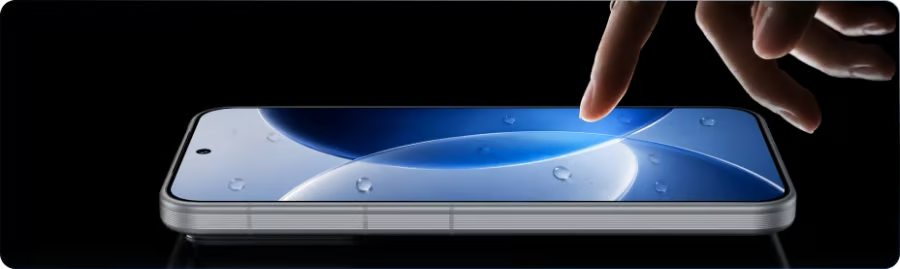
The Robot Phone carries an IP54 rating when the gimbal is stowed. That provides limited protection against dust and water splashes, but it falls short of the IP68 water resistance commonly offered by premium phones.
More importantly, Honor says the same level of protection should not be expected while the gimbal is deployed. That means shooting in the rain is a bad idea. This could be especially relevant to the exact people the phone is targeting. Content creators often shoot outdoors, travel with their equipment and work in unpredictable conditions.
A separate gimbal camera can be protected or replaced without losing your primary smartphone. With the Robot Phone, the gimbal and the phone are one expensive package.
China-only availability changes the verdict
There is another simple problem: most readers cannot officially buy the Robot Phone where they live.
Honor launched the phone in China and has not announced plans for a wider international release. Some third-party retailers advertise international shipping, but importing a China-market phone requires buyers to check cellular-band compatibility, software localization, Google service support, warranty coverage and potential import charges.
For most international buyers, the more sensible approach is to watch what Honor does with the technology rather than rush to import the first-generation device.
Who should buy the robot phone?
Buy it if you are a serious mobile creator
This is the clearest audience. If you shoot a lot of video, especially alone, the built-in gimbal can eliminate the need for another piece of equipment.
Subject tracking, automated camera movements, mechanical stabilization, LogC3, ARRI Looks, manual controls and the ability to immediately edit and upload footage make a compelling package.
Consider it if you livestream
The ability to put the phone on a stand and have the camera follow you could be genuinely useful for livestreaming and video calls. You also avoid the extra complexity of connecting a separate gimbal.
Consider it if you love experimental hardware
This may actually be the Robot Phone’s biggest audience. The device is less about replacing an ordinary flagship and more about owning something that does something no conventional phone does.
Skip it if you want maximum durability
The moving camera mechanism creates an obvious additional failure point. If you are rough with your phone, regularly use it in wet environments or simply want a device that disappears into the background of daily life, a conventional flagship makes more sense.
Skip it if you want the best value
A good flagship phone plus a separate pocket gimbal can give you similar creative capabilities for potentially less money. The Robot Phone’s advantage is convenience and integration, not necessarily price.
Honor robot phone vs. a conventional flagship
The Robot Phone’s proposition becomes clearer when you stop treating it as a normal phone. A conventional flagship is optimized around being thin, durable, pocketable and reliable. The Robot Phone sacrifices some of those qualities to add a camera that can physically move.
That trade-off is almost the opposite of where the smartphone industry has been heading. For years, manufacturers have competed over thinner bodies, smaller bezels, better computational photography and more powerful chips. Honor instead added a mechanical system to a device category that has largely settled on a rectangular slab. That is why the Robot Phone is interesting even if you never buy one.
Robot phone vs. a separate gimbal
| Honor Robot Phone | Phone + separate gimbal | |
|---|---|---|
| Convenience | Excellent | Lower |
| Portability | One device | Two devices |
| Mechanical stabilization | Built in | Depends on gimbal |
| Subject tracking | Built in | Usually available |
| Professional video tools | Strong | Depends on phone/camera |
| Repair risk | Higher | Spread across devices |
| Phone durability | Compromised by mechanism | Phone remains conventional |
| Price | ¥9,999 and up | Can be cheaper |
| Best for | Mobile creators and enthusiasts | Most users |
| Verdict | The Robot Phone wins on integration | The separate-gimbal setup wins on flexibility and potentially value |
Bottom line
The Honor Robot Phone is too expensive, specialized and mechanically complicated for most buyers. Its built-in gimbal could be genuinely useful for mobile video creators, but the added weight, IP54 rating, China-only availability and uncertain international support make a conventional flagship paired with a separate gimbal the safer choice for most people.
Best reason to buy: A genuinely useful built-in gimbal that turns the phone into a serious mobile video tool.
Biggest weakness: The mechanical camera adds weight, bulk, durability concerns and cost.
Best feature: The combination of mechanical stabilization, subject tracking and professional video controls.
Most unnecessary feature: Yoyo’s dancing and expressive robot behavior.
Best audience: Mobile filmmakers, vloggers, livestreamers and technology enthusiasts.
Is it worth paying attention to? Absolutely.
Read more: If professional video matters more than an integrated gimbal, compare what the Pixel 11 Pro and iPhone 17 Pro offer at the same $1,099 starting price.