
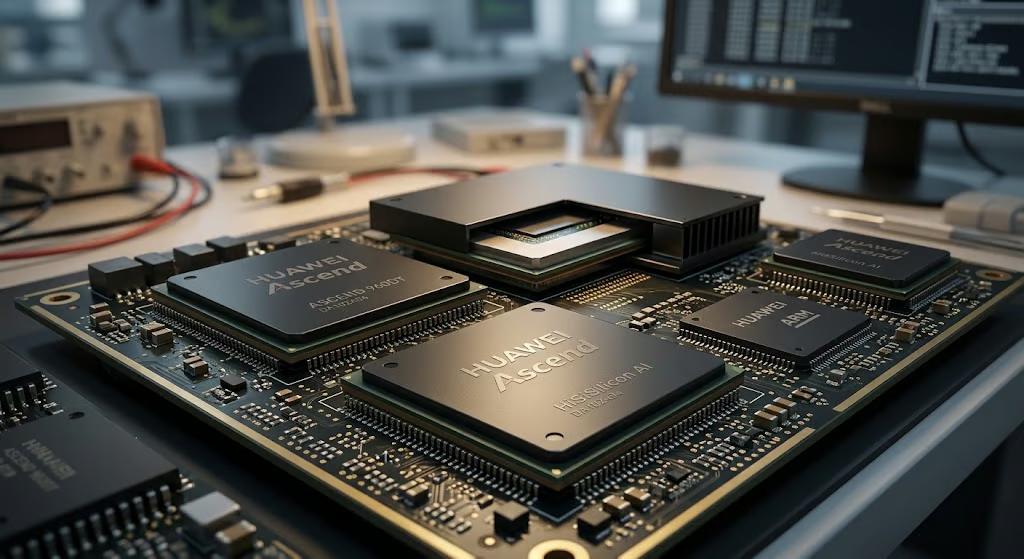


Huawei is accelerating its AI chip roadmap as it tries to build a stronger domestic alternative to Nvidia.
The company plans to launch the Ascend 960DT in the first quarter of 2027, three quarters earlier than its previous Q3 target. It also plans to release the Ascend 960PR in the third quarter of 2027, according to TechCrunch.
David Wang, Huawei’s rotating and acting chairman, announced the revised schedule at the company’s Huawei Connect conference in Shanghai. Huawei said the new Ascend generation is advancing ahead of schedule, with performance expected to double from one generation to the next.
The faster schedule comes as Huawei builds out a domestic alternative to Nvidia amid U.S. restrictions on advanced chips and semiconductor manufacturing equipment. Huawei has also laid out plans for annual Ascend generations, with the 970 and 980 expected in 2028 and 2029.
The bigger bet is beyond the chip
Huawei’s strategy is not simply to make one chip that matches Nvidia’s most powerful processors. Instead, it is trying to make large numbers of less advanced chips behave more like one enormous computer.
Its Peerium Computing Architecture uses UnifiedBus to connect processors with memory, storage and networking hardware. Huawei says its largest planned superclusters could eventually link as many as 1 million AI processors, while a new Ascend 960 supernode is designed to connect up to 4,096 processors.
That approach reflects one of Huawei’s central challenges. With China’s access to the most advanced foreign AI hardware restricted, the company is trying to extract more performance from large clusters of domestically available processors.
The trade-off is that those clusters depend heavily on networking efficiency. Huawei says communication between machines can consume more than 40% of training time in conventional server systems, Reuters reports. This is why it is also investing in technologies such as near-packaged optics to improve data movement and reduce energy use.
Huawei has demand, but capacity is a constraint
The company says it has already shipped more than 1,000 AI computing systems to more than 370 customers and has more than 5,200 developers working on its Ascend software ecosystem. Reuters also reported that Huawei cannot currently produce enough AI computing equipment to meet Chinese demand.
That shortage could limit how quickly Huawei can turn its hardware progress into market share. Eric Xu, Huawei’s rotating chairman, said the company is not planning a full-scale international expansion while domestic demand exceeds supply.
More must-read AI coverage
- SS&C Intralinks DealCentre AI vs. Datasite: Which platform is built for the future of dealmaking?
- SS&C Intralinks FundCentre AI vs. Juniper Square: Which platform better supports modern private markets fund managers?
- Why Data, Not Models, Determines AI Success
- The Rise of the AI-Native Factory: How Physical AI Is Transforming Manufacturing
The software problem could matter as much as silicon
Huawei’s biggest challenge may not be connecting enough chips. It is making those systems useful enough for developers and AI companies to choose them over established Nvidia infrastructure.
Nvidia’s advantage is not limited to chip performance. CUDA has accumulated years of developer tooling, libraries, optimization, and application support, making switching platforms more difficult than replacing one processor with another.
Huawei’s strategy could therefore reshape the competition differently: rather than immediately matching Nvidia chip-for-chip, it is betting that scale, interconnect technology and a growing domestic ecosystem can make large collections of constrained hardware practical. Whether that model can deliver comparable performance and reliability remains an important question as Huawei moves toward 2027.
What it means for AI buyers
For Chinese AI developers, the faster 960DT schedule could provide another domestic option for training increasingly demanding models. For Huawei, the immediate opportunity is also defensive: stronger in-country hardware and software infrastructure could reduce dependence on technology affected by U.S. export controls.
The challenge is that faster chip releases alone will not solve manufacturing constraints, networking overhead, or the software gap with Nvidia. Large clusters also become harder to operate efficiently as they scale.
Huawei’s strategy is therefore less about beating Nvidia chip-for-chip and more about building an AI stack that can function within China’s hardware constraints. Whether that combination of domestic silicon, high-speed interconnects, and software can deliver competitive performance at scale will become clearer as the 960 generation arrives in 2027.
More news: Anthropic has secured capacity at a planned 2.16-GW data center in Queensland, giving Claude a major Australian inference hub as AI companies compete for power, land, and computing capacity.