
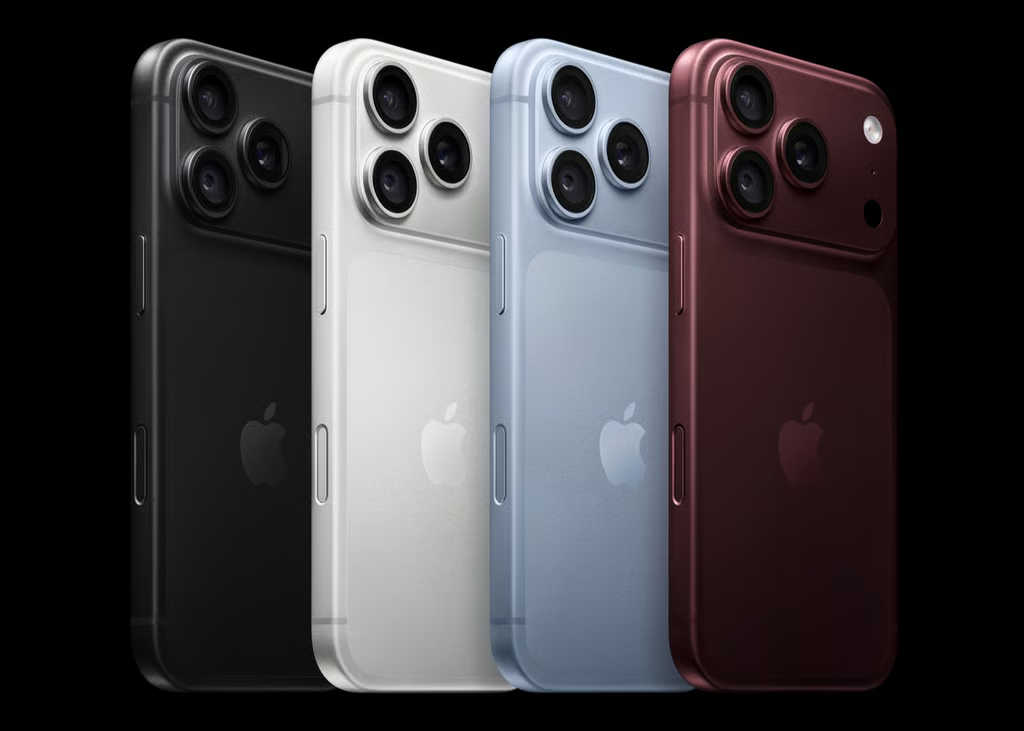


Apple’s iPhone 18 Pro is more than a routine processor-and-camera refresh. This generation changes how the main camera works, pushes the Pro line deeper into on-device AI, and gives buyers more battery life without abandoning Apple’s two-size strategy.
Apple launched the iPhone 18 Pro and iPhone 18 Pro Max on Sept. 9, with both phones hitting stores on Sept. 18. The lineup starts at $1,199 and introduces the A20 Pro chip, a 48MP variable-aperture main camera, Siri AI, faster charging, and storage configurations up to 2TB. Apple’s iPhone 18 Pro announcement
TechRepublic previously examined whether the $1,199 iPhone 18 Pro upgrade is worth it. This cheat sheet goes into greater detail, covering specifications, cameras, performance, AI features, battery life, pricing, differences between the Pro and Pro Max, and what buyers should consider before upgrading.
- iPhone 18 Pro at a glance
- How much does the iPhone 18 Pro cost?
- What is new with the iPhone 18 Pro?
- How does the variable-aperture camera work?
- What cameras does the iPhone 18 Pro have?
- What is the A20 Pro chip?
- Why does the new vapor chamber matter?
- What AI features does the iPhone 18 Pro have?
- How long does the iPhone 18 Pro battery last?
- How fast does the iPhone 18 Pro charge?
- What display does the iPhone 18 Pro use?
- What happened to the Dynamic Island?
- What connectivity does the iPhone 18 Pro support?
- Is the iPhone 18 Pro durable?
- iPhone 18 Pro or iPhone 18 Pro Max: Which should you choose?
- How does the iPhone 18 Pro fit into Apple’s 2026 lineup?
- Should you buy the iPhone 18 Pro?
iPhone 18 Pro at a glance
The iPhone 18 Pro comes in two sizes, but Apple keeps most of the important hardware consistent across both models.
| iPhone 18 Pro | iPhone 18 Pro Max | |
|---|---|---|
| Starting price | $1,199 | $1,299 |
| Display | 6.3-inch Super Retina XDR OLED | 6.9-inch Super Retina XDR OLED |
| Resolution | 2622 x 1206 | 2868 x 1320 |
| Refresh rate | ProMotion, up to 120Hz | ProMotion, up to 120Hz |
| Processor | A20 Pro | A20 Pro |
| Storage | 256GB, 512GB, 1TB, 2TB | 256GB, 512GB, 1TB, 2TB |
| Main camera | 48MP variable aperture | 48MP variable aperture |
| Ultrawide | 48MP | 48MP |
| Telephoto | 48MP, 4x | 48MP, 4x |
| Maximum Apple-rated video playback on US eSIM model | Up to 36 hours | Up to 45 hours |
| Wireless charging | MagSafe/Qi2 up to 25W | MagSafe/Qi2 up to 25W |
| Software | iOS 27 | iOS 27 |
| AI | Apple Intelligence and Siri AI | Apple Intelligence and Siri AI |
| Weight | 211g | 249g |
| Colors | Black, silver, glacier, burgundy | Black, silver, glacier, burgundy |
Apple’s full iPhone 18 Pro specifications provide additional details on connectivity, charging, camera formats, accessibility, and supported cellular bands.
How much does the iPhone 18 Pro cost?
Apple set the entry point for its Pro lineup at $1,199 for the iPhone 18 Pro and $1,299 for the Pro Max in the US
Both models start with 256GB of storage and are available in:
- 256GB
- 512GB
- 1TB
- 2TB
That 2TB ceiling is particularly notable for people who record large amounts of ProRes video or maintain large media libraries locally.
Apple offers the phones in black, silver, glacier, and burgundy.
Pricing differs substantially outside the US. TechRepublic found notable variation when comparing iPhone 18 Pro pricing across Southeast Asia, an important consideration for companies managing regional device budgets.
What is new with the iPhone 18 Pro?
The headline upgrades fall into five areas:
- A new 48MP main camera with variable aperture
- The A20 Pro processor
- A redesigned vapor chamber for better sustained performance
- Longer battery life and faster charging
- iOS 27 with the new Siri AI
The phone also gets a smaller Dynamic Island that can display up to three Live Activities simultaneously.
Rather than concentrating the entire upgrade around raw processor speed, Apple is tying the new hardware together around photography, sustained performance, AI, and battery life.
How does the variable-aperture camera work?
The most unusual hardware change is the 48MP Fusion Main camera with variable aperture.
Instead of using one fixed aperture, the main camera can operate at four aperture settings:
- f/1.48
- f/1.8
- f/2.8
- f/4.0
Apple uses six physical aperture blades to change how much light enters the camera and how much of a scene remains in focus. Apple says the camera automatically adjusts based on lighting and depth of field, while users can also take manual control.
That creates several practical possibilities.
A wider aperture such as f/1.48 can collect more light in darker environments. A narrower setting such as f/4 can keep more people or objects in focus when shooting groups or landscapes.
Apple has also expanded its Pro camera controls, including manual access to:
- Aperture
- Shutter speed
- White balance
- Exposure information through a histogram
That is a more substantial change than simply increasing megapixels because it alters how photographers can control the image before it is captured.
What cameras does the iPhone 18 Pro have?
The iPhone 18 Pro uses a three-camera rear system built around 48MP sensors.
The setup includes:
- 48MP Fusion Main: The new variable-aperture camera serves as the primary shooter and can also provide a 2x optical-quality view by cropping into the sensor.
- 48MP Fusion Ultra Wide: Apple lists a 13mm focal length and 120-degree field of view.
- 48MP Fusion Telephoto: The telephoto uses a tetraprism design and provides a 100mm-equivalent, 4x optical view.
Apple is also leaning harder into professional video. The Pro models support tools including ProRes RAW, Apple Log 2, genlock, and Dolby Vision capture.
To combat AI-generated deepfakes, Apple also introduced an opt-in Apple Reference Image mode. This acts as a digital negative by securely signing sensor data at the pixel level to verify a photo was taken on an iPhone and hasn’t been artificially altered.
For a closer look at how Apple’s approach differs from its Android rivals, TechRepublic compared the iPhone 18 Pro with the Pixel 11 Pro and the iPhone 18 Pro with the Galaxy S26 Ultra.
Those comparisons highlight a useful distinction: Apple is emphasizing camera control and professional video workflows, while competing Android flagships increasingly differentiate themselves through longer zoom ranges and AI-assisted photography.
What is the A20 Pro chip?
The iPhone 18 Pro and Pro Max both use Apple’s A20 Pro chip.
The chip contains:
- A 6-core CPU with integrated Neural Accelerators
- A 7-core GPU with Neural Accelerators
- A Dual 16-core Neural Engine, totaling 32 cores
- Hardware-accelerated ray tracing
Apple says the A20 Pro provides 50% more memory bandwidth than the A19 Pro, while its new architecture delivers up to 20% faster CPU performance and 40% faster GPU performance over the previous generation. Apple’s A20 Pro details also emphasize improvements designed for on-device AI workloads.
The Dual 16-core Neural Engine is designed to accelerate computational photography and on-device AI workloads.
Those are manufacturer performance claims rather than independent benchmarks, so real-world performance should be judged separately.
The more interesting architectural change may be thermal management.
Why does the new vapor chamber matter?
Apple redesigned the cooling system around a next-generation vapor chamber.
The company says the new chamber has three times the surface area of the previous generation and, combined with the A20 Pro design, moves heat more effectively.
Apple claims the combination can deliver up to 40% better sustained performance than the iPhone 17 Pro. That does not necessarily mean every app will run 40% faster. The bigger benefit should appear during longer, demanding workloads such as:
- High-end gaming
- Extended video recording
- Video editing
- Computational photography
- On-device AI processing
Thermal improvements matter because processors can reduce performance when heat builds up. Better cooling can help the chip maintain higher performance for longer rather than simply hitting a higher peak for a short period.
What AI features does the iPhone 18 Pro have?
The iPhone 18 Pro ships with iOS 27 and the next generation of Apple Intelligence.
The most visible addition is Siri AI, Apple’s redesigned assistant, which began rolling out in English beta on Sept. 14. Apple says Siri AI can understand personal context, use onscreen awareness, draw on broad world knowledge, and take actions across apps.
Siri AI can use information from sources such as messages, emails, and photos to help answer requests. It can also respond to content displayed on screen and is integrated into the Camera app via Siri mode.
Other AI-assisted capabilities in Apple’s new software include:
- Spatial Reframing for changing photo composition after capture
- Extend for expanding images
- An upgraded Clean Up tool
- Photorealistic Image Playground generation
- Siri integration with the Camera app
- Safari Notify Me for monitoring webpages for changes
Apple says some processing happens directly on the device, while more demanding requests can use its Private Cloud Compute infrastructure.
The caveat is important: Siri AI is still in beta, and availability varies by language and region. Due to regulatory requirements, Apple Intelligence features will also not be available in the EU or China at launch. That means the software side of the iPhone 18 Pro remains less settled than its camera or processor upgrades.
How long does the iPhone 18 Pro battery last?
Battery life is one of the clearest differences between the Pro and Pro Max.
Apple rates US eSIM-only models for up to:
- 36 hours of video playback on iPhone 18 Pro
- 45 hours on iPhone 18 Pro Max
Apple says that eliminating the physical SIM tray in eSIM-only models frees up internal space for increased battery capacity. Those models gain two additional hours of rated video playback compared with configurations that retain a physical SIM.
The Pro Max therefore remains the better option for buyers who prioritize endurance over size and weight.
Apple’s claims are based on its own testing and should not be treated as equivalent to independent real-world battery tests.
How fast does the iPhone 18 Pro charge?
Apple has also increased wired charging speed.
The company says the iPhone 18 Pro can reach approximately 50% charge in around 15 minutes when paired with a 60W-capable adapter or higher that supports Adjustable Voltage Supply.
Wireless charging supports:
- MagSafe up to 25W
- Qi2 up to 25W
Apple says MagSafe can charge the phone to approximately 50% in about 30 minutes when used with a compatible 35W or higher adapter.
The company also says five minutes of wired charging can provide the Pro Max with approximately seven hours of video playback under its test conditions.
For buyers accustomed to faster charging from some Android manufacturers, Apple’s numbers may still look conservative. But they represent a meaningful improvement within the iPhone lineup.
What display does the iPhone 18 Pro use?
The two models retain Apple’s familiar size split:
iPhone 18 Pro
- 6.3-inch OLED
- 2622 x 1206 resolution
- 460 pixels per inch
iPhone 18 Pro Max
- 6.9-inch OLED
- 2868 x 1320 resolution
- 460 pixels per inch
Both support:
- ProMotion adaptive refresh rates up to 120Hz
- Always-On display
- HDR
- True Tone
- P3 wide color
- Up to 3,000 nits of outdoor peak brightness
The smaller Pro is easier to handle one-handed, while the Pro Max offers considerably more screen area for video, documents, gaming, editing, and other productivity tasks.
What happened to the Dynamic Island?
The Dynamic Island remains, but Apple has made it smaller by moving the Face ID infrared camera under the display and expanded what it can display.
The iPhone 18 Pro can display up to three Live Activities simultaneously, keeping multiple ongoing events visible. For example, the interface could show a delivery, a timer, and another live event at once, rather than forcing users to switch between apps.
Face ID remains integrated into the display system.
What connectivity does the iPhone 18 Pro support?
The Pro models introduce Apple’s N1 wireless networking chip and support:
- Wi-Fi 7
- Bluetooth 6
- Thread
- 5G
- Ultra Wideband
- NFC
- USB-C with USB 3 data transfer up to 10Gbps
Apple introduced its C2 cellular modem with the iPhone 18 Pro generation. Apple says C2 consumes 15% less energy than C1X, delivers meaningfully faster upload performance, and supports mmWave in the US.
Apple’s documentation is inconsistent on one detail. Its current US technical-specifications page explicitly lists C2 under the iPhone 18 Pro but omits it from the Pro Max connectivity list.
However, Apple’s technical-specifications pages in several other markets, including Canada, Australia, India, and New Zealand, explicitly list the C2 modem for both the iPhone 18 Pro and iPhone 18 Pro Max. That’s because the iPhone 18 Pro Max in the US uses Qualcomm’s Snapdragon X80 modem, which teardowns have confirmed.
For business buyers, Wi-Fi 7 and improved cellular efficiency are likely to matter more over the phone’s lifespan than they do on launch day, particularly as newer wireless infrastructure becomes more common.
Is the iPhone 18 Pro durable?
Both models use an aluminum unibody with Ceramic Shield 2 on the front and Ceramic Shield on the back.
They carry an IP68 rating under IEC 60529, which Apple lists as resistance to water at a maximum depth of 6 meters for up to 30 minutes. An IP rating does not make a device waterproof, and resistance can diminish as a phone ages or is damaged.
The iPhone 18 Pro weighs 211g, while the much larger Pro Max weighs 249g. That 38g difference is worth considering for people who spend long periods holding their phone or want something easier to carry.
iPhone 18 Pro or iPhone 18 Pro Max: Which should you choose?
The decision is simpler this generation because Apple has kept most of the core specifications aligned.
Choose the iPhone 18 Pro if you want:
- A smaller 6.3-inch flagship
- The same A20 Pro processor as the Max
- The same primary camera system
- Up to 2TB of storage
- Lower starting price
- A lighter device
Choose the iPhone 18 Pro Max if you want:
- A larger 6.9-inch display
- Apple’s longest battery-life claim
- More room for documents, video, games, and editing
- Maximum endurance and do not mind the additional size and weight
Moving to the Pro Max is primarily about screen size and battery life, rather than gaining an entirely different processor or core camera system.
How does the iPhone 18 Pro fit into Apple’s 2026 lineup?
Apple’s 2026 lineup is unusually broad.
Alongside the iPhone 18 Pro family, the company introduced its first foldable iPhone, the iPhone Duo, as well as new Apple Watches and AirPods. TechRepublic’s guide to Apple’s 2026 product lineup breaks down the wider range.
That gives buyers more choices at the premium end than Apple has historically offered.
Someone deciding between devices is no longer simply choosing a standard iPhone or a Pro. They may now be weighing a conventional flagship against a foldable, an older iPhone, or competing Android devices.
Should you buy the iPhone 18 Pro?
The iPhone 18 Pro makes its strongest case to people who will actually use what changed.
The variable-aperture camera is more consequential for photographers and video creators than another routine sensor upgrade. The A20 Pro and redesigned cooling system matter most to people running demanding games, creative software, or increasingly complex on-device AI. And the Pro Max battery improvements become much more valuable for people who regularly spend a full day away from a charger.
But owners of recent Pro models should look at their actual workload before upgrading.
An iPhone 17 Pro that already handles everyday messaging, browsing, photos, work apps, and video comfortably does not suddenly become obsolete because A20 Pro exists. Likewise, Siri AI is still rolling out as a beta and availability varies by region and language, so buyers primarily interested in Apple’s new AI experience should judge the software on what it does today rather than what it may do later.
For business buyers and IT teams, the practical questions are similarly straightforward: Does the improved camera or battery solve a real workflow problem? Does Wi-Fi 7 or the new modem matter for the intended deployment? Will 256GB be sufficient, or are employees generating enough local video and media to justify 512GB or more?
The iPhone 18 Pro is Apple’s highest-end conventional iPhone line of 2026, but its value depends on which of those capabilities will actually make it into a buyer’s daily routine. At $1,199 and up, that distinction matters more than the spec sheet alone.
More iPhone news: Still deciding whether to upgrade? See how the iPhone 18 Pro compares with the iPhone 17 Pro.