


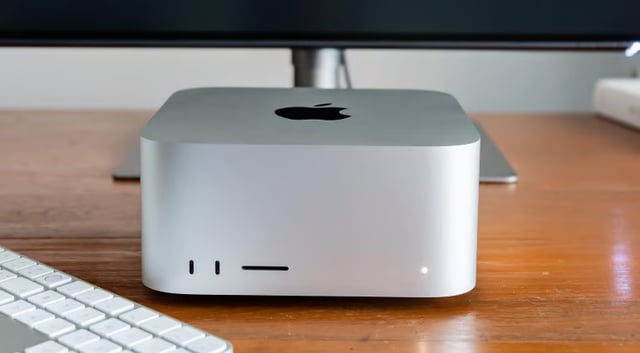
Apple’s desktop roadmap has taken an unexpected detour, revealing a high-stakes strategy that sacrifices an entire generation of pro chips to build a powerhouse for the artificial intelligence era.
According to Bloomberg’s Mark Gurman, Apple is mapping out two separate Mac Studio refreshes: an M5 Ultra model that could arrive as early as this year and a more ambitious M7 Ultra version expected in 2028.
The gap exists because Apple is reportedly skipping the M6 generation entirely for its high-end chips.
TechRepublic previously reported that Apple is canceling the M6 Pro and M6 Max, releasing only a base M6 this year before jumping straight to the M7 family for its Pro, Max, and Ultra silicon. That means no M6 Ultra will ever exist as the Mac Studio goes directly from M5 Ultra to M7 Ultra.
Cooling and design changes on the horizon
While the M5 Ultra Mac Studio is expected to be a straightforward chip refresh, the M7 Ultra model is being linked to more substantial internal upgrades. Bloomberg’s report suggests Apple is developing a redesigned heat sink and improved cooling system for future Mac Studio machines. The goal is to handle higher sustained power loads from increasingly AI-focused chips.
Some analysts believe this could also open the door to a partial redesign of the Mac Studio’s internal architecture, though there is no confirmation of a full external redesign yet. Historically, Apple has been slow to change desktop enclosures, often keeping designs for many years at a time.
Why it matters
The Mac Studio occupies an unusual spot in Apple’s lineup. It’s the machine professionals buy for video editing, 3D rendering and heavy software work, but it’s also become Apple’s de facto local AI workstation as the company leans harder into on-device processing. A chip built around AI workloads, paired with a cooling system designed to sustain them, signals where Apple thinks its desktop power users are headed.
It also means the current Mac Studio, built around the M3 Ultra and M4 Max, will keep aging in place for a while. Buyers won’t see a true architectural leap until the back half of the decade.
Analysis: The pricing problem
Apple just raised prices across nearly its entire lineup, largely blamed on surging memory and component costs tied to the broader AI boom. The Mac Studio has already felt this squeeze directly: its maximum RAM configuration was reportedly cut from 512GB down to 96GB, even as reports suggest Apple has tested support for up to 768GB in future builds.
That’s the risk hanging over the M7 Ultra. If memory and component costs remain elevated or worsen, a more powerful chip with greater bandwidth and a beefier cooling system could arrive with a price tag that puts it further out of reach for all but the most committed professional buyers.
Also read: Leaked Tata files reportedly included possible iPhone 18 Pro images and supplier records, adding another early clue to Apple’s hardware roadmap.