
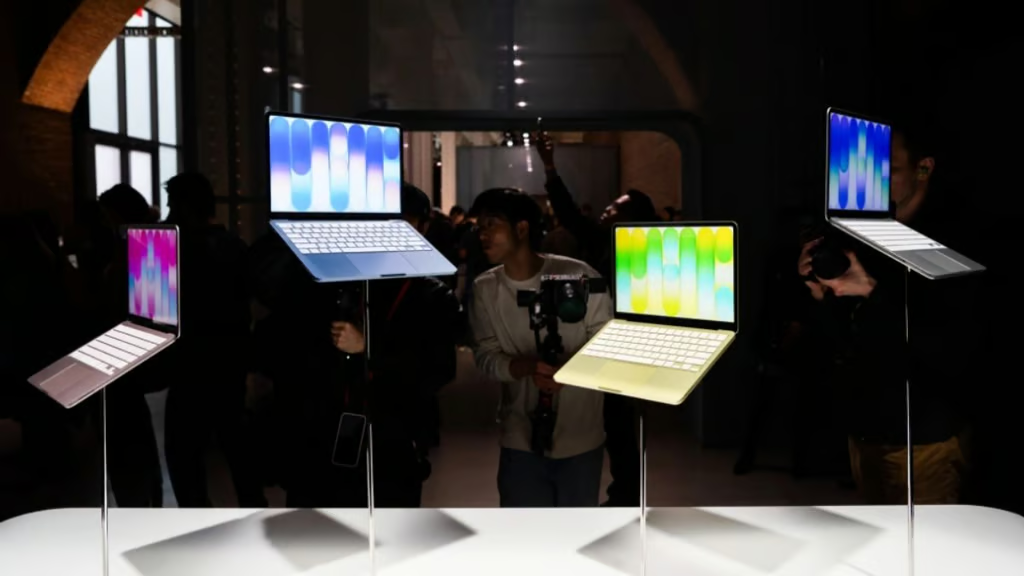


Apple just passed the AI tax to shoppers.
The tech giant has brought sweeping price hikes to almost all of its products, with the iPad, Mac, home devices, and Vision Pro all seeing noticeable increases. The iPhone was one of the few product lines not to see a price rise. Apple Watch and AirPods, which require less memory, also avoided any price changes.
The huge spike in demand for memory has led all major RAM manufacturers to raise prices, with knock-on effects across consumer electronics. Even Apple, which has at times been able to set the market price due to the scale of its hardware business, has struggled, as memory manufacturers can sell RAM to data centers and neoclouds at far higher per-unit prices.
“The rapid expansion of AI data centers has created an extraordinary surge in demand for memory and storage, [and we have] never seen a component price increase this much, this quickly,” said an Apple spokesperson to Bloomberg.
“We have shielded our customers from these increases so far, but we have now reached a point where we need to begin raising prices on a number of products, including today’s increases for iPad and Mac.”
It is the first time Apple has been forced to increase prices across such a wide range of product lines at once. Most of the increases are in the $100 to $200 range, although the 14-inch MacBook Pro, 16-inch MacBook Pro, and Mac Studio exceeded even that. For custom configurations, increases in memory can quickly add hundreds of dollars to the price at checkout.
Memory crunch at an inopportune time for Apple
The reported price increases include:
- HomePod mini: $129, up from $99 (+$30)
- HomePod: $349, up from $299 (+$50)
- Apple TV: $199, up from $129 (+$70)
- iPad: $449, up from $349 (+$100)
- iPad mini: $599, up from $499 (+$100)
- iPad Air: $749, up from $599 (+$150)
- iPad Pro: $1,199, up from $999 (+$200)
- MacBook Neo: $699, up from $599 (+$100)
- MacBook Air: $1,299, up from $1,099 (+$200)
- MacBook Pro: $1,999, up from $1,699 (+$300)
- iMac: $1,499, up from $1,299 (+$200)
- Mac mini (M4 Pro): $1,599, up from $1,399 (+$200)
- Mac Studio (M4 Max): $2,499, up from $1,999 (+$500)
- Mac Studio (M3 Ultra): $5,299, up from $3,999 (+$1,300)
- Vision Pro: $3,699, up from $3,499 (+$200)
This has come at an inopportune time for Apple, with the company only recently launching its new mid-range MacBook Neo. The price has gone up to $699 from $599, still competitive with other mid-range laptops, but a tougher sell in a market where Chromebooks and other two- to three-year-old laptops are unaffected by the price rises.
The new Mac mini, reportedly coming later this year or in early 2027, will likely also arrive at a less competitive price point, which could be an issue, given that affordability was one of the key factors for consumers looking to use it as an always-on AI agent hub.
It is unclear why the iPhone was spared the price increase, though it may be due to the $100 increase Apple added to the iPhone 17 Pro last year. Apple may also be hoping that the surge in memory demand is short-lived and that it can absorb a few years of lower per-unit income if it helps maintain or improve smartphone market share.
Must-read Apple coverage
- Nearly 7 in 10 iPhone Owners Plan iPhone 17 Upgrade
- Apple Prepares AI-Powered Siri Upgrade With Google Search Integration
- Apple’s Xcode 26 Beta Now Supports GPT-5 and Claude
- Apple’s Vision Pro Adoption Stalled As Content Released ‘Drip by Drip’
Data center demand has changed the game
The surge in data center demand from AI has changed the game for component suppliers.
Nvidia looks set to overtake Apple as TSMC’s largest customer. At the same time, memory manufacturers that previously made deals with consumer electronics brands in return for large orders have started selling their units at a single price, with no negotiation.
The success of memory manufacturers is most evident in the astonishing rise of SK Hynix, whose valuation recently surpassed $1 trillion. It is seen as a leader in the advanced memory chip market, which is used in AI data centers.
The huge gap between supply and demand is forcing companies like Apple to seek alternatives to their key suppliers. It has recently opened discussions with Intel about building its custom chips, potentially moving some production away from TSMC.