


Vibe coding started as a shortcut for developers. Meta now wants to turn it into a social-media habit.
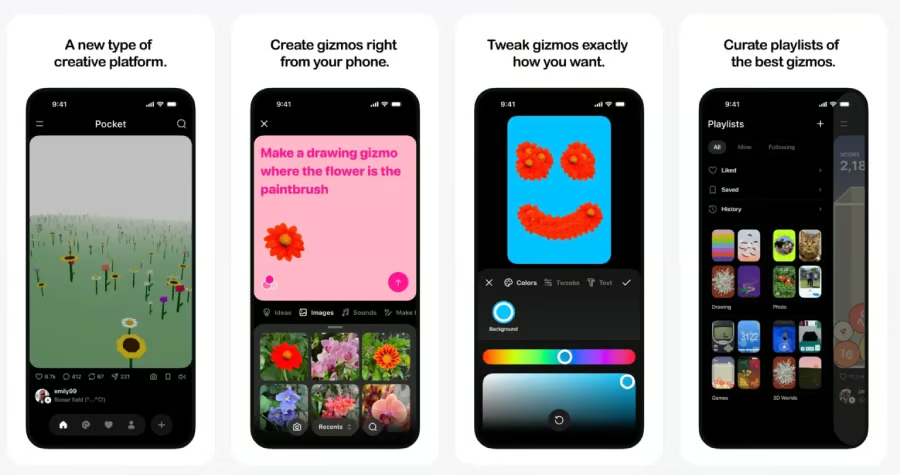
The company is rolling out Pocket in the US, an app that allows users to create small games and interactive experiences simply by describing them to AI. Those creations, called “gizmos,” can then be published to profiles, played by other users, and remixed into something new.
That makes Pocket more than another AI coding experiment. Meta is testing whether AI-generated software can become a form of social content, turning prompts into interactive posts designed to be played, shared, and endlessly reworked.
Pocket is more than an AI game generator
Meta did not build Pocket entirely from scratch.
According to TechCrunch, the app grew out of the technology and team behind Gizmo, an interactive app created by Atma Sciences, a startup founded by former Snapchat employees.
Meta hired the team and acquired a non-exclusive license to Atma’s technology, which it has since adapted into Pocket, under its Muse Spark AI engine.
The interactive design of Pocket is what makes the platform more than a normal social feed. A gizmo can behave like a small game, toy, or interactive meme, allowing the person viewing it to actually manipulate what is on screen rather than passively consume it.
The app also lets users take existing creations further. A user can tweak a gizmo’s original prompt, create from images stored on their phones, change its visual elements, or add music, while remixing lets them build their own version of another person’s creation.
More must-read AI coverage
- SS&C Intralinks DealCentre AI vs. Datasite: Which platform is built for the future of dealmaking?
- SS&C Intralinks FundCentre AI vs. Juniper Square: Which platform better supports modern private markets fund managers?
- Why Data, Not Models, Determines AI Success
- The Rise of the AI-Native Factory: How Physical AI Is Transforming Manufacturing
Why is Meta suddenly launching more apps?
The first reason is AI. Meta has directly attributed its recent ability to build and launch more standalone apps to AI.
During the company’s second-quarter earnings call, CEO Mark Zuckerberg told investors that AI is helping its teams speed up product development and ship new experiences faster. TechCrunch reports that Meta now expects it to become much easier to launch new apps, allowing the company to test more ideas and scale the ones that gain traction.
That brings us to monetization. Meta’s core business still depends heavily on advertising, which generated $59.36 billion of the company’s $60.8 billion in second-quarter revenue. As a result, every successful standalone app could eventually give it another audience, an engagement source, and a potential advertising surface.
Pocket does not currently show ads, according to Business Insider, so Meta is not launching it as an immediate advertising business. Instead, the app gives the company another product to test. If its social feed attracts enough users and generates sufficient engagement, Meta might eventually explore advertising or other monetization options for that audience.
What Pocket could mean for social media users
For users, Pocket hints at a version of social media where posts are no longer limited to photos, videos, and text. A successful gizmo could be something people play, modify, and republish, giving creators a new format that blends entertainment, software, and social interaction.
That also raises a broader question about where social platforms are headed as generative AI becomes easier to use. If Pocket gains traction, people may increasingly encounter feeds filled with content that is not simply watched or read, but generated on demand and reshaped by everyone who touches it.
For now, Pocket is still an experiment. But it gives Meta a chance to test whether the next big social format could be less about posting what you made and more about inviting other people to remake it.
Related reading: Meta is also pushing AI deeper into everyday workflows, with its new Meta AI Mac app adding screen sharing, dictation, and integrations for business users.