
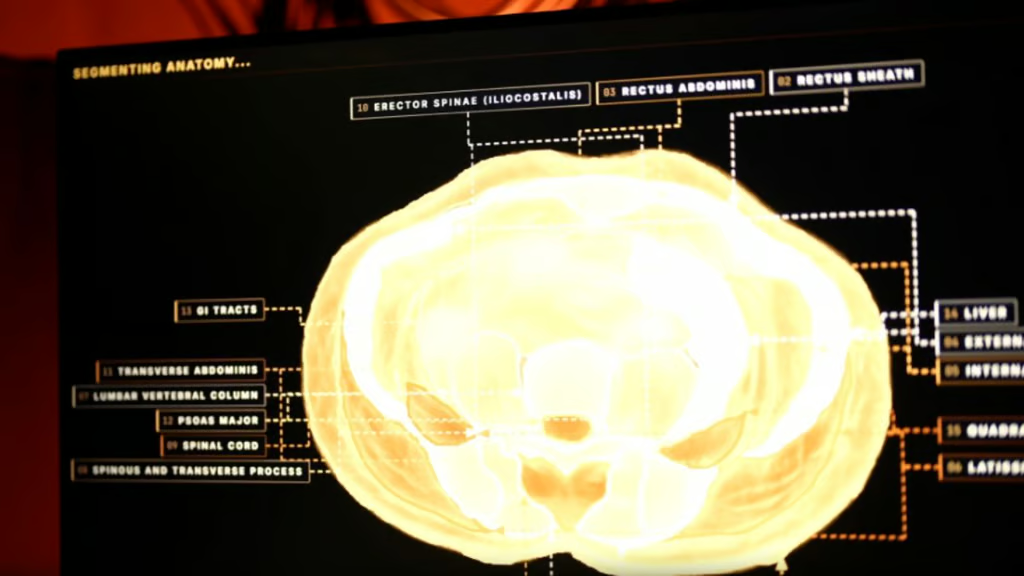


Midjourney’s next big image project may be the human body.
The AI image company announced Midjourney Medical, a new effort to build a full-body ultrasonic scanner that it says could map the body in about a minute. The plan moves Midjourney beyond generative image software and into health-focused hardware, with spa-like scanning locations, research trials, and a possible path toward FDA review.
That makes the project more than a strange company pivot. It raises early questions about medical accuracy, sensitive body data, and whether a creative AI company can operate inside one of technology’s most regulated markets.
Midjourney Medical starts with a scanner
Midjourney said its new medical project is “not related to anything you’ve seen from us so far.”
The company described the goal as building something “as powerful as MRI, and as casual as a trip to the spa.”
The proposed Midjourney Scanner would place a person on a platform that descends into water at about 2 inches, or 5 centimeters, per second. As the body moves through the scanner, it passes a ring of underwater sensors that send ultrasonic waves from different angles.
Midjourney said the scanner would use reflected sound waves to reconstruct a detailed body map down to a fraction of a millimeter. The target is to complete the scan in 60 seconds or less.
Engadget reported that Midjourney is developing the machine with Butterfly Network, the maker of handheld ultrasound devices. The report said that Midjourney signed a licensing agreement with Butterfly Network in November 2025 for exclusive rights to Butterfly Network’s ultrasound-on-a-chip technology.
The spa plan is part of the product
Midjourney is not pitching the scanner only as a hospital or clinic device.
The company noted it plans to build Midjourney Spas, where people could get scanned in a setting with hot tubs, saunas, cold plunges, and private scanning rooms.
The first spa is planned for San Francisco in 2027. Midjourney said the next 12 months will focus on refining the scanner, improving algorithms, running research trials, and working toward a second-generation hardware design.
The company also said diagnostic capabilities would require FDA approval. For now, Midjourney said it plans to begin with detailed body-composition maps and to submit regular test results to the FDA as it seeks expanded capabilities.
In 2028, Midjourney expects to begin scaling to more cities and move toward a third-generation scanner with custom silicon. Its longer-term goal is much larger — more than 50,000 scanners worldwide by 2031.
More must-read AI coverage
- SS&C Intralinks DealCentre AI vs. Datasite: Which platform is built for the future of dealmaking?
- SS&C Intralinks FundCentre AI vs. Juniper Square: Which platform better supports modern private markets fund managers?
- Why Data, Not Models, Determines AI Success
- The Rise of the AI-Native Factory: How Physical AI Is Transforming Manufacturing
Health data is the real question
The scanner is still early, and Midjourney’s claims are ambitious. A 60-second body scan could sound convenient, but medical imaging is not just another consumer tech feature.
Any system built around repeated full-body scans would raise questions about data storage, consent, accuracy, false positives, medical oversight, and who can access the results. The questions become even more important if the service is offered in a spa-like setting rather than a traditional medical environment.
The project also shows how far some AI companies are willing to move beyond software. Midjourney is talking about scanners, health data, spa-like locations, and FDA review, not just another image model.
Midjourney’s move into medical scanning is unusual, but the concerns are not.
Before a scanner like this becomes part of everyday health routines, the company will need to prove the technology works, show how it handles sensitive data, and clear the medical rules that apply to diagnostic tools.
Read how Apple and Samsung are racing to turn glucose data into AI-powered health advice.