


OpenAI’s unusual business structure, which has a nonprofit arm and a for-profit arm linked by a web of control and money, may be about to change. The ChatGPT maker’s for-profit arm is slated to transition to a Public Benefit Corporation (PBC), potentially bringing even more wrinkles as to who benefits from OpenAI’s money and mission.
“OpenAI is not a normal company and never will be,” the company’s CEO Sam Altman wrote in a May 5, 2025 blog post.
This possible structural change impacts consumers and tech professionals because how OpenAI makes its governance choices affects product roadmaps, licensing arrangements such as Microsoft carve-outs, and who decides when artificial general intelligence is reached. AGI may never exist, but the decisions of executives who push toward beneficial AGI can have significant impacts.
How do OpenAI’s nonprofit and for-profit pieces fit together?

OpenAI was founded with one big idea in mind: AGI was on the horizon, and someone needed to ensure humanity would benefit from it instead of being harmed. In OpenAI’s explanation of the company structure, it defines AGI as “a highly autonomous system that outperforms humans at most economically valuable work.”
Since OpenAI began, the definition of AGI has proven to be murky. “Human-level” AI seems to always be just over the horizon. And OpenAI and Microsoft may have settled on a more down-to-earth definition: For the purposes of their contract, AGI is a product generating $100 billion in profits.
“Seeing no clear path in the public sector,” as OpenAI wrote in the May 5 blog post, the company was formed as a nonprofit. In 2019, it was restructured with the addition of a for-profit subsidiary, structured as a capped for-profit business. Around the same time, Microsoft pledged $1 billion to OpenAI’s cause, providing Azure cloud services.
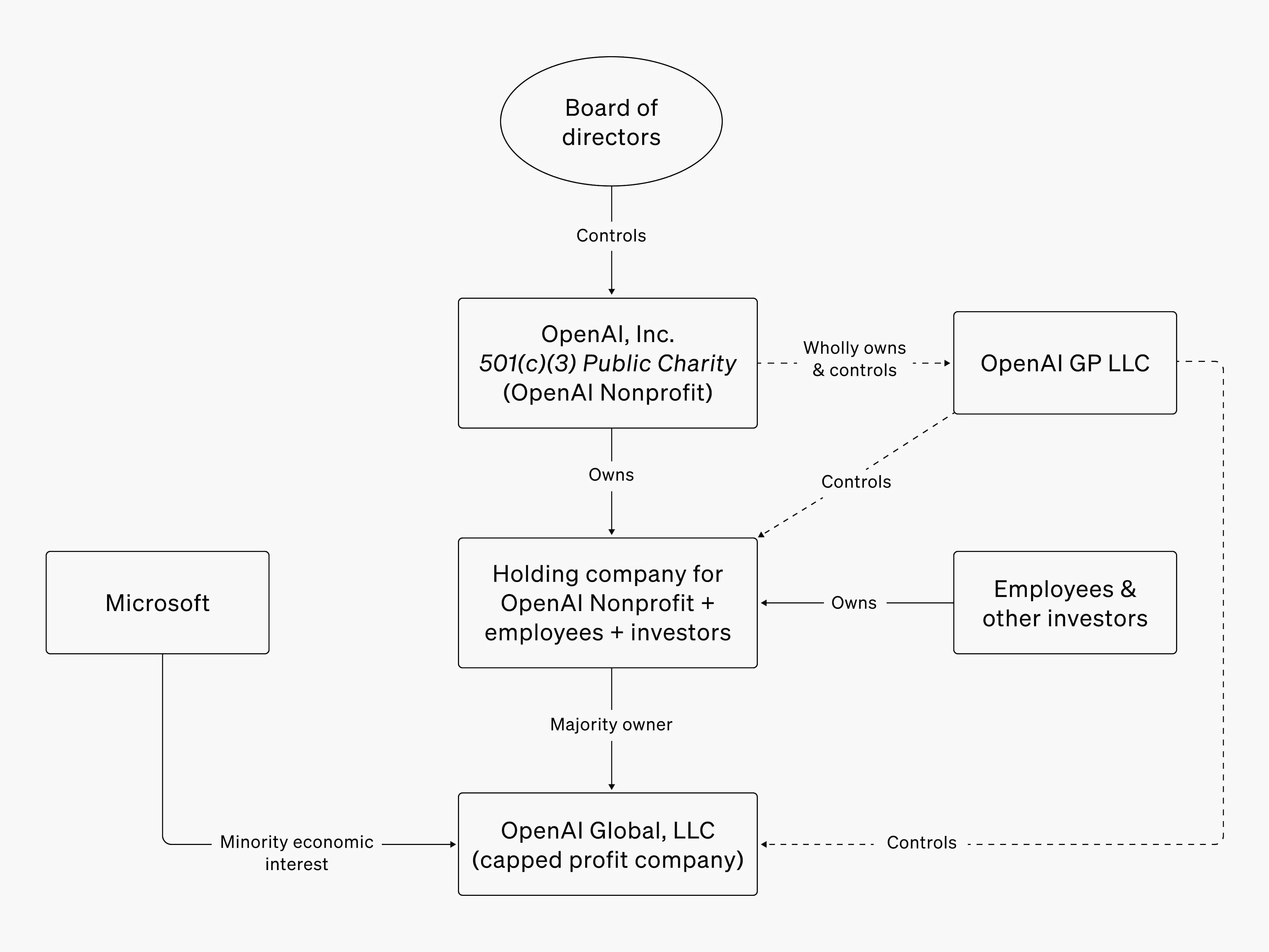
As of September 2025, OpenAI is structured as seen in the image above. The board of directors sits atop the OpenAI, Inc. 501(c)(3) nonprofit. The nonprofit wholly owns and controls OpenAI GP LLC. The LLC, in turn, controls the for-profit. A holding company aggregates nonprofit, employees, and investors; it’s the majority owner of OpenAI Global, LLC (the capped-profit company). Microsoft has a minority economic interest.
What about the AGI part?
The board has the power to determine when AGI is attained, and Microsoft’s existing IP licenses and other commercial terms will end when the board says AGI has appeared.
The operating agreement of the for-profit includes the statement: “It would be wise to view any investment in OpenAI Global LLC in the spirit of a donation, with the understanding that it may be difficult to know what role money will play in a post-AGI world.”
Companies saying their products will change the world is nothing new, but structuring their organization around it is bold and unusual.
More must-read AI coverage
- SS&C Intralinks DealCentre AI vs. Datasite: Which platform is built for the future of dealmaking?
- SS&C Intralinks FundCentre AI vs. Juniper Square: Which platform better supports modern private markets fund managers?
- Why Data, Not Models, Determines AI Success
- The Rise of the AI-Native Factory: How Physical AI Is Transforming Manufacturing
OpenAI proposes initial switch to for-profit
In December 2024, OpenAI announced an initial proposal to restructure to transform the for-profit arm into a PBC, allowing it to raise more funds; the nonprofit would hold shares in the PBC. However, this plan proved controversial and led to legal challenges, including from co-founder and former ally Elon Musk.
OpenAI shifts toward a PBC again
In May 2025, OpenAI announced the intent to transform the for-profit LLC into a PBC. In the new version of the plan, the nonprofit would retain oversight and control, and become a large shareholder in the PBC.
“Instead of our current complex capped-profit structure — which made sense when it looked like there might be one dominant AGI effort but doesn’t in a world of many great AGI companies — we are moving to a normal capital structure where everyone has stock,” Altman wrote at the time in his OpenAI post. “This is not a sale, but a change of structure to something simpler.”
The oversight of OpenAI’s direction would stay with the nonprofit. Equity mechanics would change, letting employees own stock in the way a more conventional tech company might.
“We want to be able to operate and get resources in such a way that we can make our services broadly available to all of humanity, which currently requires hundreds of billions of dollars and may eventually require trillions of dollars,” Altman wrote.
In both versions of the PBC plan, Altman still operates under the idea that AGI might result in an unrecognizable future financial landscape; until then, he needs conventional money. OpenAI aims to attract investors to continue expanding its commercial and enterprise businesses, while backers seek returns.
OpenAI’s decision receives criticism from multiple directions
Altman’s blog post proved controversial; the announcement was met with more outcries from entities as different as major philanthropies and Musk. By September, California and Delaware attorneys general were examining the plan and stated the shift might violate nonprofit rules. OpenAI said it had already consulted with those AG offices before making the May plan.
Here is where OpenAI’s unusual structure comes back into play in full force. OpenAI’s mission to protect humanity from theoretical AI (while making one of the most popular consumer applications in the world) is governed by the same rules as other nonprofits.
In April, a group of nonprofits led by the San Francisco Foundation said that OpenAI “has failed to protect its charitable assets.”
“Initially, OpenAI’s founders saw the nonprofit structure as essential for ensuring that their research avoided harmful artificial intelligence developments and enabled humanity broadly to benefit from the research. However, OpenAI soon abandoned its commitment to its charitable mission,” according to a petition sent before California AG Rob Bonta by SFF.
The SFF funnels money to causes promoting diversity and economic inclusion, workers’ rights, and other social causes.
In September, the progressive nonprofit consumer advocacy group Public Citizen called the OpenAI nonprofit “little more than a rubber stamp of the for-profit” and asked the AGs to dissolve the nonprofit arm.
Competitors, including Meta, have also requested that California regulators block the restructuring.
In response, OpenAI committed $50 million in September to other nonprofits in the form of grants. Known as the People-First AI Fund, the money is intended for organizations working on AI-related projects with operating budgets between $500,000 and $10 million.
Meanwhile, Bonta and Delaware Attorney General Kathy Jennings met with and sent a letter to OpenAI in September, “expressing their deep concern” about AI chatbots leading to harm to children. One teen suicide linked to ChatGPT occurred in California.
“Together, we are particularly concerned with ensuring that the stated safety mission of OpenAI as a non-profit remains front and center,” Bonta wrote. “OpenAI purports to build AI to benefit all of humanity. Humanity includes children. And before we can even get to benefiting, we need to get to not harming.”
What to watch next
On March 16, 2026, a jury trial is scheduled to begin in the matter of Musk’s lawsuit against OpenAI that alleges transitioning to a for-profit structure compromises the company’s original mission. OpenAI characterized this case as harassment from Musk.
Investigation by the state attorney generals is ongoing. Next, we may see filings related to OpenAI’s PBC conversion or further attempts to ground the non-profit side in philanthropy while reaping the benefits of the for-profit side.
Microsoft and OpenAI signed a new non-binding memorandum of understanding in September. The companies are finalizing the terms of a definitive agreement that will need to both satisfy Microsoft’s financial interests and maintain OpenAI’s autonomy.