
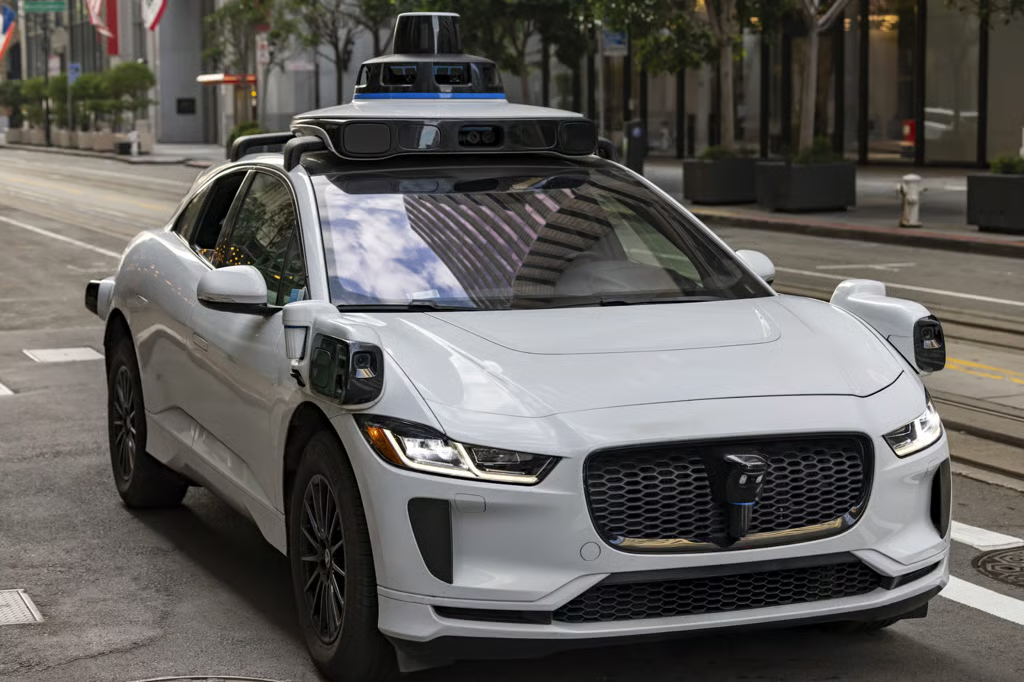


Robotaxis are getting much better at routine driving. Their harder test begins when the road stops behaving routinely.
Waymo recalled 3,871 autonomous vehicles on June 17 after identifying cases in which its driving system entered freeway construction zones, highlighting a class of problems that becomes more important as driverless fleets encounter temporary road layouts, emergency scenes and other unusual conditions.
That creates an uncomfortable paradox for the industry: autonomous vehicles can outperform human drivers on broad crash statistics while still struggling with rare situations that people can often interpret instinctively.
A paradox of two truths
Waymo’s safety data makes a strong case that autonomous vehicles can outperform human drivers on some crash measures. As of March, Waymo says its vehicles have now driven 220.6 million rider-only miles without a human driver, and its latest safety analysis found 94% fewer crashes causing serious or fatal injuries than comparable human-driving benchmarks.
Independent research points in the same direction. A recent Insurance Institute for Highway Safety (IIHS) study found Waymo vehicles were involved in 68% fewer police-reportable crashes per mile than human-driven vehicles across San Francisco, Phoenix, Los Angeles and Austin, including 81% fewer injury crashes and 85% fewer single-vehicle crashes.
But those figures describe overall crash performance, not whether an autonomous system will handle every unusual situation correctly.
In July, the National Highway Traffic Safety Administration (NHTSA) said it had documented “a clear pattern of driverless AVs interfering with law enforcement and other first responders,” including vehicles entering emergency scenes, blocking ambulances and firefighters, and failing to respond appropriately to flashing lights, flares, smoke, fire and traffic cones.
Waymo isn’t the only one here. Zoox has issued software recalls, including one related to smoke detection at emergency scenes, while Tesla’s robotaxi service has also faced questions about unusual behavior.
More cars, more edge cases
Every new robotaxi on the road expands the amount of real-world experience an autonomous-driving system can collect. It also increases the number of opportunities for that system to encounter something it has not handled before.
That creates a different kind of scaling problem.
Traditional software can often be tested against a defined set of inputs, but autonomous vehicles operate in an environment where the inputs keep changing. A vehicle can encounter combinations of objects, road conditions, and human behavior that developers could not reasonably anticipate individually.
The answer is not to stop scaling their road deployments. The requirement is making sure companies can turn real-world encounters into reliable software improvements before the same weakness appears elsewhere in the fleet.
The next phase of the robotaxi race will be measured by more than fleet size, miles driven or the number of cities served.
The stronger test will be whether companies can expand while making rare failures less frequent, less severe, and less likely to repeat across the fleet. If they can, autonomous driving starts to look less like an impressive demonstration and more like dependable transportation infrastructure.
Other News: AI data centers are rapidly increasing electricity demand, but US grid data suggests the bigger near-term problem is regional capacity bottlenecks rather than a nationwide power shortage.