


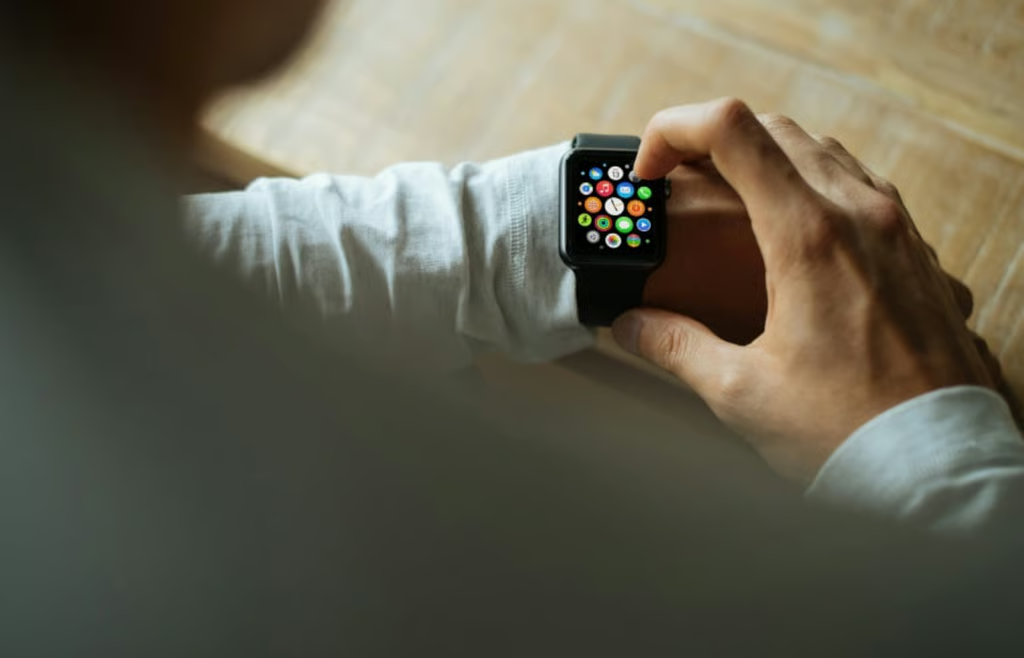
Smartwatches can already track your heart rhythm, blood oxygen, skin temperature, sleep, workouts, stress, and even blood pressure in some cases. Blood sugar is the next big prize.
Apple, Samsung, Garmin, Oura, and other wearable companies are all circling glucose tracking, but the reality is more complicated than the marketing suggests. No mainstream smartwatch or smart ring can directly measure blood glucose without a separate sensor, and the US Food and Drug Administration has warned consumers not to rely on watches or rings that claim to do so.
That does not mean wearables are out of the glucose game. It means the industry is splitting into two lanes: devices that display glucose data from approved continuous glucose monitors, and future devices that may someday measure glucose noninvasively on their own.
- Can any smartwatch measure blood sugar today?
- Apple Watch: Closest to the mainstream glucose dream, but not there yet
- Samsung Galaxy Watch: Health features are expanding, but glucose remains elusive
- Garmin: Best viewed as a data companion for athletes
- Oura: The smart ring angle is metabolic health, not direct glucose sensing
- Why noninvasive blood sugar tracking is so hard
- What to watch next
Can any smartwatch measure blood sugar today?
No major consumer smartwatch can directly measure blood sugar on its own today.
The distinction matters. A watch may be able to show glucose readings from a continuous glucose monitor, or CGM, but that does not mean the watch itself is measuring glucose. CGMs use a small sensor placed under the skin to measure glucose levels in interstitial fluid and then send the data to a phone, watch, or companion app.
The FDA made that line clear in a 2024 safety warning, saying it had not authorized any smartwatch or smart ring to measure or estimate blood glucose values on its own. The agency warned that inaccurate glucose readings could lead people with diabetes to take the wrong dose of insulin or other medication.
For now, the most useful glucose-related wearable setups still rely on CGM devices from companies such as Dexcom and Abbott.
Apple Watch: Closest to the mainstream glucose dream, but not there yet
The Apple Watch is often treated as the most likely candidate to bring noninvasive glucose monitoring to a mass-market wearable. Apple has reportedly worked on the technology for years, and the company’s health strategy has steadily expanded from fitness tracking into more medically relevant features such as ECG, fall detection, irregular rhythm notifications, and sleep apnea notifications.
But the Apple Watch still cannot directly measure blood sugar.
It can display glucose data from compatible CGMs. Dexcom, for example, announced that its G7 system could connect directly to Apple Watch in the US, letting users view glucose readings without needing their iPhone nearby. That is meaningful for people who already use a CGM, but it is not the same as Apple solving noninvasive glucose monitoring.
The practical takeaway: Apple Watch is useful as a glucose display, not a glucose sensor.
Samsung Galaxy Watch: Health features are expanding, but glucose remains elusive
Samsung has also been tied to the blood sugar monitoring race for years. The company has invested heavily in health tracking through Galaxy Watch and Samsung Health, and has continued to add wellness and cardiovascular features.
Samsung recently expanded blood pressure tracking for Galaxy Watch users in the US, though that feature still requires calibration with a traditional cuff. That rollout shows how difficult regulated health features can be, even when the underlying concept is more established than noninvasive glucose monitoring.
As with Apple, the Galaxy Watch does not directly measure blood sugar. Samsung may eventually pursue noninvasive glucose sensing, but consumers should treat any current claim that a Galaxy Watch can independently track glucose as inaccurate.
The practical takeaway: Galaxy Watch is a strong health wearable, but glucose monitoring still requires an external CGM.
Garmin: Best viewed as a data companion for athletes
Garmin’s opportunity in glucose tracking is different. Its watches are especially popular with endurance athletes, cyclists, runners, and performance-focused users who already use data-heavy training tools.
Garmin has supported Dexcom integrations via Connect IQ, allowing users to view glucose data from compatible Dexcom CGM devices on certain Garmin devices. For athletes with diabetes, that can be valuable during training, when glucose trends may affect fueling, performance, and safety.
But again, Garmin watches do not directly measure glucose. They are acting as a display layer for CGM data.
The practical takeaway: Garmin may be one of the more useful wearable ecosystems for active CGM users, but it is not a standalone blood sugar monitor.
Oura: The smart ring angle is metabolic health, not direct glucose sensing
Oura has taken a different route. Rather than trying to position the ring itself as a glucose monitor, the company has leaned into metabolic health through partnerships and app-based interpretation.
Oura’s glucose feature works with Dexcom’s Stelo CGM, allowing users to see glucose data alongside sleep, stress, activity, and other Oura metrics, according to Oura support documentation and reporting from The Verge. That makes Oura part of the broader glucose conversation, especially for wellness-minded users who want to understand how meals, sleep, and activity affect their bodies.
But the Oura Ring itself does not measure blood sugar. The glucose data comes from the CGM.
The practical takeaway: Oura is trying to contextualize glucose data, not replace the CGM.
Why noninvasive blood sugar tracking is so hard
Glucose is not like heart rate.
Smartwatches can estimate heart rate using optical sensors that detect changes in blood flow under the skin. Blood glucose is harder because the signal is weaker, more variable, and more clinically sensitive. A small error in a step count is annoying. A small error in glucose data could affect medication decisions.
Researchers are exploring approaches involving light, sweat, skin signals, and machine learning, but accuracy remains the wall everyone keeps hitting. The FDA’s warning underlines the core issue: a consumer wearable cannot just be interesting. It has to be safe enough for people who may make medical decisions based on the number it shows.
That is why the first successful smartwatch glucose-tracking version may not be a magic sensor in the watch. It may be a tighter software layer that combines CGM data, food logging, sleep patterns, exercise, medication data, and AI-driven insights.
What to watch next
The most realistic near-term progress will likely come from integrations rather than standalone watch sensors.
Expect more partnerships between wearable makers and CGM companies. Dexcom has already worked with Apple Watch and Oura, while Abbott’s over-the-counter Lingo CGM has opened the door for more consumer wellness integrations. These partnerships can make glucose data easier to access and understand, even if the sensor still sits on the body rather than inside the watch.
Apple and Samsung remain the companies to watch for a true noninvasive breakthrough. But until either company announces an FDA-cleared feature, the safest assumption is this: your smartwatch may help you view blood sugar data, but it cannot measure blood sugar on its own.
For now, the smartwatch blood sugar race has no winner. It has contenders, companion devices, and a finish line that keeps moving.
Also read: Apple continues to expand its health-focused features globally, recently bringing its AFib History feature to users in China as part of a broader push into medical and wellness tracking capabilities.