


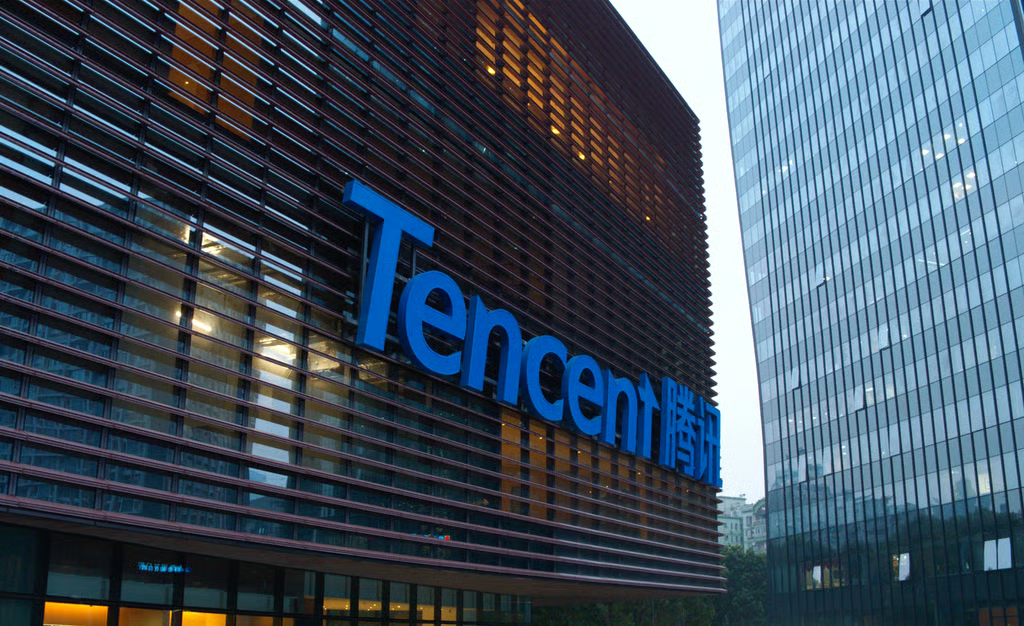
Tencent is looking beyond China for the computing power behind its AI push. The company has reportedly agreed to a five-year deal worth about $7 billion for access to roughly 100,000 advanced AI chips in Oracle data centers across Southeast Asia, according to the Financial Times.
Reuters could not independently verify the report, and neither Tencent nor Oracle had publicly confirmed the agreement when Reuters sought comment. If completed as reported, the deal would place a large block of Tencent’s AI compute outside China while raising questions about how US export controls apply when advanced hardware is hosted overseas but accessed remotely.
Tencent’s reported $7 billion Oracle deal
The agreement would span multiple Oracle data centers in Southeast Asia and require Tencent to pay about 30% of the contract value upfront, the Financial Times reported. The specific chip models, countries, facilities, and deployment schedule have not been disclosed publicly, and the reported agreement remains unconfirmed.
Tencent’s financials show the scale of its broader AI infrastructure push. In August, the company said it had increased compute procurement to support AI models, applications, and cloud demand.
Second-quarter capital expenditure reached RMB52.8 billion, up 176% year over year. Free cash flow was negative RMB13.8 billion, but Tencent said it would have been positive RMB37.6 billion without compute-procurement prepayments. The company did not identify Oracle or connect those payments to the reported lease.
Oracle is also expanding AI cloud capacity. Its AI data center funding strategy includes corporate financing, customer-supplied hardware, and project loans. On Sept. 10, Oracle said it had delivered more than 300,000 GPUs to AI cloud customers since the end of its previous quarter and booked more than $30 billion in additional AI cloud contracts during its fiscal first quarter.
The Tencent capacity would join a broader regional buildout. Southeast Asia’s data center expansion is spreading beyond Singapore, while Aolani plans to deploy 22,000 Nvidia Blackwell Ultra GPUs across Malaysia and the Philippines in early 2027.
Why the deal could draw regulatory scrutiny
US export controls already address remote access in some advanced-computing licensing contexts. In certain license applications, BIS requires disclosure of intended infrastructure-as-a-service remote end users in China and other listed jurisdictions, along with information aimed at preventing unauthorized remote access.
Those provisions do not establish how the Tencent-Oracle arrangement would be treated. Public reporting has not disclosed the chip models, hosting locations, legal structure, or technical form of Tencent’s access.
Congress is considering broader authority over remote access. The House passed the Remote Access Security Act on Jan. 12, 2026, and the bill was referred to the Senate Banking Committee the next day. It would amend US export-control law to cover certain foreign remote access through networks, including cloud computing services.
Multiyear AI contracts can hinge on where compute is hosted, which entities ultimately access it, and how data or model workloads cross borders. More details could emerge if Tencent or Oracle confirms the arrangement or regulators address it publicly.
Public reporting has not established a compliance breach. If confirmed, the lease would underscore Southeast Asia’s growing role in hosting infrastructure used for China-linked AI demand.
Want to learn more AI tips, tricks, and prompting techniques? Let us teach you How to Talk to AI for free! Try our six-minute course at The Neuron Academy, our practical learning platform designed to help professionals use AI more confidently at work.
Learn a few simple ways to write better prompts and get more useful results from AI, or browse our other AI course for free for seven days. eWeek readers get free 7-day access. Check out all the lessons here →