


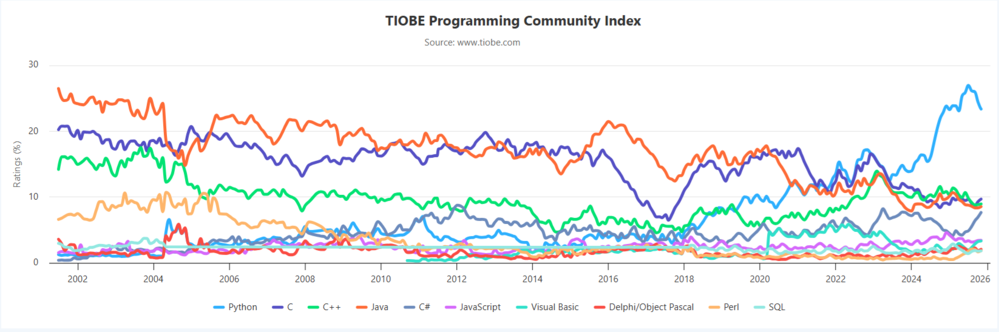
The November 2025 TIOBE Index brings another twist below Python’s familiar lead. C solidifies its position as runner-up, C++ and Java lose some ground, and C# moves sharply upward, narrowing the gap with Java to less than a percentage point. At the bottom of the leaderboard, long-established languages once again define the shape of the top 10, with Perl reappearing and Go dropping out.
The TIOBE Programming Community Index tracks programming language popularity using search engine activity.
The leaders hold, but the gap narrows
Python sits comfortably at the top at 23.37%, adding a small year-over-year bump that keeps it far out in front, even if its earlier surge is starting to level off. Just behind, C moves up to 9.68% and keeps hold of second place, reflecting renewed interest as C23 gains traction. C++ and Java both give up some ground but remain tightly grouped at 8.95% and 8.54%, respectively.
C# challenges Java
In his November commentary, TIOBE CEO Paul Jansen shifted the spotlight to C#. With Python’s momentum leveling off, he called C# the fastest-rising language in the index and suggested it could become the TIOBE Programming Language of the Year 2025 if current trends continue.
The ongoing rivalry between Java and C# is central to that story. C# has never ranked above Java in the index, yet the difference between them is now under 1% (8.54% vs. 7.65%), making a crossover a realistic short-term possibility.
Jansen argued that C# has steadily removed reasons to avoid it. It is now cross-platform, open source, and packed with modern language features, while Microsoft continues to back it heavily. Java still dominates the financial sector, but he noted that in most other domains, Java and C# now see roughly equal use. That combination — shrinking numerical distance, maturing ecosystem, and broad platform support — makes C# the most dynamic force in the upper ranks.
Must-read developer coverage
- What Powers Your Databases? Take This DZone Survey Today!
- Microsoft’s Historic 6502 BASIC Code is Now Open Source
- TIOBE Index: Top 10 Most Popular Programming Languages
- TechRepublic Exclusive: AWS Says Entry-Level Workers Need ‘Curiosity’ In the Age of AI
Classics hold the lower ranks
Below the top five, the leaderboard continues to be shaped by traditional languages rather than new arrivals.
JavaScript stays in sixth place at 3.42%, and Visual Basic edges up to seventh with 3.31%. Delphi/Object Pascal nudges upward to eighth at 2.06%, while Perl returns to the top 10 in ninth at 1.84% after a sharp year-over-year climb. SQL rounds out the list at tenth with 1.80%, maintaining a foothold that shows the enduring centrality of relational databases. Go, which held eighth place in October, slips out of the top 10 entirely.
A tightening chase pack
Python’s lead remains secure, but the real suspense is just beneath it. With C, C++, Java, and C# now packed into a relatively narrow band, and C# climbing while Java eases downward, the contest for the next few spots is tightening.
Jansen said that if C# maintains this trajectory, it’s only a matter of time before it appears above Java in the index for the first time.
Another shift on the horizon comes from Meta, which plans to phase out the familiar Facebook Like and Comment website plugins by February 2026 as part of a broader refresh.