


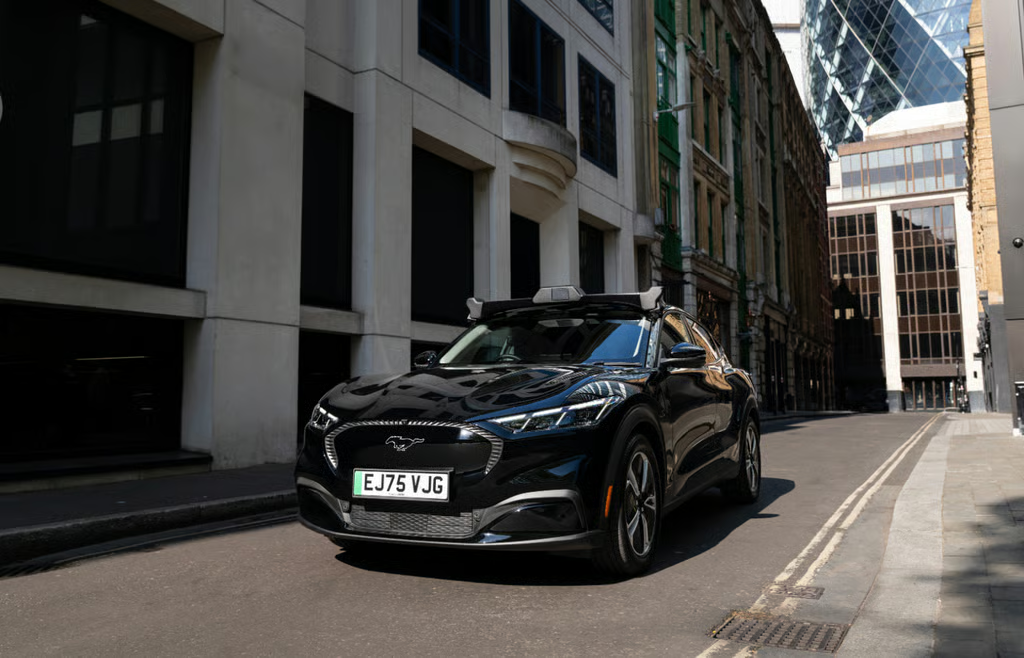
London’s robotaxi era has arrived — but human drivers have not left the front seat.
Uber and British autonomous-driving startup Wayve have launched supervised autonomous rides in London, giving passengers their first public opportunity to experience Wayve’s AI Driver through the Uber app. A trained, Transport for London-licensed private-hire driver remains behind the wheel and can intervene when necessary.
The initial fleet consists of 15 all-electric Ford Mustang Mach-E vehicles. Customers booking UberX, Uber Electric or Uber Comfort may be offered a Wayve vehicle at no additional cost, with the fare displayed upfront in the Uber app. Riders can accept the autonomous ride or request a conventional vehicle instead.
Uber said the vehicles can operate across London, excluding airports, and that more than 140,000 customers have opted in to improve their chances of being matched with one.
Early test rides have shown how human supervisors may respond when the system encounters uncertain or difficult road conditions. During a Bloomberg test drive, the vehicle navigated traffic, tight lane changes, pedestrians and a protest near Parliament. The safety driver intervened twice, including when the car was attempting to merge into gridlocked traffic.
A BBC test produced a similar result. The car handled traffic and roadworks before braking when the doors of a parked van appeared to open, prompting the safety driver to take control. Wayve said the intervention was the driver’s decision and that it believed its system could have handled the situation.
London is the real test
Wayve’s approach differs from autonomous systems that depend heavily on detailed maps and hand-coded driving rules. Its AI Driver learns from driving data and uses sensors to interpret its surroundings in real time.
That matters in London, where narrow streets, unpredictable traffic, pedestrians, cyclists and constantly changing road conditions create a tougher environment than many modern cities.
“This launch is a major milestone in scaling safe, accessible AV technology in a city with some of the world’s most complex roads,” Uber’s Sarfraz Maredia said.
The next step will be a fully driverless service without a safety driver. That will require additional regulatory approvals, including processes involving the Vehicle Certification Agency, DVSA and TfL, according to Bloomberg. Wayve is also developing Nissan Leaf vehicles for future driverless operations, while competitors including Waymo and Baidu are preparing their own London efforts.
What this means for riders and Uber
For riders, the launch offers a relatively low-risk way to try autonomous transport: there is no additional fee, a trained driver remains behind the wheel, and customers can request a conventional vehicle instead. For Uber, it is a strategic bet on becoming the platform connecting riders with both human and autonomous fleets rather than building the driving technology itself.
With only 15 vehicles and a licensed driver in every car, the launch remains an early test rather than proof that autonomous taxis are ready to replace conventional rides. The real measure of success will come if Wayve secures approval to remove the safety driver—and can show that its system handles London’s unpredictable edge cases consistently without human intervention.
Read more: Uber and Wayve’s earlier plans for autonomous rides in London explain how the companies prepared for this supervised public launch.