
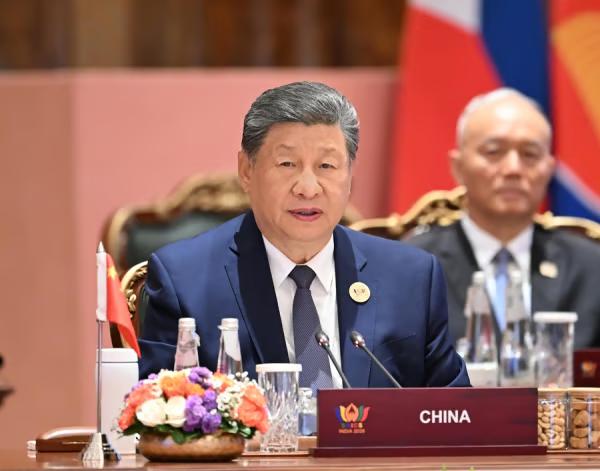


China is pitching open-source AI as part of a broader technology partnership with BRICS countries as Beijing competes with the U.S. for influence over how artificial intelligence is developed and deployed.
Speaking on Sept. 13 at the 18th BRICS Summit in New Delhi, President Xi Jinping proposed that China lead the creation of a BRICS AI open-source community focused on developing and applying large language models.
The plan would include AI seminars, training programs and an open ecosystem for members of the bloc, according to a statement from China’s Ministry of Foreign Affairs.
President Xi also proposed four other initiatives covering trade and investment, digital infrastructure, intelligent manufacturing and technology talent. China offered to help BRICS countries build smart factories, develop manufacturing standards and establish an engineer training alliance.
The proposal matters beyond model development. If it gains traction, China could deepen its influence over the infrastructure, standards, training, and technology ecosystems used by emerging economies building their own AI capabilities.
Beijing’s open-source bet
China is increasingly promoting open-source and openly available AI models as part of its technology outreach, giving countries another option beyond proprietary systems from companies such as OpenAI and Anthropic.
Beijing has also established the World AI Cooperation Organization, a group of nearly 30 countries that President Xi invited BRICS members to join. The broader effort comes as governments debate who should shape the rules governing advanced AI.
President Xi called for faster progress toward a global AI governance framework and said AI should be developed “for the positive and for good,” according to China’s Foreign Ministry.
But China’s position is more complicated than simply advocating unrestricted access. Bloomberg reported that President Xi has also stressed balancing AI development with security, while Chinese policy commentary has supported limiting access to the most powerful AI capabilities.
That creates an important distinction between expanding access to AI tools and providing unrestricted access to the most powerful systems.
More must-read AI coverage
- SS&C Intralinks DealCentre AI vs. Datasite: Which platform is built for the future of dealmaking?
- SS&C Intralinks FundCentre AI vs. Juniper Square: Which platform better supports modern private markets fund managers?
- Why Data, Not Models, Determines AI Success
- The Rise of the AI-Native Factory: How Physical AI Is Transforming Manufacturing
BRICS unity has limits
The proposal did not receive an explicit endorsement in the BRICS joint declaration issued on Sept. 13. Instead, the bloc called for international cooperation to improve access to AI resources while ensuring safety, security, inclusiveness and reliability, Bloomberg reported.
India also raised concerns about technology and critical minerals becoming tools of economic pressure. Prime Minister Narendra Modi said, “The weaponisation of technology and critical minerals can hinder our shared progress,” according to SCMP.
That concern exposes a practical limit to any AI sovereignty push. AI systems and smart factories still depend on advanced chips, manufacturing equipment, power infrastructure, batteries, and critical minerals.
China has significant influence over parts of those supply chains, while the U.S. and its allies retain leverage over access to some of the world’s most advanced semiconductors and chipmaking technologies. That means BRICS countries seeking greater technology independence may still find themselves navigating dependencies on both sides.
What China’s strategy could mean
China’s offer could appeal to countries that want access to capable AI without becoming completely dependent on either Beijing or Washington. Training, cloud infrastructure and open-source models could also lower barriers for countries trying to build domestic AI capabilities.
But turning that offer into a durable alternative will require more than access to models. BRICS members have different security priorities, economic interests, and relationships with both Washington and Beijing, while advanced AI still depends on global supply chains that no single bloc fully controls.
For technology buyers, the result may be less a clean split between Chinese and U.S. AI ecosystems than a more fragmented market in which governments and enterprises have to weigh cost, openness, performance, security, and geopolitical exposure at the same time.
More APAC news: Ant Group’s AQ health app has reached 150 million users as the Chinese company expands the platform beyond medical services into wearable tracking, nutrition, sleep, exercise, and AI-powered health coaching.