


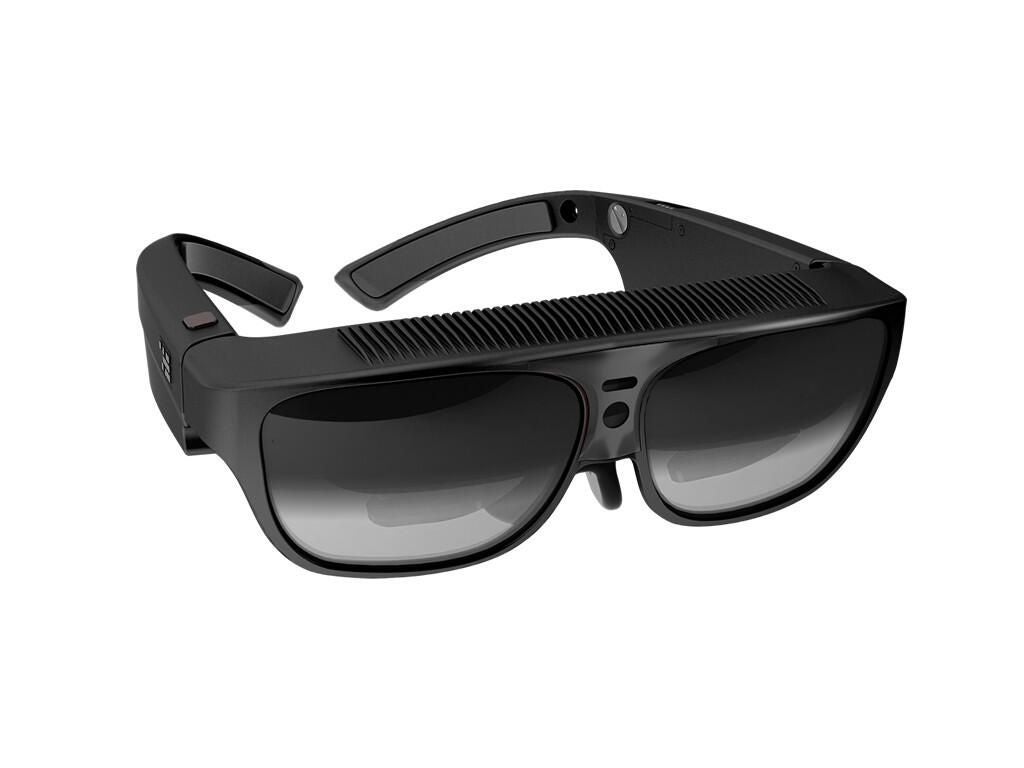
It’s probably not hard to think of a time when you could have used a heads-up display (HUD) to give you important info while working on a two-handed project. Those working in security, industrial environments, in transportation, and other jobs could all benefit from a standalone HUD headset, and San Francisco company ODG thinks it has the perfect solution: R-7 Smartglasses.
TechRepublic’s smart person’s guide about ODG’s R-7 Smartglasses is a quick introduction to this commercial augmented reality (AR) product. This resource will be updated periodically as changes are released.
SEE: All of TechRepublic’s smart person’s guides
Executive summary
- What are ODG R-7 Smartglasses? The R-7 is a stand-alone, Android-powered headset designed for a variety of commercial and industrial uses. These smartglasses are packed with sensors and can be customized to fit their particular role.
- Why do ODG R-7 Smartglasses matter? Unlike many consumer-facing products, R-7s are designed from the ground up for business use. ODG’s ReticleOS, which powers the R-7, features an SDK that allows businesses to customize the glasses for a variety of tasks.
- Who do ODG R-7 Smartglasses affect? ODG specifically lists transportation, healthcare, energy and utilities, logistics, and security as fields where the R-7 has applications, but its use doesn’t end there. Almost any business where AR is useful is affected by, and could benefit from, the R-7.
- When were ODG R-7 Smartglasses released? R-7 Smartglasses have been available since 2015. ODG recently added a hazardous locations variant to its lineup (currently in pre-order status), and are also planning for consumer releases later this year.
- How do I get ODG R-7 Smartglasses? R-7s can be ordered from ODG’s website or from a reseller.
SEE: Free ebook–Executive’s guide to the business value of VR and AR (TechRepublic)
What are ODG R-7 Smartglasses?
Unlike other wearables like Google Glass, R-7 Smartglasses weren’t constructed with consumers in mind. Instead, San Francisco-based ODG built them from the ground up for business users.
R-7s are stand-alone smartglasses that ODG describes as being more like “a high-end tablet on your head.” They don’t need to be connected to a PC to function; instead they’re powered by an ODG-built, Android-based OS called ReticleOS. The Android core is largely unrecognizable though–the UI is completely different from a traditional Android device. There are still apps though, but not very many.
The technology packed into the six-ounce glasses is impressive, and it should be given the price of $2,750. These are definitely not smartglasses made for the average home user.
Specs for ODG R-7 Smartglasses
From ODG’s website:
- Qualcomm Snapdragon 805 2.7GHz quad-core Processor 3GB Pop LP-DDR3 RAM
- 64 GB Storage
- Dual 720p 16:9 stereoscopic see-thru displays at up to 80fps
- ReticleOS Custom Framework on Android Marshmallow
- Bluetooth 4.1, 802.11ac, GNSS (GPS/GLONASS)
- Dual 650mAh Lithium-Ion Batteries
- Multiple Integrated Inertial Measuring Units with 3-axis accelerometer, 3-axis gyroscope, 3-axis magnetometer
- Autofocus Camera (1080p @ 60fps, 720p @ 120fps)
- Camera orientation available in Portrait or Landscape
- Magnetically Swappable Lenses
- Magnetic Stereo Ear Buds
For a more thorough rundown of the R-7’s tech specs check out its product sheet (PDF).
Additional resources
- ODG launches rugged smart glasses for heavy industry and ‘extreme environments’ (TechRepublic)
- Osterhout Design Group launches new smart glasses as company bridges consumer, industrial applications (ZDNet)
- Why ODG’s new smart glasses could drive AR adoption in the enterprise (TechRepublic)
- Video: CES 2017: ODG smartglasses bring more power and hi-res to augmented reality (TechRepublic)
Why do ODG R-7 Smartglasses matter?
ODG designed the R-7 with business and industry in mind. Yes, a consumer could use an R-7 for reading email, getting directions, and other basic tasks, but that’s not the purpose behind the product.
The real power of the R-7 lies in its SDK and third-party SDK compatibility, which businesses can use to develop custom tools. Given enough resources the R-7 could be an invaluable tool for a variety of different professions, from delivery drivers to doctors.
A pair of R-7 Smartglasses could be used to give a mechanic step-by-step video guidance with an exploded view of an engine, guide a delivery driver to a hard-to-find destination, or even highlight intricacies of the human body for a doctor.
In short, ODG’s R-7s have the potential to make a lot of professionals better at their jobs.
Additional resources
- Why 2017 could be a big year for AR and VR in business (TechRepublic)
- Are smart glasses about to make a comeback? (ZDNet)
- AR to be key to business, as VR lands with consumers, says IDC (ZDNet)
- Research: Virtual and augmented reality in the enterprise (Tech Pro Research)
- Virtual and augmented reality policy (Tech Pro Research)
- The Complete Game Design & Developer Bundle (TechRepublic Academy)
Who do ODG R-7 Smartglasses affect?
The R-7 Tech Sheet specifically mentions transportation, healthcare, energy and utilities, logistics, and security as industries that are affected by the smartglasses, but those particular fields are hardly an exhaustive list of who the R-7 affects.
SEE: All of CNET’s coverage about augmented reality (CNET)
What makes the R-7 useful to a variety of businesses is its ability to provide industry-specific AR features, as well as being able to perform basic tasks a user would normally do on a smartphone or tablet.
Any job that requires using both hands while still needing access to technology could be affected by the R-7. Controlling the headset can be done with a touch-sensitive button on the right temple, allowing for relatively easy interaction with minimal interruptions to work.
Additional resources
- 7 ways AR and VR are changing the healthcare world (TechRepublic)
- VR and AR: The Business Reality (ZDNet/TechRepublic special feature)
- Microsoft’s new AI app to assist the blind could be a ‘game changer’ in accessibility (TechRepublic)
- Virtual reality and augmented reality in the workplace: A primer for CIOs (TechRepublic)
When were ODG R-7 Smartglasses released?
ODG R-7 Smartglasses have been available since 2015. The new hazardous locations version of the R-7, the R-7HL, will be shipping later in 2017.
There are also two consumer models of ODG Smartglasses, the R-8 and R-9, both of which are supposed to ship in 2017. The R-9 is a higher-end model that will be priced around $1,800.
ODG’s website says the R-9 should start shipping in Q2 2017, but the ODG online store still doesn’t feature them for purchase or pre-order.
The R-8 is supposed to be less than $1,000 when it goes on sale in the latter half of 2017, but that’s about all we know. There’s no spec sheet, or other information aside from that.
Additional resources
- Osterhout Design Group raises $58 million to boost its smartglasses lineup (ZDNet)
- Photos: ODG’s Qualcomm-powered glasses tout AR, VR (CNET)
- Heavy metal can’t break these glasses (CNET)
- CIO Jury: 83% of CIOs allow wearables at work (TechRepublic)
- The dark side of wearables: How they’re secretly jeopardizing your security and privacy (TechRepublic)
Competitive products
At first glance (especially physically) the R-7 looks like a competitor for the Microsoft HoloLens. It actually fills a very different role, making its direct competitor Google’s enterprise-focused Glass.
The HoloLens, on the other hand, is more geared toward projecting 3D holographic images instead of just being a HUD unit, which is the primary purpose of the R-7.
That means ODG could be going head-to-head with Google for the enterprise-focused smartglasses market, and that could be a tough battle.
Additional resources
- How Apple leapt ahead of Google, Facebook, and Microsoft on AR (CNET)
- Mira Prism aims to turn the iPhone into a mini-HoloLens for $99 (CNET)
- Could Microsoft’s new hologram glasses replace traditional eyeglasses? (TechRepublic)
- Lenovo enters smart glasses fray, targets business, augmented reality, June availability (ZDNet)
- AirWatch Connect: VMware announces unified solution for smart glass management in the enterprise (TechRepublic)
- For the blind, Google Glass offers a clear path ahead (CNET)
How can I get ODG R-7 Smartglasses?
R-7 Smartglasses can be purchased directly from ODG’s online store. ODG does state that there are some restrictions based on location, though, and in those cases you can contact one of its resellers.
Additional resources
- Cisco Live 2017: Chuck Robbins and Tim Cook discuss iOS 11 security, AR, mobile devices, and cat videos (TechRepublic)
- Enterprise wearables predicted to top $55 billion by 2022, driven by advances in data security (TechRepublic)
- RealWear’s HMT-1: A hands-free, head-mounted tablet for connected industrial use (TechRepublic)
- Gallery: 10 augmented reality apps that are actually worth it (TechRepublic)
- Video: The future of virtual reality and augmented reality in the enterprise (TechRepublic)
- Best Wearable Tech of 2017 (CNET)