


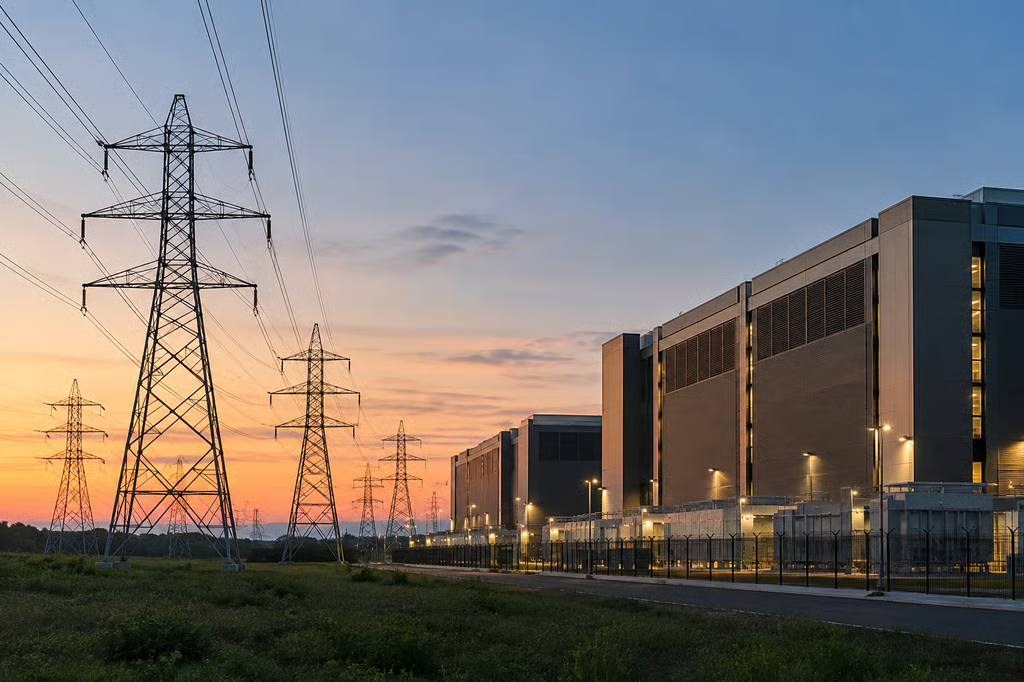
Data centers used to need protection from grid disturbances. They still do. However, the scale of the latest AI data centers has reversed the equation. Now the grid needs to be safeguarded from problems caused by AI data centers.
A downed power line that generated a brief voltage disturbance near Washington, D.C. caused 3.8 GW of data centers to revert to on‑site backup power within seconds. This represented about 3% of demand and caused lights to flicker as far away as Chicago.
The system operator (PJM Interconnect) scrambled and restored stability within about ten minutes. Similar events occurred in 2024 and 2005 in Virginia after scores of data centers tripped off the grid and reverted to backup generation.
That’s just one way data centers can suddenly cause grid destabilization. Large AI factories suffer from massive swings in power use. They can surge up and down – sometimes from 1 GW to almost nothing and back again several times a second in extreme cases.
If not properly managed, rapid changes in demand can contribute to voltage or frequency disturbances, potentially affecting grid reliability and sensitive equipment.
The standard solution for changes in grid demand is to add or subtract generation sources. Gas turbines and gas engines are generally used for this purpose. They can come online in anywhere from five minutes to half an hour. That’s good enough for traditional grid traffic but not for AI data centers.
“Frequency oscillations from AI data centers pose serious reliability challenges to the grid,” said Sai Somayajula, Principal Electrical Design Engineer at Nvidia at the Data Center World Power (DCWP) show in September of 2026.
Grid Authorities Take Action
Due to voltage drops, frequency oscillations, and other problems, grid authorities are proposing or enacting standards and adopting technologies to enable more control of AI data center demand. Texas Senate Bill 6 requires data centers to pay for new grid infrastructure to support their operations.
There are also rules within the state related to voltage and frequency ride-through—the ability of data centers to continue operating during minor grid disruptions instead of automatically tripping offline. At a federal level, the North American Electric Reliability Corporation (NERC) is adding similar rules for large AI data centers that should be ratified by the end of 2026.
The PJM Interconnect, which oversees Virginia and other data center-rich areas of the Northeast, is another grid authority proposing new rules. Its latest proposal is for large data centers to be able to ride through transmission faults. Regard these as the first wave of requirements as the 20th-century grid catches up with the modern world.
Responsive Developers
Data center developers are largely showing willingness to comply with grid authorities and implement solutions that make facilities become better grid citizens. The vendor community, too, is responding.
Nvidia, for example, has introduced power smoothing features that operate at the rack level using a combination of storage of AI traffic and built in intelligence to even out AI workloads. The Nvidia DSX architecture includes high-speed telemetry with advanced analysis to detect and mitigate electrical oscillations.
There is also a wealth of power electronics systems being released to buffer the grid from AI data center transient. Miami-based company ON.energy has released AI UPS. It consists of bidirectional advanced power electronics and batteries to protect both the data center and the grid.
Rajesh Gopanath, Core Infrastructure Engineering Architect at Oracle Cloud, explained some of the dangers of AI data center workload fluctuations.
“Subsynchronous oscillations which are basically frequencies less than the 60 hertz frequency where the U.S. grid operates, can lead to catastrophic failures,” he said at DCWP. “The solution is the right combination of capacitors, batteries, uninterruptible power supply (UPS), low voltage ride through, power smoothing, and fast-responding generation.”
Presidential Mandate
One of the most recent developments is presidential involvement. President Trump took to Truth Social to announce that, “Data Centers are mandated by me to make their own electricity and give or sell any excess back to the local community.”
He added that unpopular data centers reversed their fortunes by following this advice and finding ways to deliver cheaper energy to the local community. That announcement will add momentum to NERC, PJM, ERCOT, and other authorities seeking to gain greater control of how data centers can behave on the grid.
It should bring more data center developers and hyperscalers to the table to figure out the best way forward.
“Data centers are going to play a larger role in grid reliability,” said David Roop, head of Mitsubishi Electric Power Products (MEPI) at DCWP. “They need to better understand utility requirements and follow any new guidelines, standards, and compliance criteria being introduced to instability much faster.”
As AI campuses expand, grid compatibility could become as important to project planning as computing capacity, cooling, and power availability.
In other news: Growing opposition to AI data centers is forcing developers to rethink how they engage with local communities.