


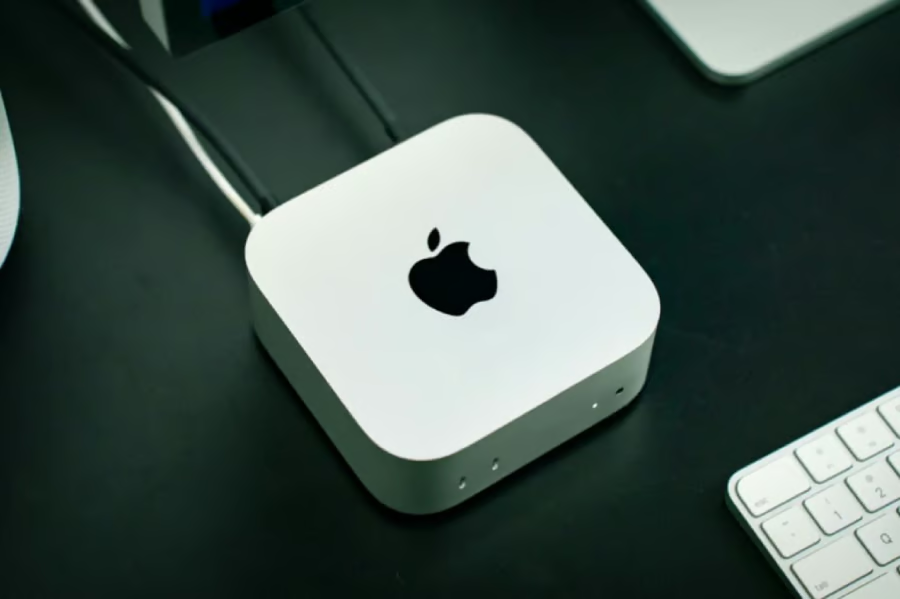
Apple says customers may struggle to get their hands on the Mac mini and Mac Studio for months, as demand driven by artificial intelligence workloads outpaces supply.
Speaking during the company’s latest earnings call, CEO Tim Cook acknowledged that shortages affecting both machines are unlikely to ease quickly. “We think, looking forward, that the Mac mini and Mac Studio may take several months to reach supply-demand balance,” Cook said during the call.
“Both of these [mini and Studio] are amazing platforms for AI and agentic tools, and the customer recognition of that is happening faster than what we had predicted, and so we saw higher than expected demand,” Cook added.
The surge is tied to growing interest in running AI systems locally on personal machines rather than relying on cloud services. Tools like OpenClaw have pushed developers and small teams toward compact but powerful desktops like the Mac mini.
Apple’s desktop systems have become particularly attractive for AI workloads due to their unified memory architecture. Unlike traditional PCs that separate CPU and GPU memory, Apple Silicon allows all components to share a single pool of high-bandwidth memory.
This design enables users to run larger AI models more efficiently on a single machine, something that would otherwise require multiple high-end GPUs in conventional setups. As a result, even the entry-level Mac mini has seen overwhelming demand, with some reports noting it went completely out of stock shortly after release.
Industry-wide constraints add pressure
The shortages are not solely demand-driven. Apple is also facing broader supply chain challenges affecting the semiconductor industry.
Cook pointed to constraints around advanced chip manufacturing and memory components, explaining that production capacity has struggled to keep pace. He noted that the limited availability of advanced manufacturing nodes is a key bottleneck.
At the same time, global demand for memory, fueled by AI infrastructure, has pushed costs higher. Apple confirmed it is already paying more for memory and expects prices to continue rising in the coming quarters.
Must-read Apple coverage
- Nearly 7 in 10 iPhone Owners Plan iPhone 17 Upgrade
- Apple Prepares AI-Powered Siri Upgrade With Google Search Integration
- Apple’s Xcode 26 Beta Now Supports GPT-5 and Claude
- Apple’s Vision Pro Adoption Stalled As Content Released ‘Drip by Drip’
Strong financial performance despite constraints
Despite the supply issues, Apple reported a strong financial quarter. The company posted $111.2 billion in revenue, driven largely by iPhone sales and continued growth in its services division. Demand for Macs overall also remained solid, even as shortages limited availability of key desktop models.
Apple expects it will take several months to stabilize supply and meet demand for the Mac mini and Mac Studio. However, ongoing pressure on chip manufacturing and memory supply could prolong the imbalance.
In other Apple news: Check out this breakdown of a new leak suggesting future iPhones may drop MagSafe entirely… and what that could mean for charging, design, and the broader accessory ecosystem.