


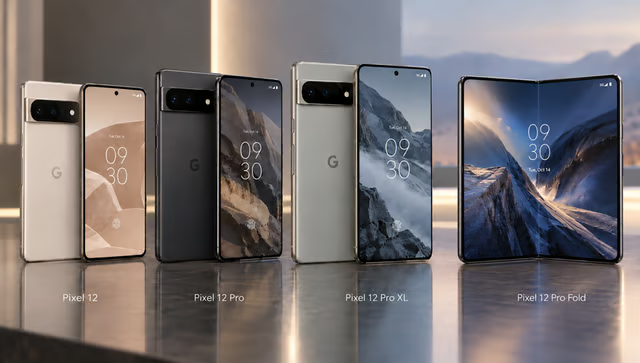
Google’s next Pixel lineup is starting to take shape well ahead of its expected 2027 debut.
Four devices reportedly appearing in GSMA IMEI records point to a standard Pixel 12, two Pro models, and a foldable. Separate display reporting also suggests Google is testing changes to the Pixel 12 Pro Fold’s inner screen.
The most notable upgrade may be aimed at one of foldable phones’ most persistent problems: the crease running through the center of the display.
Industry records fill in the lineup
Reported entries in GSMA IMEI records cover the Pixel 12 lineup from the standard phone through the Fold.
| Model | Model number | Reported display resolution |
| Pixel 12 | GC0QU | 1080 x 2400 |
| Pixel 12 Pro | GWU59 | 1280 x 2824 |
| Pixel 12 Pro XL | G7U1Y | 1344 x 2952 |
| Pixel 12 Pro Fold | G4D5D | 2296 x 2404 inner display |
The listings point to four devices spanning the standard Pixel 12 through the Pro Fold, although database appearances do not guarantee that every model will reach retail under those names.
Physical display dimensions have not surfaced, so resolution alone does not reveal how large the three conventional models will be. The Pixel 12 Pro Fold is listed with a 2296-by-2404 inner display.
Separate prototype work also suggests Google is experimenting with changes to the folding screen’s support structure.
Fold prototypes target the center crease
The Elec reports that Samsung Display is producing prototype OLED panels to the Pixel maker’s specifications with ultra-thin glass above and below the flexible screen. A lower glass layer supports the OLED from underneath and spreads folding stress around the hinge.
Reducing deformation through the center could make the crease less noticeable after repeated opening and closing. Performance and durability are part of the evaluation, along with whether the panel can be mass-produced at the required thickness.
More Google coverage
- New Google Search AI Mode is ‘Total Reimagining,’ Says CEO Sundar Pichai
- In Major Ruling, Judge Finds Google ‘Willfully Acquired and Maintained Monopoly Power’ Over Digital Ad Market
- Google’s Big Bet on Nuclear Energy: ‘The Race to Power AI-Driven Data Centers is Accelerating’
- Computer History Museum Releases Original AlexNet Code: Why It Matters
Pixel 12 Pro Fold could enter a tougher foldable race
If the dual-glass screen reaches retail hardware, Pixel 12 Pro Fold would join a premium foldable market where rivals are tackling the same crease problem in different ways.
Apple’s iPhone Duo uses a similar two-layer glass structure, paired with a nano-texture finish and hinge support. Its multilayer inner display also distributes stress across the panel. Samsung’s Galaxy Z Fold8 takes a different route with titanium reinforcement beneath the OLED.
Buyers would have more to compare than resolution alone. Folded thickness and weight affect how comfortable a device is to carry, and long-term screen durability becomes important once a phone is opened and closed throughout the day. Battery life and camera performance would also influence how the Pixel stacks up against established rivals.
Price will set expectations quickly. Pixel 11 Pro Fold and Galaxy Z Fold8 currently start around $1,900, and iPhone Duo begins at $1,999. A Pixel 12 Pro Fold near that range would need its screen changes to translate into a better ownership experience without compromising other parts of the phone.
Google has not confirmed the Pixel 12 lineup, display specifications, foldable design, or release timing.
The next useful signals will likely come from additional regulatory listings, supplier reports, and prototype leaks as Google moves closer to finalizing its 2027 hardware.
More on mobile phones: Certain AT&T iPhone 18 Pro Max models are facing a service issue serious enough that Apple says replacement is necessary.