


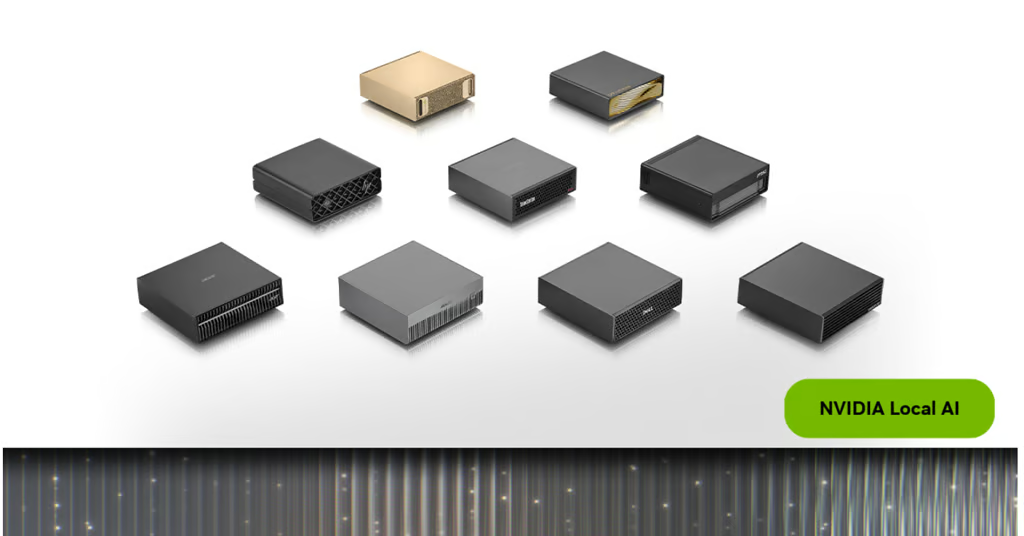
Nvidia’s new 64GB DGX Spark arrives Oct. 23, starting at $4,999. The smaller-memory configuration gives developers and IT teams another way to run AI models locally without buying the original 128GB system.
The new model keeps the same GB10 Grace Blackwell Superchip and Nvidia software platform. The trade-off is memory: buyers get half the capacity, which can limit model size, context length, and the number of AI workloads running at once.
Nvidia DGX Spark 64GB price and availability
According to Nvidia’s Oct. 2 announcement, the 64GB configuration is available from six manufacturing partners:
- Acer
- ASUS
- Dell
- Gigabyte
- HP
- MSI
Nvidia lists a $4,999 starting price, but buyers should confirm the exact configuration and regional pricing with their chosen manufacturer.
The company has not published one universal specification sheet covering storage, ports, and warranty terms across all six partner systems.
The 64GB model retains DGX OS and Nvidia’s AI software ecosystem, with support for tools including Ollama, vLLM, PyTorch with CUDA, Nemotron models, and the Nvidia Agent Toolkit.
That software support gives developers a starting point for local inference, coding agents, and model experimentation. It does not guarantee that every model will fit comfortably in memory or run at an acceptable speed.
DGX Spark 64GB vs 128GB: What’s different?
The biggest confirmed difference is unified memory capacity.
| Specification | DGX Spark 64GB | DGX Spark 128GB |
|---|---|---|
| Unified memory | 64GB | 128GB |
| Starting price | $4,999 | Varies by system and seller |
| Processor | GB10 Grace Blackwell | GB10 Grace Blackwell |
| Operating system | DGX OS | DGX OS |
| Networking | ConnectX-7 | ConnectX-7 |
| Claimed model support | Up to 100B parameters | Up to 200B parameters |
| Main advantage | Lower entry price | More memory for larger workloads |
Nvidia says the 64GB model supports AI models with up to 100 billion parameters. The original 128GB DGX Spark was advertised as supporting models with up to 200 billion parameters, as covered in TechRepublic’s original DGX Spark launch.
Those parameter counts are vendor-stated capabilities, not guarantees that every model of that size will perform well. Quantization, context length, runtime overhead, and concurrent workloads all affect memory requirements.
The larger configuration is better suited to memory-intensive work, including larger models, longer contexts, and certain fine-tuning tasks.
The 64GB version makes more sense when the models a team actually uses fit within the smaller memory pool.
How we compared the two configurations
This comparison uses Nvidia’s published specifications, announced starting prices, and documented software capabilities.
The new 64GB configuration has not been independently benchmarked for this article. We therefore distinguish Nvidia’s performance claims from measured results and do not assume that identical processors guarantee identical performance across different memory capacities.
Actual buyer costs may also differ from published starting prices because of manufacturer configurations, storage options, regional pricing, and accessories.
Can two 64GB DGX Sparks replace one 128GB system?
Nvidia says two 64GB systems can connect directly through their built-in ConnectX-7 networking ports using a QSFP cable.
Its Sync Cluster Assistant helps detect the connected systems, check their configurations, and set up the network.
Together, the two systems provide 128GB of aggregate unified memory. Nvidia says the configuration can support models with up to 200 billion parameters.
In the company’s Qwen 3.8 27B test, two clustered 64GB systems delivered up to 1.7 times the performance of a single unit.
That result applies to Nvidia’s reported test. It does not establish a universal 70% performance improvement across AI workloads.
There’s also an important cost comparison: two $4,999 systems cost at least $9,998 before additional cables, accessories, or other expenses.
A pair of systems is not identical to one computer with 128GB of unified memory. Distributed workloads require compatible software and communication between machines, which can introduce overhead.
Nvidia’s PAIR workload-sharing tool offers a different approach. PAIR distributes independent AI jobs across available computers rather than combining memory to run one larger model.
Nvidia also announced Oct. 21 that DGX Spark supports manually configured clusters of up to eight systems. Its GTC Berlin update describes a maximum of 1TB of unified memory across eight 128GB units.
That larger configuration should not be confused with the simpler two-unit Sync Cluster Assistant workflow.
What IT buyers should check before ordering
A lower entry price is useful only if the system can handle the intended workloads.
Before choosing between the 64GB and 128GB versions, IT teams should verify:
- Model memory requirements: Check the actual model format, quantization, context window, and runtime overhead rather than relying only on parameter counts.
- Performance: Test representative prompts, response times, and concurrent requests before committing to a larger rollout.
- Storage and connectivity: Confirm the selected manufacturer’s SSD capacity, available ports, and supported networking accessories.
- Software compatibility: Verify required AI frameworks, libraries, and management tools against DGX OS.
- Total cost: Compare the price of one larger system with a two-unit cluster, including networking, power, support, and administration.
Nvidia says its upcoming Sync Model Launcher will simplify downloading and running models on a single DGX Spark or a cluster. As of Oct. 23, the company describes that feature as arriving later this month, not as a capability already available to every buyer.
The 64GB DGX Spark gives developers a lower-memory entry into Nvidia’s local AI platform, but its $4,999 price still demands a workload-specific purchasing decision.
Teams running smaller models may find 64GB sufficient. Those planning larger models, longer context windows, or memory-intensive development should compare the 128GB option before buying two smaller machines.
Also read: Nvidia RTX Spark laptops offer another approach to local AI, bringing compatible models and agents to Windows systems starting at $2,599.