


- What is lead scoring?
- Benefits of lead scoring
- Different lead scoring models
- What metrics to look at for lead scoring
- How to instill a lead scoring system for your business
- Lead scoring best practices
- Common challenges in lead scoring & how to overcome them
- Popular tools used for lead scoring
- Frequently asked questions (FAQs)
What is lead scoring?
Lead scoring is a methodology that assigns numerical scores to individual leads to enable sales and marketing teams to prioritize them based on their likelihood of conversion. Some of its key components include a lead’s demographic data, online behavior, frequency of engagement, and buying stage indicators. The goal is to identify high-value leads and dedicate more effort to conducting personalized follow-ups to drive more conversions.
What is a lead score?
A lead score is a numerical value representing the likelihood of a potential customer converting into a paying customer. I typically see lead scores ranging from 0 to 100 and classified as cold, warm, or hot. The score is calculated by assigning points to key components, such as demographic data and engagement, and adding the total points. The higher the score, the more likely the lead is to make a purchase.
Benefits of lead scoring
Lead scoring helps businesses focus their efforts on leads with the highest potential. As a result of doing that, your business can enjoy more efficient sales processes, higher ROI, and other benefits.
Efficient sales process
By scoring your leads, you can easily identify and hone in on the high-quality ones who are most likely to buy from your business. That means your sales reps won’t have to waste their time and energy on prospects who are not ready to make a purchase.
Higher marketing ROI
Marketing teams can use lead scores to measure the effectiveness of their campaigns. It can also help them focus on leads requiring nurturing and the most effective outreach channels. Plus, you can figure out where you can invest your future marketing budget and implement improvements based on these scores.
Better sales and marketing alignment
Lead scoring provides sales and marketing teams with a common framework that they can use to understand their leads and identify prospects that they need to focus on. That said, both teams can work towards the same goal and collaborate on improving their strategies for customer communication.
Improved conversion rates
Sales and marketing teams can focus on high-priority prospects with the highest lead scores. This prevents them from missing opportunities by encouraging high-value leads to convert.
For example, say you have a lead who’s ready to speak to a sales rep to inquire about your products. At the same time, your marketing automation tools can send them relevant content to help convince them to buy the product they’re interested in.
Accurate revenue forecasts
By tracking lead scores, businesses can easily see how likely a lead is to make a purchase. You can use this information to predict future revenue. Accurate forecasts help businesses plan their sales resources well and be better equipped to meet projected demand.
Different lead scoring models
Here are some examples of lead scoring models that you can develop and use to rank your potential customers.
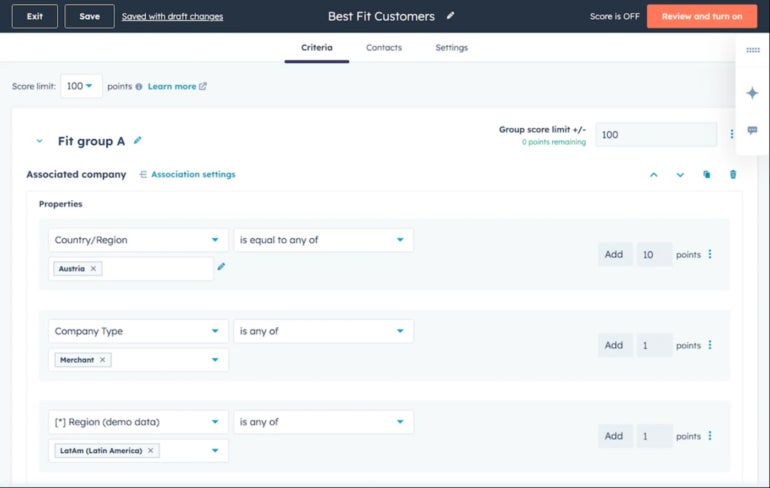
Demographic or firmographic model
You can create a lead scoring model for your ideal customers based on specific demographic or company data, such as age, location, industry, and company size. To do that, ensure your landing page forms include questions that gather demographic and firmographic data to exclude outliers. You can also deduct points from leads that don’t have the characteristics you are looking for.
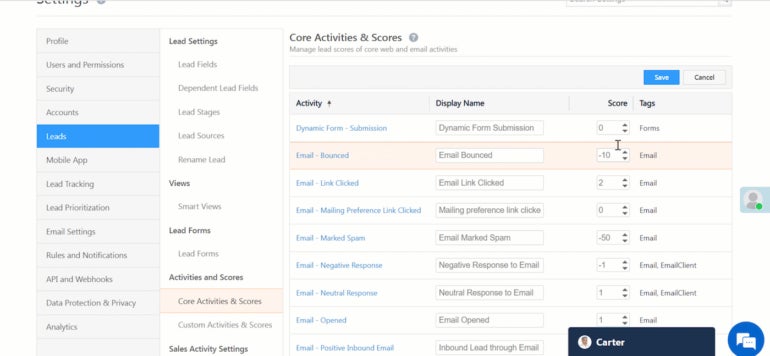
Engagement model
This model measures your lead’s level of interest in your product or service based on their email or social media engagement with your brand. This requires tracking email open rates, click-through rates, social media interactions, and engagement frequency. You can also track granular details and assign higher scores for those who open a demo or promo email.
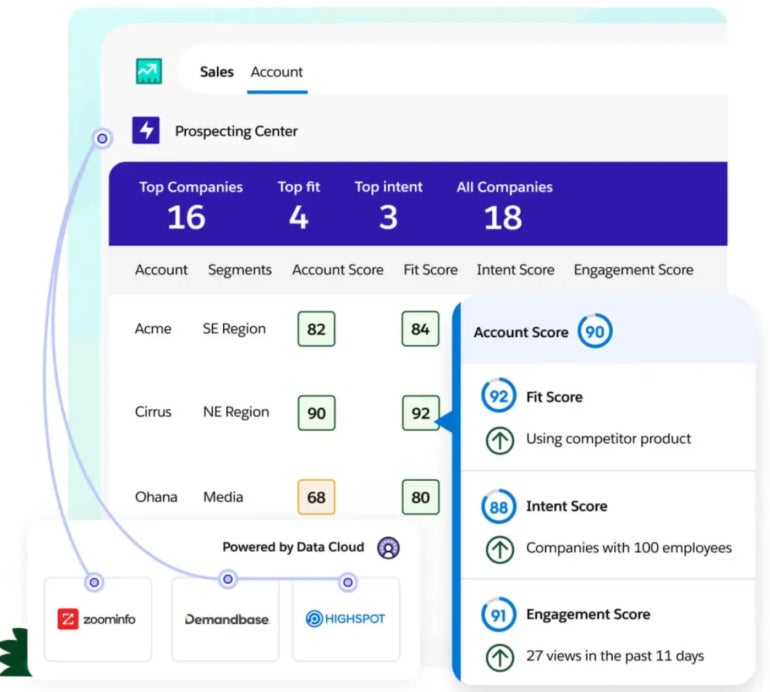
Online behavior model
Another good way to determine purchase readiness is to score leads based on their behavior on your business website. This requires a lead tracking system, like Salesforce, to automatically calculate lead ranks and update the scores based on values assigned to different actions. I suggest including filling in a contact form, visiting your pricing page, watching a demo video, and downloading materials in your list of actions.
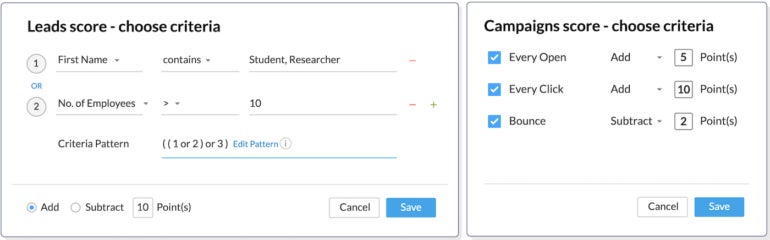
Negative scoring attributes
Some leads express little interest in your brand, browse your website simply for academic reasons, or are not interested in purchasing. I suggest excluding these leads or adjusting their rank to move them down your priority list. Leads that you can assign negative scores to include those who unsubscribe from your email list, submit spam, work for a competitor, and type in “student” in the job title field.
What metrics to look at for lead scoring
Tracking key performance indicators (KPIs) helps you measure the effectiveness of your lead scoring system. The top metrics may vary from one company to another, but they generally include
- Lead engagement: Includes email opens, email clicks, and social media interactions.
- Conversion rate: The percentage of leads that convert into customers.
- Cost per lead: The cost of acquiring each lead.
- Customer acquisition cost (CAC): The total cost of identifying and converting leads.
- ROI per lead: The revenue generated from scored leads.
- Sales cycle time: How much time it takes to convert a lead.
- MQL to SQL ratio: Monitors the ratio of marketing-qualified leads (MQL) versus sales-qualified leads (SQL) to gauge alignment between the two teams.
How to instill a lead scoring system for your business
Follow these steps to build a data-backed lead scoring system for your business.
1. Establish your minimum lead qualifications.
Consider the minimum criteria a lead must meet to turn into a customer and the factors that can exclude leads from your scoring system. For example, you will only accept leads above 18 years old who live in a specific region. This way, your sales team won’t waste time pursuing leads that have no chance of converting.
2. Identify the core qualities of your typical customers.
List the core attributes that your typical customer base possesses but are not necessarily required to be qualified as customers. These attributes could include company size, industry, and annual revenue. If your leads also possess these core qualities, they are likely a good fit for your business.
3. Define the qualities of your ideal lead.
Think about the traits your perfect customer should have to get the highest score on your lead scoring system. Zero in on the qualities that set them apart from other leads. These could include the likelihood of purchasing within a short period of time, being a decision-maker, and having a specific budget size.
4. Determine the lead behaviors that you will track.
List all the possible behaviors worth tracking to hone in on those who are most interested in your brand. These behaviors could include opening your emails, sharing your social content, filling in a contact form, downloading content assets, scheduling a product demo, and attending a webinar. Then, assign a value to each of these behaviors.
5. Categorize your leads.
Lead actions vary depending on their level of interest in your brand and their sales-readiness. This is why you have to divide them into categories so that you can take the appropriate steps and tailor engagement based on where they are in their customer journey. There are four major business-to-business (B2B) lead categories: prospect, lead, MQL, and SQL.
- Prospect: Accesses or downloads your company’s free resources.
- Lead: Fills out your lead capture form and engages with your marketing content.
- MQL: Engages further with your brand by sharing their contact information or participating in events and starting free trials.
- SQLs: Demonstrate sales readiness by inquiring about your pricing or requesting detailed demos.
6. Build a custom lead scoring model.
Using a custom lead scoring model for qualifying leads is important because leads have varying preferences and needs as they move through the sales funnel. Determine your point scale (usually 0 to 100) and distribute the points across your lead categories. In my example, I assigned the lowest point value to the prospect category.
- Prospects: <10 points
- Leads: 11-40 points
- MQLs: 41-70 points
- SQLs: 71-100 points
7. Review and refine your lead scoring system.
Review your lead scoring system to ensure it aligns with the key traits you’ve identified for your ideal customer profile. Evaluate the performance of your scoring model every 30 days and refine it as you see fit. Find out if there are low-scoring leads that converted and high-scoring leads that did not. Adjust your point distribution criteria to correct these flaws.
Lead scoring best practices
The following best practices can help you make the most of your lead scoring process.
Define clear criteria for lead qualification
Establish clear criteria for qualifying leads. These criteria include demographic and behavioral data. For example, I would give higher scores to leads from tech companies with more than 500 employees and those who visited my company’s pricing page.
Use data-driven insights
Analyze historical data to spot patterns in top-scoring leads and prioritize behaviors that lead to conversion. If past data shows that leads who sign up for a demo are twice as likely to convert, then you should assign a higher score to that action.
Incorporate negative scoring
Deduct points for behaviors that indicate low interest to weed out leads that are a poor fit. In the past, I’ve deducted points for unsubscribing to emails, submitting invalid contact information, or those who put “intern” or “student” in a job title field.
Prioritize key engagement metrics
Give a higher score to high-intent actions and engagement than casual website browsing. I consider attending a product webinar to indicate stronger buying intent than visiting a career page.
Segment leads by profile and behavior
Different customer profiles may require different scoring models. For instance, scoring methods differ between a B2B SaaS enterprise and a small business since they have different customer journeys.
Promote sales and marketing alignment
Ensure that your sales and marketing teams agree on your scoring criteria and when a lead is sales-ready. For example, the marketing team classifies a lead as qualified at 60 points, while the sales team expects 80 points. In this situation, I have to align their expectations to prevent lost opportunities.
Leverage automation tools
Use CRM systems like HubSpot, Salesforce, or Pipedrive to automate lead scoring, reduce manual effort, and ensure consistency. These tools allow you to assign pre-defined points to lead actions and automatically compute, rank, and assign leads. For instance, when a lead submits a contact form, the CRM automatically adds 20 points to that lead.
Regularly review, test, and refine the lead scoring model
Adjust your scoring models based on evolving market trends, customer behavior, and sales processes. If a new product feature drives interest, I would add relevant engagement actions to the scoring model.
It’s also important to incorporate a feedback loop among sales teams to gain valuable insights on lead quality and how to refine your rules. You can also run A/B tests to evaluate your scoring models and identify which version best predicts conversions.
Common challenges in lead scoring & how to overcome them
A one-size-fits-all approach will not help you connect with the right customers for your business. You will always encounter challenges that get in your way. Here are the common challenges in lead scoring and the solutions you can implement to overcome them.
Data quality and quantity issues
One of the top challenges in lead scoring is maintaining enough accurate data to build and refine your lead scoring model. Using incomplete or outdated data can lead to ineffective and inaccurate lead scoring.
To overcome this challenge, collect data from multiple sources, including your CRM, social media, email marketing, and web analytics platforms. In addition, you need to regularly clean, validate, segment, and deduplicate your data.
Imbalanced scoring criteria & weight
Another challenge in lead scoring is building a scoring system with balanced criteria and weight. There should also be a balance between demographic (prospect attributes) and behavioral (prospect actions) factors, as well as implicit (intent) and explicit (direct responses) signals.
You can overcome this challenge by reviewing your scoring criteria and aligning them with your business goals, customer journey, and buyer personas.
Unclear lead qualification and handoff thresholds
Sometimes, there is a mismatch in lead qualification and sales-readiness thresholds perceived by your sales and marketing teams. In my experience, you can address this by clearly defining the threshold and rules for when leads become MQLs and SQLs. You can also create a service level agreement (SLA) outlining your sales team’s expectations, responsibilities, and lead qualification and handoff processes.
Low customer retention
Maintaining and increasing your lead’s engagement throughout the buyer’s journey can be difficult. Customers sometimes lose interest and switch to a competitor. You can sustain their interest and drive loyalty by providing personalized, relevant, and valuable content and offers. Also, tailor your interactions and lead nurturing strategy according to their needs, preferences, and stages in the buyer’s journey.
Wrong lead scoring tools and integrations
Choosing the right tools for lead scoring and automation is one key to a solid lead scoring process. To overcome this challenge, find a platform that can collect, store, analyze, and score leads from various sources.
This solution should also integrate with your sales and marketing tech stack. Research and compare lead scoring tools to find the one that fits your feature and pricing needs. Then, test and evaluate their performance alongside your existing workflows and systems.
Best CRM Software
- Best CRM Software
- Best CRM Software for Startups
- Best CRM For Small Business
- Best Free CRM Software
- Best Enterprise CRM Systems
- Best Open Source CRM Software
- Best White Label CRM Software
Popular tools used for lead scoring
The top lead scoring platforms have custom lead scoring, capture, and reporting capabilities. More advanced systems offer lead tracking, routing, and prediction tools.
 HubSpot CRM | |||||
 Salesflare | |||||
 | |||||
 LeadSquared | |||||
 Salesforce Sales Cloud |
*Billed annually.
SEE: 7 Best Lead Generation Companies
Frequently asked questions (FAQs)
What is the difference between lead scoring & lead qualification?
Lead scoring is assigning numerical scores to leads to rank and prioritize them based on their likelihood of conversion. Lead qualification, on the other hand, is determining whether a lead is a good fit for a business based on pre-set criteria like interest and finances.
What is the difference between lead scoring and account scoring?
Lead scoring assigns scores to individual leads based on their likelihood to engage and convert. Account scoring focuses on assigning numerical scores to target accounts to determine their overall potential in account-based marketing (ABM) models.
What is the range of lead scores?
Lead scores typically range from 1 to 100. However, you can also go beyond 100, depending on your lead scoring model and the combined tally of points for each scoring rule.
Why is lead scoring important?
Lead scoring is important because it enables sales and marketing teams to identify high-quality leads. As a result, they can prioritize follow-up efforts and allocate their resources and time more efficiently.
What to do if you just have one lead score?
The best thing to do if you have only one qualified lead based on your scores is to prioritize contact with that lead since they are your only potential customer. At the same time, work to generate new leads to build a steady stream of potential customers is also important.
How to evaluate a lead score?
To evaluate a lead score, examine several factors and metrics, including lead quality, conversion rates, attribution, and velocity. Determine if your lead scoring model aligns with your sales and marketing goals.