


The price gap has all but disappeared.
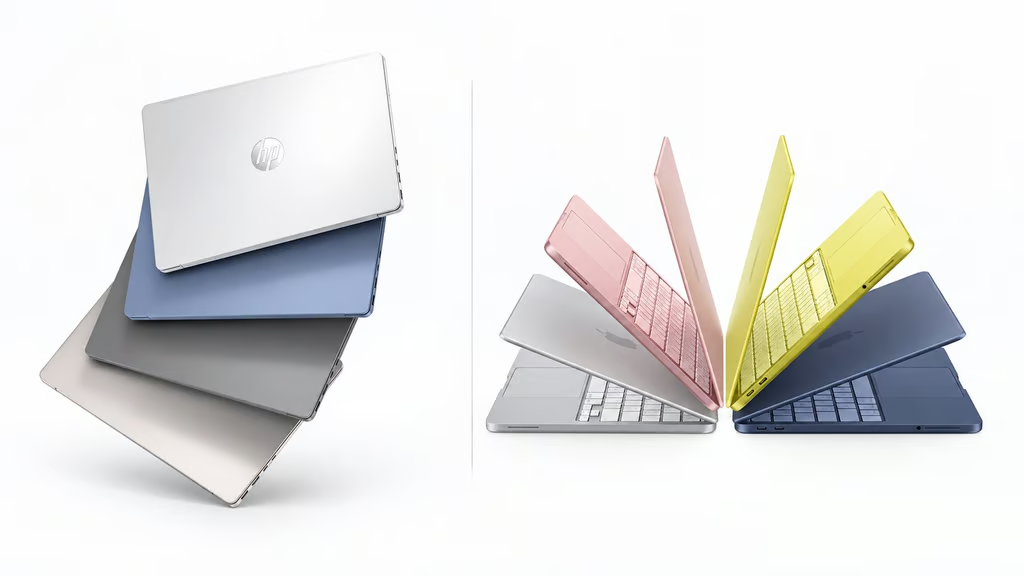
HP announced its new 14-inch OmniBook 5 AI PC on Oct. 1 with a $699.99 starting price, putting it almost dollar-for-dollar against the MacBook Neo, which Apple currently lists from $699 in the US. For work buyers, the bigger differences are operating system, memory, ports, display options, and external-monitor support.
HP’s Oct. 1 launch announcement sets the $699.99 starting price and October availability, while Apple’s current US Mac store confirms the Neo’s $699 starting price. Both sit in a sub-$800 laptop market where similarly priced models can differ sharply in memory, storage, and connectivity.
| HP OmniBook 5 14 | MacBook Neo | |
|---|---|---|
| U.S. starting price | From $699.99, October | $699 current |
| Processor | Intel Core 5 320 or Core 7 350 | Apple A18 Pro |
| Memory | 16GB or 32GB options | 8GB unified memory |
| Storage | 256GB to 1TB | 256GB or 512GB |
| Display | 14-inch OLED; 2K or optional 3K | 13-inch IPS, 2408 x 1506, 500 nits |
| Main ports | 2 USB-C, 2 USB-A, HDMI 2.1, audio jack | 1 USB 3 USB-C, 1 USB 2 USB-C, audio jack |
How we compared them: We evaluated current manufacturer pricing and specifications, focusing on operating-system compatibility, memory, storage, displays, ports, external-display support, and battery claims. Neither laptop was tested hands-on for this comparison, so manufacturer battery figures are not treated as direct benchmarks.
HP and Apple make different work trade-offs
Windows-only applications, drivers, or peripherals favor the OmniBook 5, while the Neo fits workflows already centered on macOS and iPhone. The same platform split appears in the ASUS Zenbook 14 vs. MacBook Neo comparison, where extra ports and memory options also distinguish the Windows machine.
Memory gives HP more room to scale. The current OmniBook 5 configurator lists 16GB and 32GB options, with SSDs from 256GB to 1TB. Apple’s MacBook Neo specifications list 8GB of unified memory and either 256GB or 512GB of storage.
Apple is reportedly testing a second-generation MacBook Neo with an A19 Pro and 12GB of memory. Apple has not announced it, leaving the current Neo at 8GB.
HP’s standard display is a 14-inch 1920-by-1200 OLED rated at 300 nits, while an optional 2880-by-1800 OLED reaches 500 nits in SDR. The Neo’s 13-inch IPS display is smaller but sharper at 2408 by 1506 pixels and is also rated at 500 nits.
Which laptop makes more sense for work?
HP has the stronger port selection: two 10Gbps USB-C ports with DisplayPort and power delivery, two USB-A ports, HDMI 2.1, and a headset jack. The Neo has two USB-C ports, but only one reaches 10Gbps and supports DisplayPort; the second is limited to USB 2 speeds of 480Mbps.
Apple also limits the Neo to one external display at up to 4K and 60Hz. Buyers who regularly connect monitors and peripherals may need fewer adapters with the HP.
Battery claims are not directly comparable. HP advertises up to 42 hours of local video playback under controlled conditions, while Apple rates the Neo for up to 16 hours of streaming video and 11 hours of wireless web use.
At roughly the same starting price, the OmniBook 5 is the stronger work-focused choice for buyers who need Windows, more ports, or more than 8GB of memory. The Neo remains a good fit for routine macOS work and Apple-centric setups.
Also read: Businesses planning larger deployments should also weigh security, remote management, and lifecycle support; the latest enterprise laptop guide compares models designed around those requirements.