


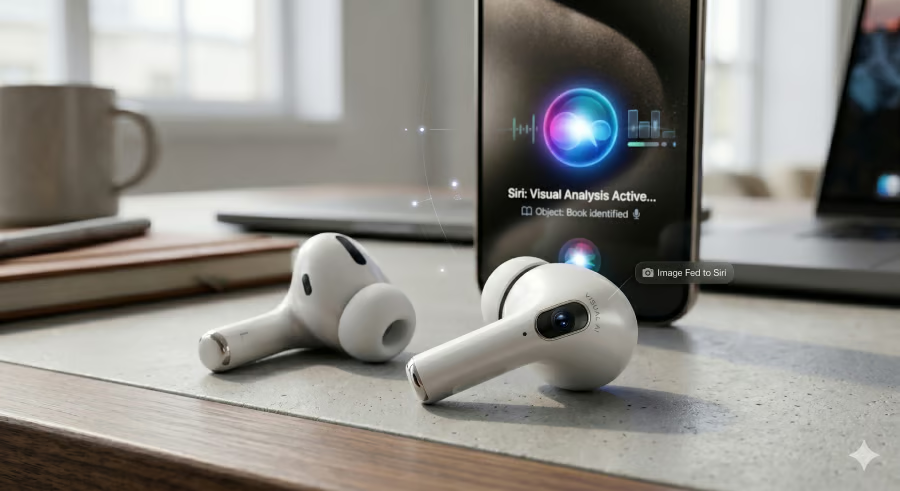
Apple may be preparing to add cameras to one of its most familiar products.
Bloomberg reports that Apple has reached late-stage testing on AirPods with built-in cameras, a device that would give Siri a way to interpret a user’s surroundings. The product would give Apple a more concrete AI hardware play as tech companies race to build assistants that can understand the world around them.
The question is whether earbuds are the right place for cameras at all.
The hardware may be close, but Siri still has to catch up
The earbuds appear to be well past the “interesting idea” stage. Prototypes now have a near-final design and feature set, and the project has entered design validation testing, the last major development phase before Apple begins producing early mass-production units.
Apple had planned to release the device as early as the first half of this year, but the timeline slipped after delays to its revamped Siri. The assistant upgrade is now targeted for September, after Apple worked Google’s Gemini technology into the underlying models.
The launch now depends on whether Siri can turn limited visual input into responses that feel quick, accurate, and natural. If those features are not ready, the product could be pushed back again.
Cameras for Siri, not selfies
The cameras would not turn AirPods into tiny point-and-shoots. They would function more like sensors, providing Siri with low-resolution visual context of the wearer’s surroundings.
A user could glance at ingredients on a counter and ask what to make for dinner. During a walk, Siri could refer to a landmark ahead instead of only a street name. The feature could also support reminders based on what the earbuds detect nearby. The cameras would sit in both earbuds, with longer stems to accommodate the hardware. Otherwise, the product is expected to look similar to the AirPods Pro 3.
Must-read Apple coverage
- Nearly 7 in 10 iPhone Owners Plan iPhone 17 Upgrade
- Apple Prepares AI-Powered Siri Upgrade With Google Search Integration
- Apple’s Xcode 26 Beta Now Supports GPT-5 and Claude
- Apple’s Vision Pro Adoption Stalled As Content Released ‘Drip by Drip’
Earbuds do not see the world as glasses do
Glasses place cameras near a user’s line of sight. AirPods would work from the side of the head, giving Siri a less direct view.
A side-facing camera may be useful for spotting nearby objects or reading the surrounding environment. It may be less reliable when the user wants Siri to identify something straight ahead unless they turn their head more deliberately.
Siri would need to infer meaning from partial visuals, spoken prompts, motion, and timing. If someone asks, “What is this?” the assistant has to know which “this” they mean.
Apple’s other reported AI hardware projects may have an easier setup. Smart glasses naturally face outward from the eyes, while a camera pendant could be positioned more deliberately. AirPods may be more familiar, but they may also be a harder place for visual AI to feel precise.
People may trust AirPods, but cameras change the deal
AirPods already feel ordinary to many users, but adding cameras would change how people read the device in public.
Apple has a built-in privacy cue: a small LED that turns on when visual data is sent to the cloud. On an earbud stem, though, that light may not be obvious to people nearby.
Camera wearables affect everyone within view, not just the person wearing them. A bystander may not know whether the earbuds are listening, looking, processing visual data on-device, or sending information elsewhere.
Apple also has to make the feature worth the discomfort. If Siri misreads objects, misses context, or answers too slowly, the cameras become harder to justify, turning a useful assistant upgrade into a wearable privacy concern.
A $250 million Siri settlement may compensate eligible iPhone buyers over Apple Intelligence marketing claims.