


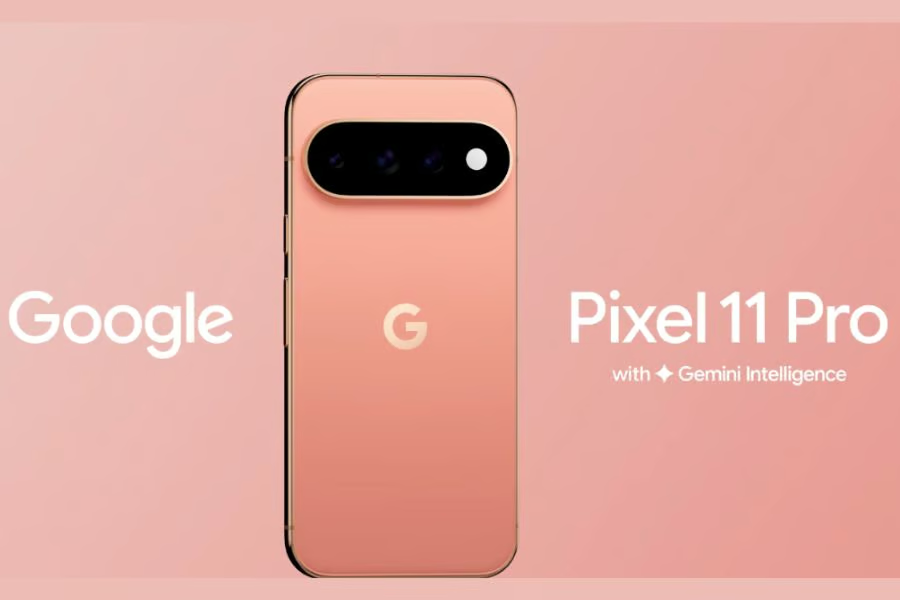
Google’s Pixel 11 launch wasn’t really about a new phone — it was about turning Gemini into the thing that runs your day.
At its Made by Google 2026 event Wednesday, the company unveiled the Pixel 11, Pixel 11 Pro, and Pixel 11 Pro XL with a strong focus on Gemini Intelligence, a new layer of artificial intelligence designed to work across apps, messages, calendars, maps, and other parts of the phone. While the hardware sees camera and processor upgrades, Google’s main pitch is that Pixel 11 can understand what you’re doing and help complete tasks before you ask.
According to Google, the new lineup is “designed for Gemini Intelligence” and is powered by the Tensor G6 chip, which runs the latest Gemini Nano model and enables faster on-device AI processing.
- Gemini becomes more proactive
- Rambler makes voice typing sound smarter
- Live Translate now works across media
- Sign language translation arrives on Pixel
- Magic Capture automatically chooses the best shot
- Camera Looks brings customizable photo styles
- Creator Suite turns the phone into a small production tool
- Instant Night Sight speeds up low-light photography
- Circle to Search moves into the camera
- Tensor G6 is the engine behind the AI
- What this means for buyers
Gemini becomes more proactive
The biggest change is that Gemini is no longer limited to a chatbot interface. On Pixel 11, it works across the operating system and can surface information from different apps when it thinks it will be useful.
Google said users will see “timely, helpful information through easily glanceable cards in the apps you’re already using.” For example, if someone asks about an upcoming trip, Pixel 11 can pull flight details from Gmail and show whether the flight is on time or delayed.
The phone can also suggest actions such as saving events to Google Calendar, adding locations to Maps, or storing airline and hotel membership numbers in Google Wallet.
Google is pushing Gemini further toward agentic AI. Its multistep-task capabilities can work with select food, grocery, and rideshare apps while allowing users to monitor, interrupt, or stop the process. Availability varies by device, app, and region.
Rambler makes voice typing sound smarter
One of the most practical new features is Rambler, a voice-input tool designed to understand natural speech.
Instead of requiring carefully structured sentences, Rambler can process run-on thoughts, filler words such as “um” and “ah,” and mid-sentence corrections. Google said it delivers fast, accurate voice transcription that produces cleaner and more concise text.

CNET, which tested the feature before launch, found that Rambler could turn a hesitant conversation about dinner plans into a coherent message without including the speaker’s verbal stumbles.
Live Translate now works across media
Pixel 11 expands Live Translate beyond text messages and conversations.
The feature can now translate videos, podcasts, voice messages, and other audio content in real time, using on-device AI powered by Tensor G6. Google demonstrated automatic dubbing that converts spoken media into a user’s preferred language while the content is playing.
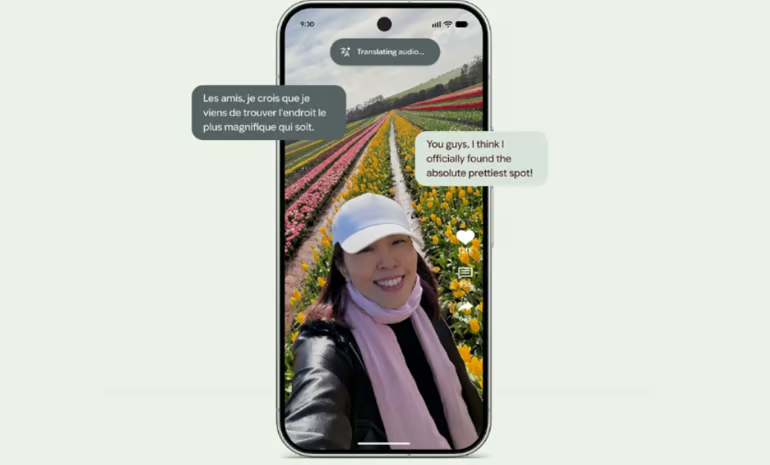
CNET reported that the feature could translate YouTube videos on the fly, allowing users to watch foreign-language content with real-time AI-generated dubbing.
Sign language translation arrives on Pixel
One of the most significant accessibility additions is sign-language-to-text support. Google’s new Sign Language-to-Text (SL2T) model allows users to sign to their phone using the Pixel camera, with gestures translated into text through Gboard and Live Transcribe.

The feature launches first with support for American Sign Language and is intended to help deaf and hard-of-hearing users search the web, compose messages, draft documents, and interact with Gemini more naturally.
Google said the model was trained on more than 100,000 hours of sign-language data across more than 50 languages.
Magic Capture automatically chooses the best shot
Google’s flagship AI camera feature is Magic Capture.
Instead of forcing users to choose between taking photos or recording video, Magic Capture continuously analyzes a scene and selects the best frames automatically. Google said it uses on-device intelligence and Gemini models to process roughly 400 frames and produce high-quality 12-megapixel photos.
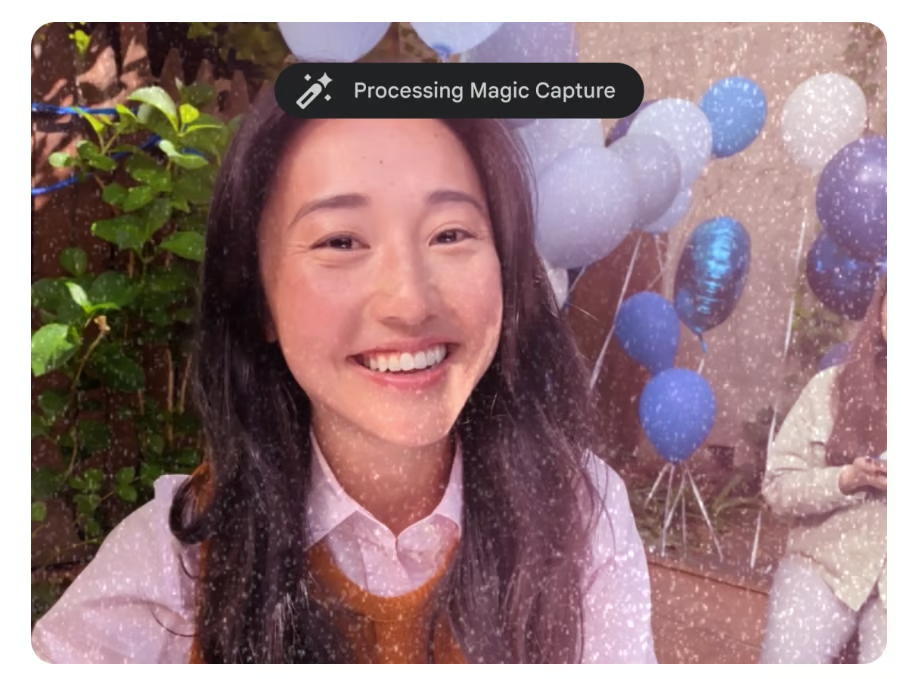
The feature can also automatically crop images, reduce blur, and generate a video from the same capture session. Google said Magic Capture is designed for moments that happen too quickly to photograph manually, such as a baby smiling, a pet moving unexpectedly, or a fast sports action shot.
Camera Looks brings customizable photo styles
Pixel 11 introduces Camera Looks, a new system for choosing the visual style of photos at the moment they are captured.
Users can set one of three default looks — Natural, Shadows, or Vanilla — or choose from six additional styles including Digi, Black Tie, Minimal, Editorial, Classic, and Velvet. Google said the looks were created by adjusting image processing techniques such as frame merging and color rendering to emulate different photographic aesthetics, and every look can be customized further.
Creator Suite turns the phone into a small production tool
Pixel 11 is also getting AI-assisted tools aimed at people who create videos for social media and other platforms.
Creator Suite adds an on-screen teleprompter that scrolls as the user speaks. It also provides tools such as social-media gridlines and automatically saves recorded videos into project folders. After recording, Storyboard can be used to trim and rearrange clips.
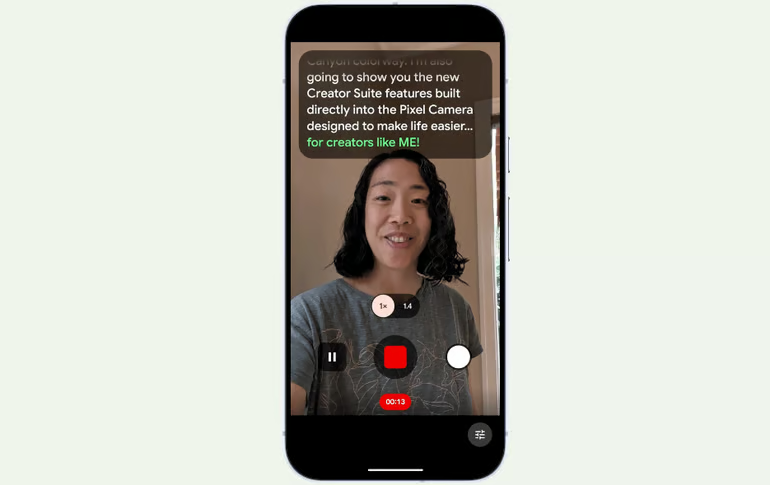
Users can also set video as the default camera mode, allowing them to open the camera directly into video recording.
The feature does not replace dedicated video-editing software, but it could make the phone more useful for people who regularly record short-form content and want to reduce the number of tools they need.
More Google coverage
- New Google Search AI Mode is ‘Total Reimagining,’ Says CEO Sundar Pichai
- In Major Ruling, Judge Finds Google ‘Willfully Acquired and Maintained Monopoly Power’ Over Digital Ad Market
- Google’s Big Bet on Nuclear Energy: ‘The Race to Power AI-Driven Data Centers is Accelerating’
- Computer History Museum Releases Original AlexNet Code: Why It Matters
Instant Night Sight speeds up low-light photography
Google is also targeting one of the biggest frustrations in mobile photography: waiting for a low-light image to finish processing.
Instant Night Sight, available on the Pixel 11 Pro and Pixel 11 Pro XL, can capture Night Sight images up to 4.5 times faster than the Pixel 8, Pixel 9, and Pixel 10 series while maintaining image quality, according to Google. The faster processing is enabled in part by the new Tensor G6 chip and its upgraded image signal processor.
That could make a noticeable difference when photographing people or moving subjects at night, where holding the phone completely still for an extended exposure can be difficult.
Circle to Search moves into the camera
Google is also making Circle to Search more directly useful in the real world.
On Pixel 11, users can activate Circle to Search from the camera viewfinder and search for something they are looking at without first taking a picture. The feature can identify objects, translate text or provide additional information about something in view.
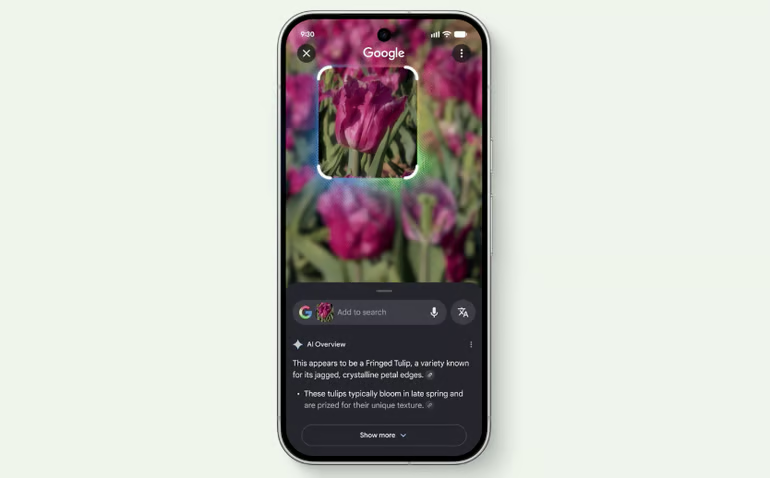
The change is small, but it removes a step from an already useful feature. Instead of taking a picture simply to search for something, users can search while keeping the camera open.
Tensor G6 is the engine behind the AI
All of these features depend heavily on Google’s new Tensor G6 processor.
Google says Tensor G6 delivers 25% faster web browsing and 15% faster app launches, while its TPU provides 50% more compute. The company also says the chip can process on-device AI tasks up to 3.5 times faster while using up to 3.5 times less energy.
The processor also supports the Pixel 11 camera improvements, including faster Night Sight and higher zoom capabilities. On the Pixel 11, the 5x telephoto camera reaches 30x Super Zoom, while the Pixel 11 Pro and Pro XL reach 120x Pro Zoom.
These improvements matter because Google’s AI strategy increasingly depends on the phone being able to process more information locally. Faster on-device processing can reduce latency and help limit the amount of work that has to be sent to the cloud.
What this means for buyers
Pixel 11’s AI features are notable because most of them are tied to tasks people perform every day: texting, traveling, eating out, recording videos, translating content, or taking photos.
Rather than adding a standalone AI app, Google is weaving Gemini into Messages, Gboard, Maps, Calendar, Wallet, the camera, and the lock screen. That could make the assistant feel less like a novelty and more like part of the phone itself.
The downside is that some features will initially be available only in certain regions or as preview experiences, and Google has indicated that higher usage of some Gemini capabilities may require a subscription.
The Pixel 11 launch also reveals Google’s broader strategy in the AI race. Apple is expected to introduce a rebuilt Siri with many of the same goals: understanding personal context, recognizing what is on screen, and taking actions across apps. Google is trying to establish Pixel as the first place where those capabilities become real products rather than future promises.
Read more: Google’s Biggest Announcements of 2026 examines the company’s broader AI strategy, including how Gemini is expanding across Google’s products.