
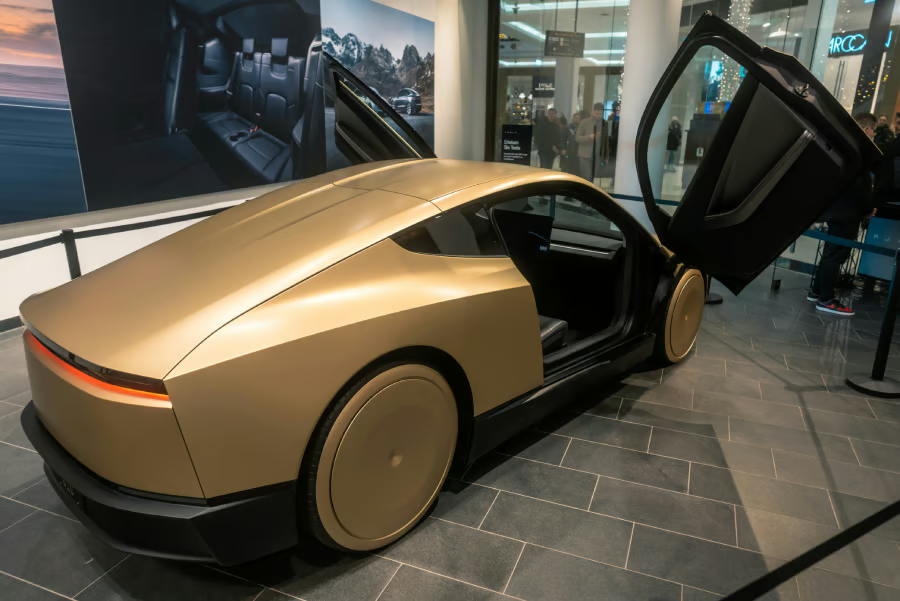


Tesla had barely begun charging passengers for rides in its steering-wheel-free Cybercab when federal regulators started examining how the vehicle was certified for public roads.
The National Highway Traffic Safety Administration has opened an audit covering about 1,000 Tesla Cybercabs, examining how the company determined that its steering-wheel-free robotaxi complies with federal vehicle safety standards.
The two-seat Cybercab began commercial service in Austin, Texas, on Sept. 3. Unlike conventional cars, it has no steering wheel, accelerator pedal, brake pedal, or mirrors.
Tesla told NHTSA that it had self-certified the vehicles as compliant with all applicable Federal Motor Vehicle Safety Standards and planned to gradually expand the service to more vehicles and locations, according to Reuters.
The central question is not whether the Cybercab can drive itself. NHTSA is examining the certification process and technical data Tesla used, including whether the company determined that some federal safety standards do not apply to a vehicle without conventional driver controls.
“NHTSA fully supports the safe development and deployment of automated vehicles. But as the federal regulator, we need to ensure that all of our laws are followed,” NHTSA Administrator Jonathan Morrison said, per Reuters.
A legal gap for driverless cars
The investigation highlights a tricky problem for the autonomous vehicle industry: U.S. safety rules were largely written around cars operated by human drivers, while companies are now building vehicles designed to operate without one.
Under the U.S. system, automakers generally certify their own vehicles rather than waiting for NHTSA approval before selling or deploying them. That gives Tesla a path to launch the Cybercab, but it also leaves the regulator to determine afterward whether the company’s interpretation of the rules holds up.
NHTSA is already working on changes that would remove some requirements for manual controls in autonomous vehicles. But those proposed changes are not yet in effect, Reuters reported.
Tesla also has not sought the exemption used by Amazon-owned Zoox for its own steering-wheel-free robotaxis. NHTSA granted Zoox an exemption in July that allows limited commercial deployment.
More must-read AI coverage
- SS&C Intralinks DealCentre AI vs. Datasite: Which platform is built for the future of dealmaking?
- SS&C Intralinks FundCentre AI vs. Juniper Square: Which platform better supports modern private markets fund managers?
- Why Data, Not Models, Determines AI Success
- The Rise of the AI-Native Factory: How Physical AI Is Transforming Manufacturing
What the probe could mean for Tesla
The timing could become important for Tesla’s robotaxi ambitions. The company has said it wants to expand Cybercab service to additional vehicles and locations, while eventually positioning the vehicle as a major part of its autonomous business.
NHTSA could ultimately determine that Tesla’s certification was valid. But if the agency finds the Cybercab does not comply with applicable standards, Tesla could face additional regulatory requirements, including a potential recall, according to the Wall Street Journal.
The bigger issue is precedent. Tesla is effectively testing whether an automaker can fit a radically different vehicle into rules created for conventional cars without first obtaining a special exemption.
That makes the Cybercab audit more than a Tesla compliance dispute. If NHTSA accepts Tesla’s approach, it could give other autonomous-vehicle makers a clearer route to deploy purpose-built robotaxis. If it rejects it, companies may have to rely more heavily on exemptions while regulators rewrite the rules.
For Tesla, that distinction could determine how quickly its promised robotaxi expansion moves from a small Austin fleet to a much larger business.
More Robotics News: Xiaomi has begun factory trials of its CyberOne humanoid robot in China, testing how the machine can handle industrial tasks alongside human workers.