


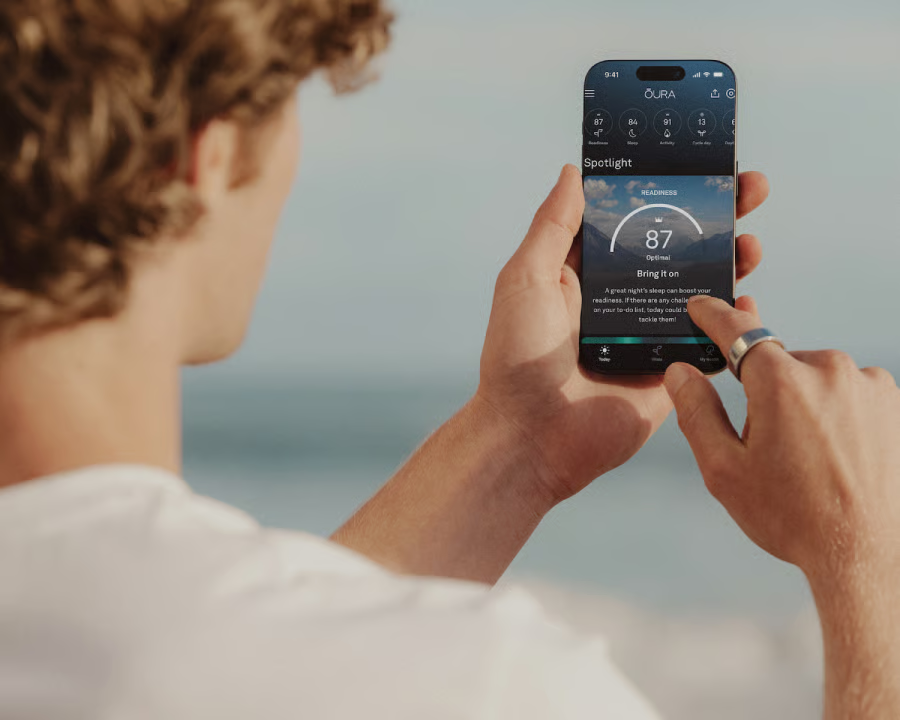
Oura’s sleep-tracking claims are facing a legal challenge over how accurately a smart ring can tell whether someone is awake, dreaming or in deep sleep.
The complaint, filed Thursday, Aug. 20, in the U.S. District Court for the Northern District of California by Clarkson Law Firm, was brought on behalf of California resident Madison Surber. She says she paid $513.68 for an Oura Ring in 2025 after relying on the company’s marketing claims.
The lawsuit challenges Oura’s claims that its rings can provide sleep-stage tracking with up to 95% accuracy compared with clinical sleep labs. It argues that accurately identifying sleep stages requires measurements of brain activity and eye movement, which are collected during clinical polysomnography but not by a smart ring.
The complaint instead describes Oura’s sleep-stage results as guesswork with roughly “a coin flip’s chance” of being correct. Oura disputes the allegations. “We dispute the allegations in this complaint and intend to defend against them,” a company spokesperson told USA Today.
Oura defends its technology
Oura says its rings estimate sleep stages using several physiological signals, including heart rate, heart rate variability, movement, breathing patterns and temperature.
The company also says its sleep-staging technology has been validated in multiple independent studies against polysomnography, widely considered the gold standard for sleep studies.
“We stand behind our science, research, and accuracy claims,” an Oura spokesperson told TechCrunch.
Oura also stresses that its ring is not a medical device or a replacement for a clinical sleep study. The company says it developed its sleep-staging algorithm using more than 1,200 nights of data.
The complaint cites a 2025 Nature study involving 45 nights of data that reported roughly 53% overall agreement in sleep-stage classification. It also alleges that Oura’s technology can overestimate or underestimate the amount of time spent in particular stages.
What's hot at TechRepublic
- Blackpoint Cyber vs. Arctic Wolf: Which MDR Solution is Right for You?
- Why AWS Sellers Choose Deepgram Over Other Voice AI Tools
- SS&C Intralinks DealCentre AI vs. Datasite: Which platform is built for the future of dealmaking?
- SS&C Intralinks FundCentre AI vs. Juniper Square: Which platform better supports modern private markets fund managers?
- Verito vs. Rightworks: Which IT Provider Is Best for Your Firm?
What the case could mean for wearables
The bigger issue for Oura may be less about whether a ring can perfectly reproduce a sleep lab and more about how consumers interpret the precision of wearable health data.
A sleep score presented as a clean number can create an impression of certainty that an underlying estimate may not deserve. For users trying to understand long-term sleep patterns, that data can still be useful. But treating an individual score or sleep-stage reading as a medical fact carries a different risk.
The lawsuit therefore puts pressure on the growing wearable-health industry to explain not only what its devices measure, but also what they estimate and how confident users should be in those estimates.
For Oura, the timing could make the dispute especially significant. The company is preparing for a U.S. public listing and has been expanding its AI-driven health capabilities. A court challenge over the accuracy of one of its flagship features could increase scrutiny of how it markets those technologies to consumers.
The lawsuit seeks an injunction against the allegedly deceptive marketing, along with restitution and other monetary relief for affected customers. The allegations have not been proven in court, and Oura says it intends to defend itself.
The case now puts both the company’s marketing language and the limits of consumer sleep tracking under closer scrutiny — a distinction likely to matter well beyond Oura as more wearables turn sensor readings into increasingly precise-looking health scores.
Other News: Motorola has patented a flexible wearable that could transform from a smartwatch into a handheld smartphone, though the company has not announced plans to turn the concept into a commercial product.