


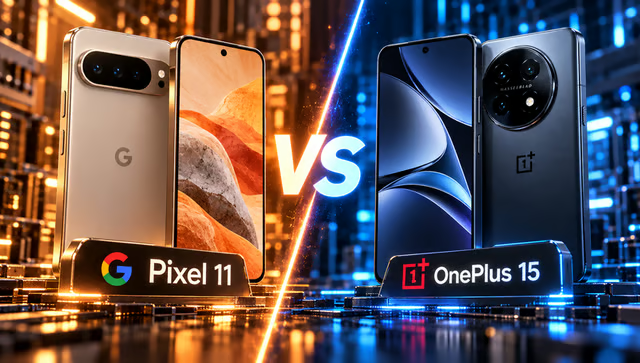
Google’s Pixel 11 and the OnePlus 15 start at essentially the same price, putting two very different Android flagships head-to-head at around $899.
Neither phone takes the same route to justify that price. Google leans on the Pixel experience and tight hardware-software integration, while OnePlus packs more high-end hardware into the phone.
With price largely removed from the decision, the feature differences matter more. Here’s how the Pixel 11 and OnePlus 15 compare and which gives you more for your money.
Pixel 11 vs OnePlus 15: Quick comparison
| Starting price | $899 | $899.99 |
| Base memory and storage | 12GB RAM, 256GB | 12GB RAM, 256GB |
| Display | 6.3-inch OLED, 60–120Hz | 6.78-inch LTPO, 1–120Hz, up to 165Hz in supported games |
| Processor | Google Tensor G6 | Snapdragon 8 Elite Gen 5 |
| Rear cameras | 48MP wide, 13MP ultrawide, 10.8MP telephoto | 50MP wide, 50MP ultrawide, 50MP telephoto |
| Optical zoom | 5x | 3.5x |
| Battery | 4,985mAh | 7,300mAh |
| Wireless charging | Qi2.2 Pixelsnap, up to 25W | AirVOOC, up to 50W |
| Software | Android 17 | OxygenOS 16 based on Android 16 |
| Long-term support | Seven years of OS and security updates | Security support through Nov. 13, 2031 |
How we compared the Pixel 11 and OnePlus 15
TechRepublic compared Google and OnePlus’ published specifications, original US pricing, software support policies, and device-specific features across display, performance hardware, cameras, battery, charging, and storage. We also calculated differences such as battery capacity and screen area from the manufacturers’ listed specs.
Almost the same price, very different hardware tradeoffs
Size and display
Pixel 11 has a 6.3-inch Actua OLED display with a 60Hz-to-120Hz refresh rate. It weighs about 196 grams and is nearly 5 mm narrower than the OnePlus 15.
OnePlus goes much bigger with a 6.78-inch LTPO display that can scale from 1Hz to 120Hz during normal use. Because both phones use a 20:9 aspect ratio, the OnePlus gives you roughly 16% more screen area.
The extra space of the OnePlus 15 is useful if you watch a lot of video, edit photos, read documents, or simply prefer a larger phone. Pixel 11 is easier to handle one-handed and less bulky in a pocket.
Performance
Gaming, media editing, and heavier workloads make the performance difference clearer.
The Pixel 11 runs Google’s Tensor G6 with 12GB of RAM. Compared with Tensor G5, Google reports 25% faster web browsing and 15% quicker app launches, with a much larger jump in its tensor processing unit for on-device AI.
OnePlus uses Snapdragon 8 Elite Gen 5 with 12GB of LPDDR5X memory and UFS 4.1 storage. It also includes a dedicated cooling system built around a vapor chamber, graphite, and aerogel insulation.
If you regularly push your phone harder, OnePlus has the stronger hardware package. Otherwise, Pixel 11 still has plenty of power for the everyday tasks most people run on a phone.
Cameras
Both phones have three rear cameras, but their strengths are different.
Pixel 11’s best hardware advantage is its 5x optical zoom, compared with 3.5x on the OnePlus. The extra reach is useful if you regularly photograph concerts, sports, animals, or anything you cannot physically get closer to.
OnePlus counters with autofocus on its ultrawide, giving it more flexibility for wide scenes and close subjects.
Video tilts further toward OnePlus. Pixel 11 records up to 4K at 60 frames per second, but OnePlus supports 4K at 120fps and 8K at 30fps, with Dolby Vision and LOG recording options.
Pixel 11 wins on true optical reach. OnePlus 15, however, has the more versatile camera hardware overall, especially if you use the ultrawide often or shoot a lot of video.
What Pixel 11 gives you that OnePlus 15 doesn’t
Pixel’s biggest advantages are its longer software commitment, Google-specific features, and standardized magnetic accessory support.
Pixel 11 gets seven years of operating system and security updates from its initial release. Google includes it under its seven-year Pixel update policy, along with new features delivered through Pixel Feature Drops.
A seven-year window has real value if you keep your phone for four or five years instead of upgrading every other cycle.
Pixel also gets Google’s deepest software integration. It runs Android 17 with Pixel-specific features built around Gemini Intelligence.
One useful example is Magic Capture. It can analyze hundreds of frames from a capture session and surface useful photos or clips from a fast-moving moment. If you are photographing a pet or a child playing sports, the feature can save you from sorting through a long burst manually.
Pixel 11 also supports Qi2.2 magnetic accessories through Pixelsnap. Compatible chargers, wallets, stands, and other magnetic accessories can attach directly to the phone without locking you into a proprietary charging system.
What OnePlus 15 gives you that Pixel 11 doesn’t
OnePlus 15’s 7,300mAh battery is about 46% larger than the Pixel 11’s 4,985mAh battery. That capacity advantage does not translate directly to the same gain in battery life, but it gives OnePlus substantially more energy to work with.
Charging is another clear win. OnePlus adds 80W wired charging in the US and Canada and also doubles Pixel’s wireless charging ceiling.
If you often forget to charge overnight or regularly spend long days using navigation, video, or mobile data, the larger battery and faster charging give OnePlus more breathing room.
Supported games can also run at 165Hz, with additional hardware designed around faster touch response.
The OnePlus 15 also offers a $999.99 configuration with 16GB of RAM and 512GB of storage. If you keep large games, offline video, photos, or work files on your phone, another $100 doubles the storage and adds more memory.
OnePlus has its own AI tools as well. Mind Space and the Plus Key let you save screenshots, schedules, places, voice memos, and other information that can be recalled later with Gemini.
More Google coverage
- New Google Search AI Mode is ‘Total Reimagining,’ Says CEO Sundar Pichai
- In Major Ruling, Judge Finds Google ‘Willfully Acquired and Maintained Monopoly Power’ Over Digital Ad Market
- Google’s Big Bet on Nuclear Energy: ‘The Race to Power AI-Driven Data Centers is Accelerating’
- Computer History Museum Releases Original AlexNet Code: Why It Matters
Pixel 11 vs OnePlus 15: Which phone gives you more?
OnePlus 15 gives you more for roughly $899.
Its lead comes from hardware value, with advantages in battery and charging, screen size, performance, camera flexibility, and gaming. If getting the most flagship hardware for your money is the priority, OnePlus is the stronger buy.
Pixel 11 is the better fit if you want a smaller phone, plan to keep it for several years, or put more value on Google’s software and Pixel-specific features.
One caveat for US buyers: OnePlus no longer sells the OnePlus 15 directly in the country, so you will need to look to third-party retailers or resellers. Stock and pricing can vary by seller.
If you can find the OnePlus 15 near its original $899.99 price, it is the stronger value of the two.
More product matchups: Read our Pro 500 vs Pro 200 comparison to weigh Astra Ultrafast, usage allowances, and the $3,600 annual price difference.