


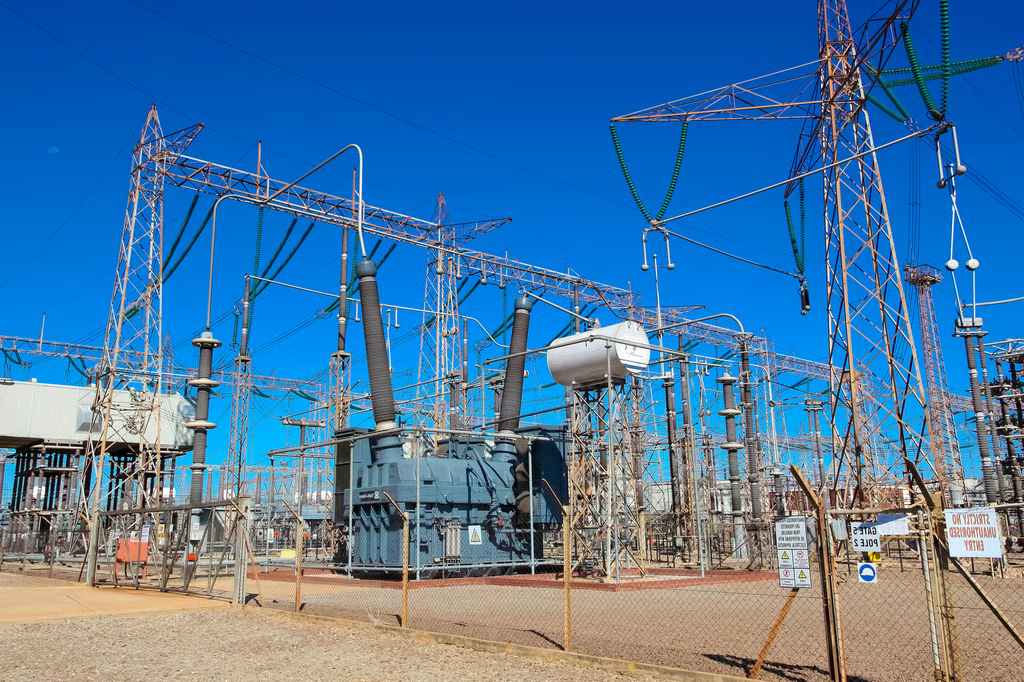
Australia’s AI data center boom is becoming a power-grid problem.
The Australian Energy Market Operator has warned that fast-growing data center loads could create stability risks if large facilities connect to the eastern grid without earlier coordination. For cloud buyers, data center operators, and APAC infrastructure investors, the warning puts power availability beside chips, fiber, and real estate as a core AI planning issue.
According to The Australian’s report on AEMO modelling, a single fault near western Sydney could disconnect about 1,500 MW of data center load in milliseconds by 2030. The modelling also found that the Victoria–New South Wales interconnector interconnector could reach a critical stress point by 2028 if multiple facilities disconnect at once.
AEMO has changed how it tracks the sector. In August 2025, the operator said data centers would be forecast as a standalone demand category, rather than grouped with other commercial loads. It estimated data centers consumed about 4 TWh of electricity across the National Electricity Market in FY2025, or 2.2% of total grid demand. Under its Step Change scenario, that could reach about 12 TWh by 2029-30, or 6%.
The pressure is not limited to Australia. APAC cloud and AI infrastructure projects are getting larger, including Meta’s first India AI data center deal with Reliance.
Why AI loads are harder to plan for
AI data centers are not just large electricity customers. GPU clusters can concentrate heavy demand in specific locations, then shift usage as workloads, cooling systems, and backup power settings change.
The larger stability risk is sudden disconnection. During voltage or frequency disturbances, multiple facilities using similar control settings could reduce demand or drop offline at nearly the same time, affecting frequency stability, voltage stability, and power transfers between states.
Australia’s market rule maker has also moved toward tighter technical standards. The Australian Energy Market Commission proposed new rules for large data centers and similar loads in March 2026, including ride-through requirements during some disturbances.
AEMO is not calling for a halt to AI data center development. The warning points to a timing problem: Developers need to involve grid planners before site selection, leasing commitments, and construction schedules are locked in.
Where APAC cloud growth meets grid risk
For operators, grid engagement now belongs early in project planning, not at the end of permitting. Developers should be ready to show realistic demand profiles and explain whether a facility can manage load flexibly during grid stress.
For CIOs and cloud buyers, power constraints could shape where providers expand AI capacity and how quickly new services become available. Energy infrastructure now belongs in the same conversation as chips, fiber, and real estate, especially as South Korea’s Nvidia-backed AI buildout ties cloud, memory, and manufacturing plans to large-scale compute capacity.
For investors, grid coordination should sit beside land cost, tax incentives, connectivity, chip supply, and construction timelines in site due diligence. Fast approvals can still carry hidden risk if network upgrades lag hyperscale demand, while AI chip supply-chain volatility can shift hardware availability and project timing.
Singapore offers one regional contrast. Its Green Data Centre Roadmap ties new capacity to efficiency and sustainability requirements.
Australia’s warning shows how quickly AI infrastructure can become a grid-planning problem. For APAC markets racing to attract data center capital, power planning has to start before the sites are full and the contracts are signed.
Also read: Google’s SpaceX compute deal shows how AI capacity planning is moving beyond standard cloud regions and into private infrastructure agreements.