


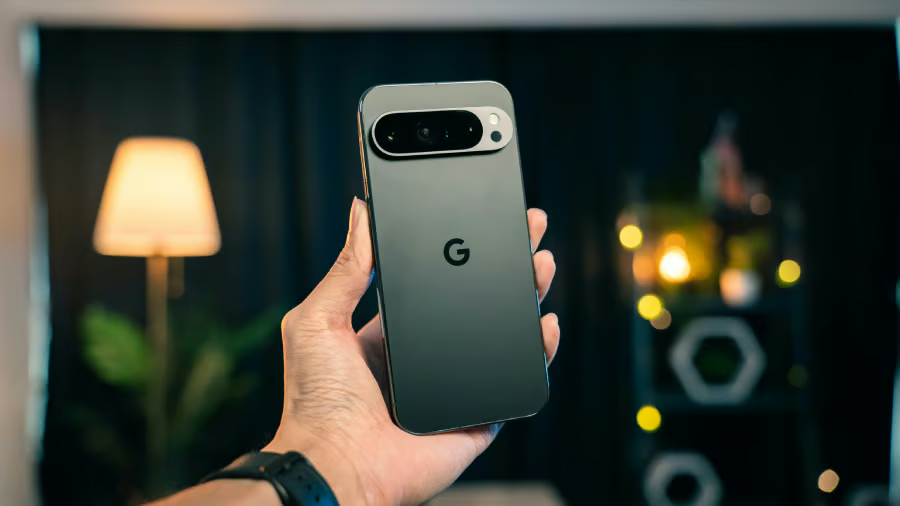
Google blames a global memory crunch for upcoming Pixel 11 price increases.
Google says soaring memory prices will force it to raise prices across the Pixel 11 lineup, marking one of the clearest acknowledgments yet of how AI-driven hardware demand is affecting consumer smartphones.
Speaking to 9to5Google, Google’s Vice President of Devices and Services, Shakil Barkat, said the company has absorbed higher component costs for as long as it could, but the economics have changed dramatically.
Barkat described the situation as a “severe, supplier-driven RAM memory crisis,” adding that “there’s never been an increase in memory prices like the world’s going through right now.” He cited Morgan Stanley data showing the cost of 1 GB of RAM climbed from $2.80 in 2025 to $12 this year.
According to Barkat, Google had “shielded our consumers from supply fluctuations for as long as possible,” but acknowledged that “the economics have fundamentally shifted and we’re not immune to that.”
As a result, Google said the entire Pixel family, including the upcoming Pixel 11 series and Pixel Watch lineup, will receive price “adjustments” that will be “rolled out dynamically to match supply realities.” The company will announce official pricing during its Made by Google event on Aug. 12.
Recent leaks cited by multiple publications suggest the Pixel 11 lineup could see price increases of around $100, although Google has not confirmed those figures.
Google leans on software to offset hardware costs
Beyond passing some of the higher component costs to customers, Google said it is working to reduce its dependence on large amounts of memory.
Barkat said the company is making a “dedicated effort” to lower memory requirements across Android and its app ecosystem “to enable devices to have less RAM while maintaining a great user experience.”
Google also said its vertically integrated approach—combining Android, Tensor chips, AI software, and on-device models—helps optimize memory usage more efficiently. Meanwhile, the company said it remains committed to “delivering premium experiences at an accessible value.”
Barkat noted that promotions, trade-in offers, and bundled perks such as Google One will remain “a central part of how we make the Pixel lineup accessible.”
More Google coverage
- New Google Search AI Mode is ‘Total Reimagining,’ Says CEO Sundar Pichai
- In Major Ruling, Judge Finds Google ‘Willfully Acquired and Maintained Monopoly Power’ Over Digital Ad Market
- Google’s Big Bet on Nuclear Energy: ‘The Race to Power AI-Driven Data Centers is Accelerating’
- Computer History Museum Releases Original AlexNet Code: Why It Matters
What buyers should expect
While Google has not disclosed final pricing, leaks indicate the base Pixel 11 and Pixel 11 Pro may replace 128 GB storage with 256 GB as the starting configuration, partially offsetting higher prices. Some reports also suggest entry-level Pixel 11 Pro models could ship with 12 GB of RAM instead of 16 GB.
Google also hinted that current Pixel devices already on the market could eventually receive price adjustments, though it did not specify which products or when those changes might take effect.
Google’s comments illustrate how AI’s rapid expansion is reshaping the smartphone supply chain. As memory manufacturers prioritize AI infrastructure, handset makers may increasingly turn to software optimization and configuration changes to offset higher hardware costs—leaving consumers to weigh improved AI capabilities against steadily rising prices.
Related News: Google recently introduced a built-in iPhone-to-Android migration tool in Android 17 that transfers passwords, Wi-Fi credentials, and eSIMs, making it easier for users to switch platforms.