


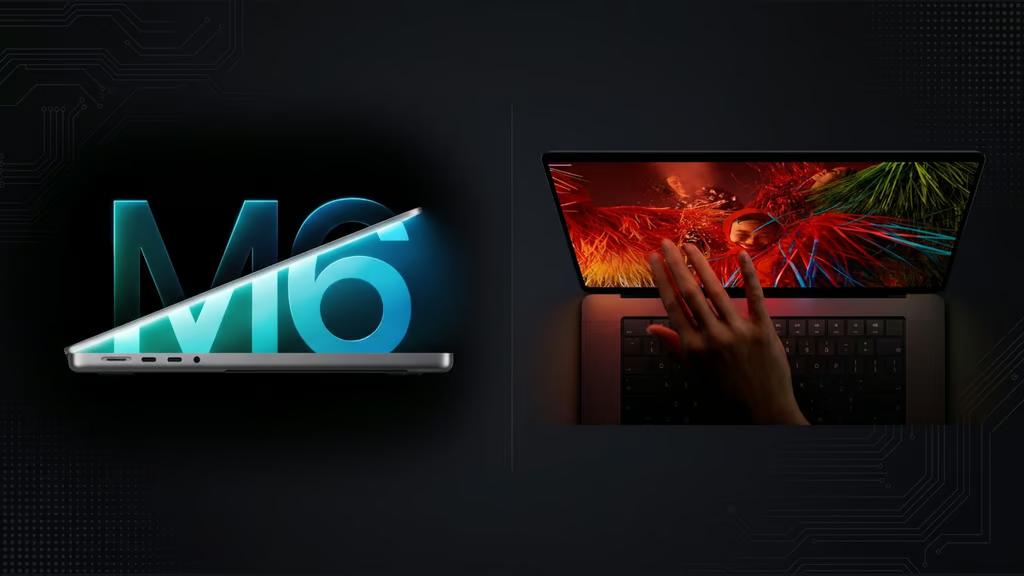
Apple’s newer M6 chip isn’t in its most expensive new 14-inch MacBook Pro. Instead, the $2,899 touchscreen model uses an M5 Pro processor, while the standard M6 MacBook Pro starts at $1,999.
Apple announced the two laptops on October 27 and 28, respectively, with availability beginning November 6. The touchscreen model introduces tandem OLED, a lighter chassis, and higher-tier hardware. But the $900 price difference isn’t simply a charge for touch, and comparing configurations reveals how much buyers actually pay for the upgrades.
The $900 gap isn’t just about the touchscreen
The 14-inch M6 MacBook Pro starts with 16GB of unified memory and 1TB of storage. Apple’s touchscreen M5 Pro model raises starting memory to 24GB and adds a redesigned display and chassis.
| Specification | M6 MacBook Pro | Touchscreen M5 Pro |
|---|---|---|
| US starting price | $1,999 | $2,899 |
| CPU/GPU | 12-core / 12-core | 15-core / 16-core |
| Starting memory | 16GB | 24GB |
| Starting storage | 1TB | 1TB |
| Display | Mini-LED Liquid Retina XDR | Tandem OLED PROLED XDR |
| Touchscreen | No | Yes |
| Peak HDR brightness | 1,600 nits | 2,000 nits |
| Thunderbolt ports | Three Thunderbolt 4 | Three Thunderbolt 5 |
| External displays | Up to 2 | Up to 3 |
| Weight | 3.4 pounds | 3.0 pounds |
| Video battery estimate | Up to 24 hours | Up to 22 hours |
Sources: Apple’s M6 technical specifications and touchscreen MacBook Pro specifications. Figures reflect base 14-inch configurations.
Part of the premium pays for additional memory. Upgrading the M6 to 24GB narrows the difference to $700, while choosing 32GB reduces it to $500.
There’s a closer price comparison. Apple sells a nontouch M5 Pro starting at $2,499, making the OLED touchscreen upgrade $400 between otherwise comparable M5 Pro configurations.
The OLED screen delivers deeper blacks, higher contrast, and support for P3 and Adobe RGB color gamuts. Touch enables direct interaction with supported applications, although software compatibility varies. Apple’s touchscreen MacBook Pro launch coverage examines those capabilities and application compatibility.
OLED, processing power, or savings: Which makes sense?
The M6 is the stronger value for everyday work. Its mini-LED display already supports a 120Hz refresh rate, and Apple estimates two additional hours of video streaming and wireless browsing compared with the touchscreen M5 Pro.
For photographers and video editors, the OLED panel’s contrast and color capabilities provide a stronger reason to upgrade. Developers handling demanding workloads may also benefit from the M5 Pro’s additional CPU and GPU cores and higher memory bandwidth. The M6 MacBook Pro upgrade analysis provides further context on the standard chip’s performance improvements over the M5.
Thunderbolt 5 and support for three external displays offer additional advantages for professional workstations. Touch also provides another way to interact with macOS 27, whose features and compatibility cheat sheet covers the operating system’s broader changes.
How we compared the laptops
We evaluated Apple’s published US prices, hardware specifications, display technology, connectivity, portability, and battery estimates. Recommendations reflect the likely usefulness of these features across different workloads.
The M6 is sufficient for most everyday tasks without the premium. The touchscreen M5 Pro is easier to justify when OLED, professional processing capacity, or expanded connectivity will be used regularly. Buyers interested primarily in touch should compare it with the $2,499 nontouch M5 Pro before spending more.
Read more: For a lower-priced alternative, the M6 MacBook Pro vs. M5 MacBook Air comparison examines whether moving from Air to Pro is worthwhile.