
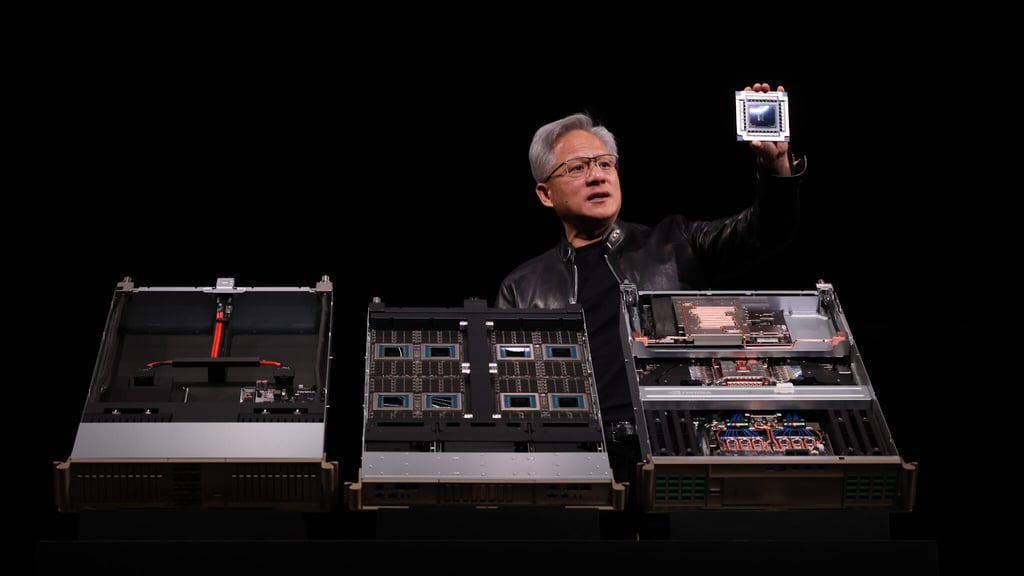


Nvidia CEO Jensen Huang expects the company to sell twice as many chips next year as demand for AI computing continues to climb.
Speaking Thursday at an AI summit convened by King Charles III in Scotland, Huang said customers across industries and countries are increasing their AI investments. His prediction goes beyond Nvidia’s formal financial outlook, but it refers to the number of chips sold rather than a promise that revenue will double.
Huang said the push is being driven by AI’s growing contribution to different industries and economies, adding that companies in almost every country Nvidia serves want to invest in the technology.
The forecast goes beyond Nvidia’s formal financial guidance. Last month, the company projected roughly 70% revenue growth for the fiscal year ending in January 2028, which would put annual revenue at about $673 billion, CNBC reported. Nvidia also indicated that revenue could potentially double if it had enough supply to meet demand.
Getting there may depend as much on Nvidia’s suppliers as Nvidia itself. Advanced memory, semiconductor manufacturing and packaging capacity will all have to expand quickly enough to turn surging AI demand into actual hardware shipments.
The supply problem behind the forecast
There is an important distinction between selling twice as many chips and doubling revenue. Nvidia does not disclose its total chip shipments, and its products vary widely in price.
The company’s portfolio includes Blackwell and Rubin data center GPUs, along with CPUs, networking and optical chips, laptop processors, Jetson chips for robotics and vehicles, and the processor used in Nintendo’s Switch 2.
Still, AI accelerators are central to Nvidia’s growth. The company generated $96.2 billion in revenue in its latest quarter and guided for $108 billion in the current quarter, according to BigGo Finance. The bigger challenge is whether Nvidia and its manufacturing partners can produce enough hardware.
Huang’s forecast effectively assumes that more manufacturing capacity will become available as AI customers continue placing orders.
More chips mean more pressure on the supply chain
Nvidia’s expansion reaches far beyond the company itself. Its GPUs depend on advanced memory and packaging, creating potential bottlenecks elsewhere in the semiconductor industry.
Next-generation GPUs require increasingly advanced high-bandwidth memory, while TSMC’s advanced packaging capacity is also under pressure. TSMC Chairman C.C. Wei recently described back-end advanced packaging capacity as tight. That means doubling chip shipments is not simply a matter of Nvidia receiving more customer orders.
Memory production, packaging capacity, and other parts of the supply chain must expand alongside it.
Competition is another pressure point. Major technology companies, including Meta, Microsoft, Amazon, Google and OpenAI, are investing in custom AI silicon, potentially reducing their reliance on Nvidia over time.
What this means for AI users
For consumers and businesses, more Nvidia chips could eventually mean more computing capacity for AI services, from generative AI tools to robotics and other applications. But the benefits may not arrive immediately.
If hardware remains supply-constrained, AI companies may continue competing for limited computing resources, while the cost and availability of large-scale AI infrastructure remain important considerations.
Huang’s forecast also shows that the AI hardware race is becoming increasingly dependent on the entire semiconductor ecosystem. Nvidia can sell more chips only if suppliers can provide the memory, packaging, and manufacturing capacity needed to build and ship them.
More must-read AI coverage
- SS&C Intralinks DealCentre AI vs. Datasite: Which platform is built for the future of dealmaking?
- SS&C Intralinks FundCentre AI vs. Juniper Square: Which platform better supports modern private markets fund managers?
- Why Data, Not Models, Determines AI Success
- The Rise of the AI-Native Factory: How Physical AI Is Transforming Manufacturing
Nvidia’s growth comes with a safety question
Huang’s comments came as the Scotland summit also focused on AI safety. He argued that companies should move quickly but stop individual products from launching when they are not safe.
“When a product is not safe, we should hold it back and keep engineering it,” Huang said, according to CNBC.
That creates an interesting tension for Nvidia. The company benefits commercially from faster AI adoption, while its CEO is also calling for safety checks before products reach users. As AI investment accelerates, the industry will increasingly have to expand computing capacity without treating speed as the only measure of progress.
Huang’s prediction underscores just how large Nvidia expects the next stage of AI infrastructure spending to become. But doubling chip shipments requires more than strong demand: memory makers, foundries and packaging providers all have to expand with it.
For businesses planning larger AI deployments, that makes supply just as important to watch as Nvidia’s next GPU. More chips could eventually ease access to computing capacity, but only if the semiconductor ecosystem can build them fast enough.
Other news: Meta plans to deploy its third-generation MTIA 450 “Arke” AI chip in 2027, aiming to lower inference costs, improve energy efficiency, and reduce its reliance on general-purpose GPUs from suppliers such as Nvidia.