


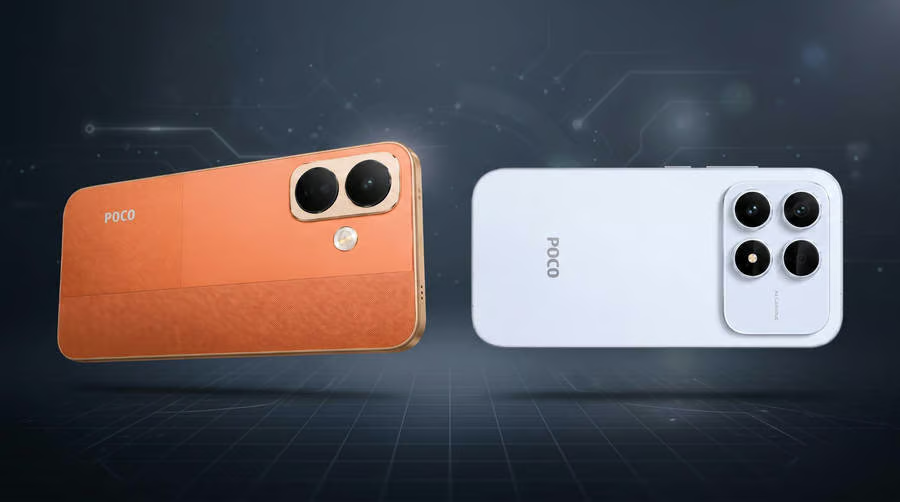
The Xiaomi-backed POCO X8 has room for a bigger battery. Its smaller sibling, the X8s, makes up for the lost capacity with a lighter frame, faster charging, and more camera options. For buyers in Southeast Asia, though, the choice isn’t entirely theirs to make.
Both phones are scheduled to go on sale in the Philippines on November 6, with introductory discounts running through November 15. In Vietnam, Xiaomi’s online catalog lists the X8s but not the standard X8. That difference in availability adds another consideration to a comparison already shaped by size, battery life, and price.
The question is whether the X8’s extra capacity is worth carrying a bulkier phone, or whether the X8s offers enough elsewhere to justify its higher price.
POCO X8 vs. X8s: Prices and hardware compared
The Philippine launch brings the two phones within ₱1,000 (approximately $16) of each other at their starting promotional prices. According to YugaTech’s launch coverage, both receive ₱2,000 discounts from November 6–15.
Vietnam presents a different picture. Xiaomi’s official Vietnamese catalog lists the X8s, with an 8GB/256GB price of VND 10.99 million (approximately $426) reported in the November 2 store listing, down from VND 12.99 million (approximately $504). No promotion end date was specified.
| Market and model | Regular price | Offer/current price |
|---|---|---|
| PH: X8 8GB/256GB | ₱23,999 (~$377) | ₱21,999 (~$346) |
| PH: X8 12GB variant* | ₱26,999 (~$424) | ₱24,999 (~$393) |
| PH: X8s 8GB/256GB | ₱24,999 (~$393) | ₱22,999 (~$362) |
| PH: X8s 12GB/512GB | ₱27,999 (~$440) | ₱25,999 (~$409) |
| VN: X8s 8GB/256GB | VND 12.99M (~$504) | VND 10.99M (~$426) |
| VN: X8 | No official online listing found | — |
Philippine promotions run November 6–15, 2026; Vietnamese pricing is a November 2 snapshot. Philippine reports list the higher-tier X8 with 512GB, while global specifications list 256GB. The local configuration remains unconfirmed.
The physical differences are substantial. The X8’s official specifications show a 6.83-inch AMOLED display and 223-gram weight. The X8s measures 6.35 inches diagonally and weighs 187 grams — 36 grams less.
| Feature | POCO X8 | POCO X8s |
|---|---|---|
| Processor | Snapdragon 6s Gen 4 | Snapdragon 7 Gen 4 |
| Battery | 8,340mAh | 6,330mAh |
| Wired charging | 67W | 100W |
| Main camera | 50MP with OIS | 50MP with OIS |
| Additional cameras | 2MP depth | 50MP telephoto, 8MP ultrawide |
A larger battery, but not necessarily longer life
The X8 carries approximately 32% more battery capacity, a substantial difference on paper. Yet capacity alone cannot predict endurance, just as the trade-offs in this OnePlus 16 and Pixel 11 Pro comparison extend beyond battery size.
In Notebookcheck’s independent testing, the X8 lasted 29 hours and 29 minutes during controlled Wi-Fi browsing. Without equivalent X8s testing, its actual endurance advantage remains uncertain.
The X8s has other strengths. Its 100W charging rating exceeds the X8’s 67W, while a dedicated 2.5x telephoto camera and ultrawide lens offer greater flexibility than the larger phone’s camera setup. Buyers should still verify whether a compatible charger comes in the box; camera quality also needs independent testing.
For work devices, network compatibility and software longevity deserve equal scrutiny. The X8 uses two physical nano-SIMs, while X8s eSIM support varies by market and carrier. TechRepublic’s Android Cheat Sheet covers security and updates, and Samsung and OnePlus update policies offer useful context for comparing support commitments.
In the Philippines, the X8 makes sense for buyers who value battery capacity and screen space over portability. The X8s asks ₱1,000 more for a lighter build, stronger camera versatility, and faster rated charging. Vietnamese buyers have a narrower confirmed online-store choice, making authorized availability as important as specifications.
Read more: Google’s September Android security update addressing 180 vulnerabilities underscores why software support deserves attention when buying a phone intended to last several years.