
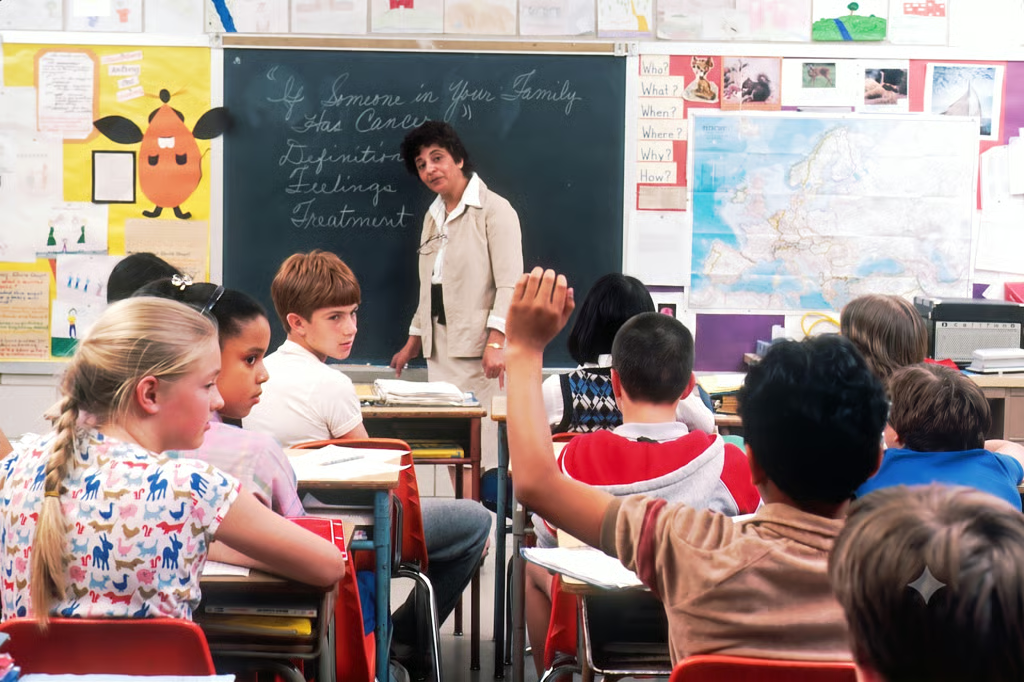


Students in Denmark are being told: Prove you wrote it, out loud.
Denmark’s government has introduced a package of measures aimed at reducing AI-assisted cheating in upper secondary schools, including a requirement that students orally defend major written assignments completed at home.
The move comes as schools face growing concerns that generative AI tools can make it difficult to determine whether students wrote their own work. The Danish Ministry of Education said AI has increasingly challenged both teaching and exam situations, prompting the government to establish clearer rules around when AI use is not allowed.
Education Minister Magnus Heunicke announced the changes ahead of the new school term, saying the government needed to act quickly.
“Unfortunately, we have a problem with cheating with AI in high school,” Heunicke said. “Action is needed now.”
Oral defenses become a new test of understanding
The biggest change applies to the større skriftlige opgave (SSO), a major written assignment completed by about 9,000 upper secondary students each year.
Under the new approach, students will no longer only submit the written paper. They will also have to defend their work orally, allowing teachers to assess whether students understand the arguments, research, and ideas behind their assignments.
The Ministry of Education said it will work with schools and upper secondary institutions to determine the best structure for the oral defenses. The goal is to shift attention from simply evaluating the final document to assessing the student’s own knowledge and ability to explain their work.
Schools encouraged to increase supervision
Denmark’s package includes two additional measures. Schools will be encouraged to have students complete more written assignments on campus under controlled conditions, where teachers can better observe the writing process and provide feedback.
The government is also calling for the use of computer monitoring tools during written exams and network filtering systems to restrict access to unauthorized content. These measures are designed to give schools more visibility into how students use technology during assessments while creating clearer boundaries around AI use.
AI creates a new challenge for education
The Danish decision reflects a growing concern among education systems that traditional methods of measuring student knowledge are becoming harder to rely on.
Neighboring Sweden has also been examining the issue. A study found that the number of students suspended or warned for unauthorized AI use increased by 688% between 2023 and 2025, according to The Guardian.
Denmark is preparing a broader national strategy for AI use across schools and the wider education sector, suggesting the government sees AI as both a challenge and a technology that requires long-term rules.
What this means for students and schools
The new rules could push schools toward assessments that test understanding rather than just writing ability. For students, it may reduce the value of using AI to complete assignments they cannot explain themselves.
However, the approach also comes with drawbacks. Monitoring software raises questions about student privacy, while increased oral exams could place more pressure on students who struggle with speaking even when they understand their subject.
The bigger challenge for education systems will be finding a balance between preventing misuse and teaching students how to responsibly use AI tools that are likely to become part of everyday work.
Also read: OpenAI has launched three ChatGPT education plugins that help teachers and college students create lessons, quizzes, study plans, and other learning materials.