


Court clears path for multibillion-dollar Apple biometric privacy lawsuit.
The iPhone maker is facing a potential $32.5 billion class-action lawsuit accusing the company of collecting biometric information through its Photos app without proper notice or consent.
The U.S. Court of Appeals for the Seventh Circuit recently denied Apple permission to immediately appeal a lower court decision certifying the case as a class action. The denial leaves the certification order in place, allowing proceedings to continue in district court, where plaintiffs must still prove that Apple violated Illinois’ Biometric Information Privacy Act (BIPA).
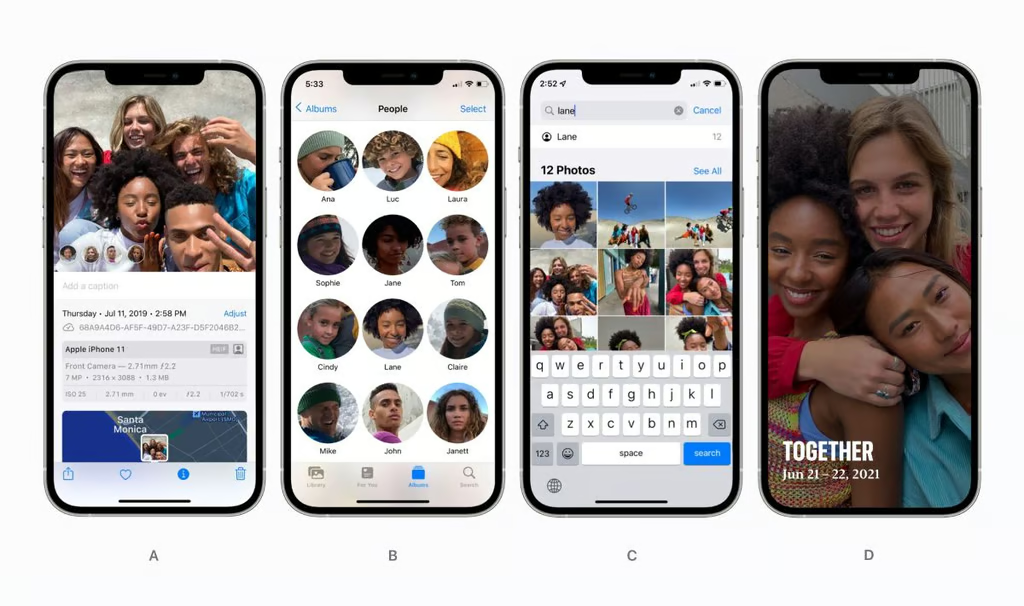
The lawsuit, first filed in 2020 and amended several times since, centers on the Photos app’s “People” feature, which uses facial recognition technology to group images of the same person.
Plaintiffs claim the feature creates unique “faceprints” from images and that Apple collected biometric information without meeting BIPA’s requirements for user notification, written consent, and data handling policies.
In a statement provided to TechRepublic after a request for comment, Andrew Schlichter, counsel for the plaintiffs, said the legal team is prepared to move ahead with the case.
“After working for more than six years to protect the rights of Illinois citizens to control the creation and use of their unique biometric data, we are pleased that a class has been certified and that Apple’s request to review the court’s order has been denied,” Schlichter told TechRepublic. “We look forward to the opportunity to prove the case at trial.”
Millions of Illinois users could be included
Plaintiffs estimate that the certified classes could include approximately 6.5 million Illinois residents whose photos were processed by Apple’s People feature.
Under BIPA, prevailing plaintiffs may recover $1,000 for a negligent violation or $5,000 for an intentional or reckless violation. If Apple is found liable and the court applies the maximum amount across an estimated 6.5 million class members, damages could theoretically reach $32.5 billion.
The lawsuit includes claims involving both local device processing and iCloud-related photo storage. Plaintiffs allege that certain Photos and iCloud configurations caused facial data to be transmitted to or stored by Apple, creating additional privacy concerns.
Apple has disputed those claims. The company argues that the data used to organize photo albums does not qualify as biometric information under BIPA because the numerical vectors used by Photos cannot recreate a face and are not tied to a person’s identity.
A major test for biometric privacy rules
The case highlights a growing legal challenge for technology companies as facial recognition becomes more common in consumer products.
BIPA, which was enacted in Illinois in 2008, was designed before many modern AI-powered features became widespread. The law requires covered private entities to provide written notice and obtain written consent before collecting biometric identifiers or information, including fingerprints, voiceprints, and scans of face geometry.
The law has already led to major settlements involving other technology companies. Meta previously agreed to a $650 million settlement over allegations that Facebook’s facial recognition system violated BIPA, while Instagram faced a separate biometric privacy settlement.
Why Apple’s case could shape future AI privacy rules
The biggest question in Apple’s case is not only whether the company violated Illinois law, but how courts will treat privacy-focused AI features that process sensitive data locally.
Apple’s defense depends heavily on the argument that its facial recognition technology works differently from systems that store and identify faces on company servers. If courts accept that distinction, it could influence how companies design privacy protections for future AI features. If they reject it, companies may face stricter requirements even when processing happens largely on consumer devices.
For users, the case could determine whether companies need clearer permission before using AI-powered tools that analyze personal images, even when those tools are built into everyday apps.
The lawsuit remains unresolved after six years of litigation. Apple has not been found liable, and no damages have been awarded. The plaintiffs will need to prove their claims before any payment is ordered.
Also read: Apple Sued After Alleged Fake Crypto Wallet App Cost Users $1.8 Million