


President Donald Trump is putting the nation’s intelligence chief at the center of his AI strategy.
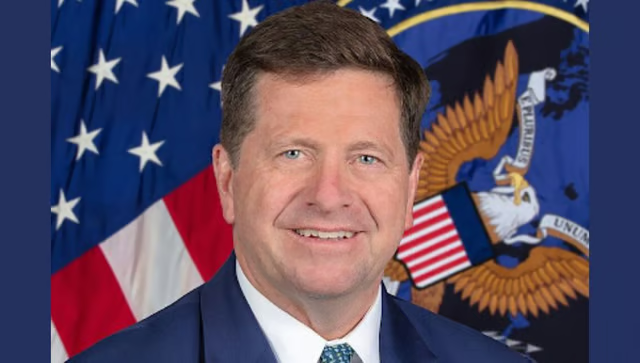
Trump on Oct. 4 named Director of National Intelligence Jay Clayton to lead the newly created Super Intelligence Force (SIF), effectively making him the White House’s AI czar.
The task force will coordinate federal engagement with AI companies, consumers, public-interest groups and critical infrastructure providers as the administration weighs the technology’s risks and opportunities.
According to Trump’s Truth Social announcement, the group will report directly to Trump and White House Chief of Staff Susie Wiles. Clayton will chair the task force alongside three vice chairs: Federal Trade Commission Chairman Andrew Ferguson, Under Secretary of Defense for Research and Engineering Emil Michael, and Office of Personnel Management Director Scott Kupor.
120 days to define the government’s role
The task force has 120 days to assess AI’s risks and opportunities and determine what role the federal government should play, Clayton told The Wall Street Journal.
“The risk of not being first is high,” Clayton told the Journal. “Not being first increases the identified, and unidentified, risks, particularly from our adversaries.”
The group’s charter calls for plans to address AI-enabled threats, review how government handles reports of breaches, hacks and jailbreaks, and improve federal response capabilities under existing authorities.
At the same time, the task force is expected to avoid regulations that could suppress innovation or competition.
The panel will include senior officials, including Vice President JD Vance, Defense Secretary Pete Hegseth, Treasury Secretary Scott Bessent and Wiles. External advisers include venture capitalist David Sacks and former Secretary of State Condoleezza Rice.
From AI regulation to national security
Clayton’s appointment puts the country’s intelligence chief at the center of domestic AI policy, rather than handing the role to a technology executive or Silicon Valley policy specialist.
That choice matters because the administration is increasingly treating advanced AI as a national security issue. Clayton previously called super intelligence a “national security issue” and opposed calls for slowing development while other countries continue advancing the technology.
The appointment also comes after Trump met with major AI companies and backed a voluntary safety agreement covering internal testing, independent reviews and board oversight. The companies signed the agreement during a White House meeting shortly before the new task force was announced.
That sets up the central tension facing the SIF: the administration wants AI companies to retain substantial responsibility for managing their own risks while giving the federal government a larger role in preparing for security threats and other failures.
What this means for AI companies
AI companies do not face new federal compliance requirements because of the task force — at least not yet.
Rather than imposing immediate regulatory burdens, the primary effect on AI vendors will likely be heightened federal coordination. The task force is explicitly examining existing laws, incident reporting and government response capabilities.
That could eventually lead to recommendations for Congress or changes in how companies report serious AI failures and security incidents. But the lack of clearly defined authority remains a major question. Sen. Mark Warner said the administration has not explained whether Clayton’s role will involve safety standards or reviews of the most advanced AI models.
More must-read AI coverage
- SS&C Intralinks DealCentre AI vs. Datasite: Which platform is built for the future of dealmaking?
- SS&C Intralinks FundCentre AI vs. Juniper Square: Which platform better supports modern private markets fund managers?
- Why Data, Not Models, Determines AI Success
- The Rise of the AI-Native Factory: How Physical AI Is Transforming Manufacturing
What the new AI push could mean for Americans
For Americans, the immediate impact will be limited. The Super Intelligence Force does not create new AI rules or change how people use ChatGPT, Gemini or other AI tools today. Its first job is to figure out what the federal government should do as these systems become more capable.
That could eventually affect how AI companies report security incidents, test advanced models and respond when systems are used for hacking or other harmful purposes. Businesses that rely heavily on AI could also face new expectations if the task force recommends changes to existing reporting or oversight rules.
For now, the bigger issue is what happens after the task force’s 120-day review. Trump wants the US to move faster than its rivals, particularly China, while the task force is also being asked to prepare for the risks that race could bring.
That leaves Clayton facing a difficult task: helping the US move quickly while making sure the race for leadership does not come at the expense of safety and security.
Other news: OpenAI CEO Sam Altman says society may need to accept some AI-related harm to preserve the technology’s broader benefits and accessibility, arguing that bounded risks should be distinguished from potentially catastrophic ones.