
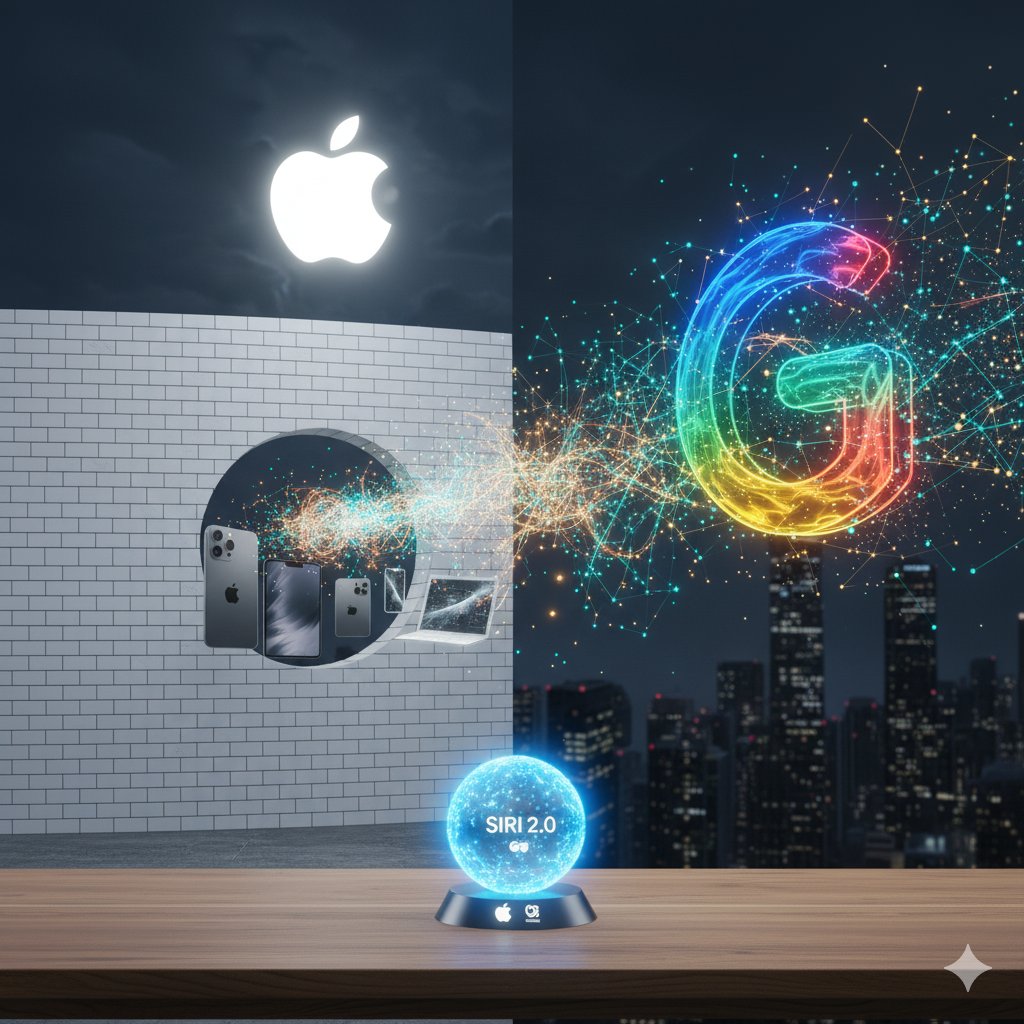


Apple is removing a few bricks from its walled garden as it is reportedly close to a $1 billion deal to use Google’s Gemini AI model to power a revamped version of its AI assistant Siri.
The potential partnership marks a significant step in Apple’s strategy to close the gap with Microsoft and OpenAI, whose ChatGPT integrations have supercharged user expectations for what virtual assistants can do.
According to Bloomberg, the partnership would make Google’s 1.2-trillion-parameter Gemini model — one of the largest and most advanced AI systems publicly known — the foundation for a rebuilt Siri, expected to debut in 2026. The upgraded assistant will likely feature improved contextual understanding, multimodal capabilities, and deeper integration across Apple’s ecosystem.
Earlier this year, Apple introduced a limited version of its own AI platform, Apple Intelligence, which is built on in-house models optimized for on-device performance and privacy. However, as competitors rapidly develop more powerful cloud-based AI ecosystems, Apple is accepting that it needs an equally robust model that can scale across devices.
Reports indicate that the deal could be finalized as early as the end of this year. Once completed, it would position Google as Apple’s key AI supplier, expanding an already lucrative relationship. Google currently pays Apple an estimated $18 billion annually to remain the default search engine on Safari — a deal that has drawn US and European regulatory scrutiny. This new AI component to the ongoing partnership could renew antitrust concerns.
Breaking down walls
Apple’s comfort with a potential Gemini integration is in stark contrast to the company’s staunch autonomous stance.
Historically, Apple has favored building its core technologies in-house, allowing it to tightly control the brand’s notoriously closed ecosystem and prioritize privacy, regardless of market pressures. But the generative AI race has put the company on the back foot, with consumer response to its proprietary Apple Intelligence platform lukewarm at best.
By tapping into Google’s Gemini model, Apple will gain immediate access to a world-class large language model capable of handling complex reasoning, code generation, and image understanding. It would be a significant development boost that would enable Apple to compete with Microsoft and Amazon, both of which have leveraged successful AI integration deals with OpenAI and Anthropic, respectively.
For Apple, whose voice assistant has long lagged behind Amazon’s Alexa and Google Assistant in accuracy and flexibility, the deal could quickly move Siri from a simple command-based interface to a full-fledged AI companion.
Must-read Apple coverage
- Nearly 7 in 10 iPhone Owners Plan iPhone 17 Upgrade
- Apple Prepares AI-Powered Siri Upgrade With Google Search Integration
- Apple’s Xcode 26 Beta Now Supports GPT-5 and Claude
- Apple’s Vision Pro Adoption Stalled As Content Released ‘Drip by Drip’
Maintaining data privacy and trust
Even though the expanded partnership with Google could accelerate Siri’s much-needed evolution, the costs could be a loosening of Apple’s tight grip on data privacy and user trust.
Apple is expected to keep sensitive user interactions on-device through its existing Apple Intelligence framework, which relies on local processing and a “Private Cloud Compute” system designed to anonymize and secure data when offloading tasks to Apple’s servers. However, the addition of Google’s Gemini introduces a reliance on Google’s cloud infrastructure, which is not under Apple’s direct control.
The company hasn’t disclosed the technical boundaries of the integration, which may raise questions about how it will ensure that user requests and contextual information are processed securely when routed through Google’s large-scale data centers.
Apple’s long-held reputation for privacy, often used by the company as a competitive differentiator, will need to be balanced with user expectations for AI-powered convenience. Any perception that Siri’s makeover comes at the expense of user control and trust could undermine one of Apple’s most valuable brand assets and blur the hard line it has drawn between itself and data-driven rivals such as Google and Meta.
Last month, it was reported that Apple was planning major display upgrades for the MacBook Air, iPad Air, and iPad Mini lines over the next two years.