


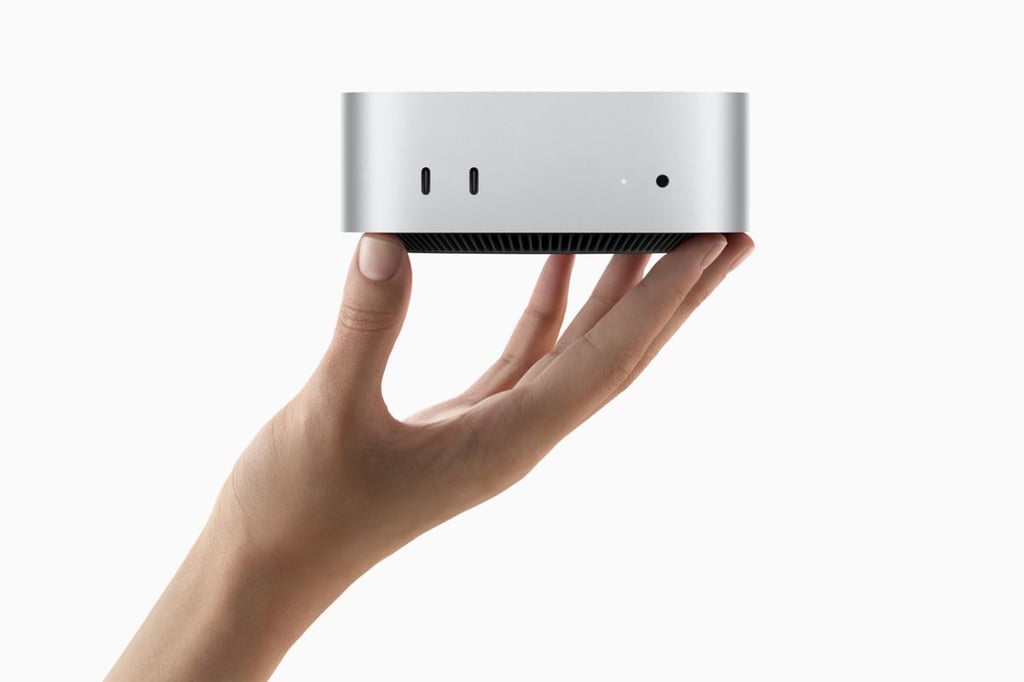
Apple plans to expand its US manufacturing by building the Mac mini at its Houston, Texas, factory.
The iPhone maker already builds its lowest-volume Mac, the Mac Pro, at the facility, alongside servers for its data centers. The Mac mini adds another small piece to its US manufacturing portfolio, part of Apple’s $600 billion investment over the next four years to bring more of its supply chain to the country, including components for iPhone glass and silicon-related manufacturing.
Unlike the Mac Pro, which Apple has considered phasing out, the Mac mini is experiencing something of a renaissance, largely because it is a relatively affordable machine for running AI software. The Mac mini starts at $599, making it the cheapest Mac model available, though it could soon be rivaled by a new MacBook model that may launch on March 4.
Apple is reportedly planning to update the Mac mini later this year, likely with refreshed M5 and M5 Pro chips. Given growing interest in AI, the company may also adjust its marketing to emphasize the Mac mini’s capabilities as a machine for running AI software.
The move to Houston comes as President Donald Trump continues urging American companies to shift more production stateside under his “Made in America” agenda.
Most of Apple’s manufacturing will remain in Asia
Even with the addition of the Mac mini, the majority of Apple’s manufacturing will remain in Asia. The company operates facilities in China, Malaysia, Vietnam, and Thailand that handle most Mac production, and Apple has spent the past two decades building up expertise in that region to ensure production runs smoothly.
That means the next-generation MacBook Pro, expected to launch later this year with a touchscreen and OLED display, will likely be produced in Asia.
It seems highly unlikely that Apple will bring iPhone production to the US, given the enormous manufacturing volume required for each new release. Lower-volume products such as the Vision Pro, HomePod, or Apple TV could potentially be assembled at the Houston factory, though that will depend on how aggressively Apple follows through on its investment plans.
Apple’s main manufacturing partner, Foxconn, has begun investing in US factories, which could give Apple a way to further scale its domestic operations.
Must-read Apple coverage
- Nearly 7 in 10 iPhone Owners Plan iPhone 17 Upgrade
- Apple Prepares AI-Powered Siri Upgrade With Google Search Integration
- Apple’s Xcode 26 Beta Now Supports GPT-5 and Claude
- Apple’s Vision Pro Adoption Stalled As Content Released ‘Drip by Drip’
AI has revived ‘Made in America’
One sector that has closely embraced the “Made in America” message is artificial intelligence. Tech giants and AI startups alike have promoted their efforts to bring construction, manufacturing, and data center jobs to the country through a rapid expansion of computing capacity.
Data centers differ from desktop computers and smartphones, as security considerations and the importance of keeping data within the country are more significant. The value of having operations located close to headquarters is also greater.
That is why Anthropic, OpenAI, and others are willing to spend billions building new data centers rather than renting space from overseas providers. OpenAI plans to spend more than $500 billion on its Stargate data center project, which aims to add 10 gigawatts of capacity. Anthropic has taken a more modest approach, committing $50 billion to custom data centers in New York and Texas.
For more on Apple’s March 4 plans, check out Apple’s roadmap preview.