


A longtime programming favorite has lost its place at the top. Meanwhile, developers’ plans for what to adopt next point to a different contest.
JetBrains’ 2026 State of Developer Ecosystem report reveals changes in programming language usage and future adoption plans. For development teams, the findings offer a fresh look at which skills and technologies are attracting attention.
Drawing on responses from nearly 29,000 developers worldwide, the JetBrain annual survey measures the languages programmers used over the past year and those they intend to adopt. Its figures reflect reported usage and interest.
Python overtakes JavaScript in developer usage
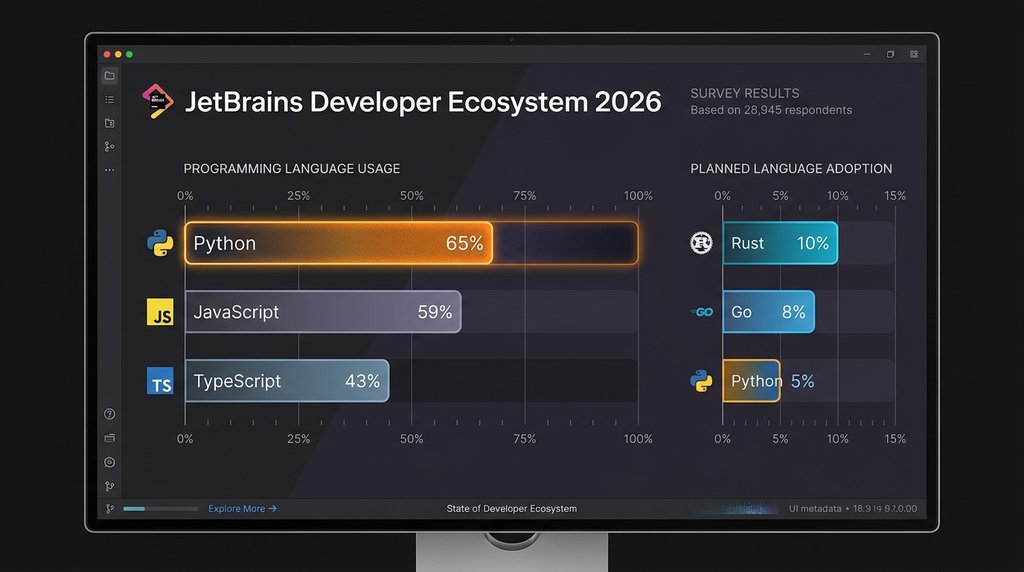
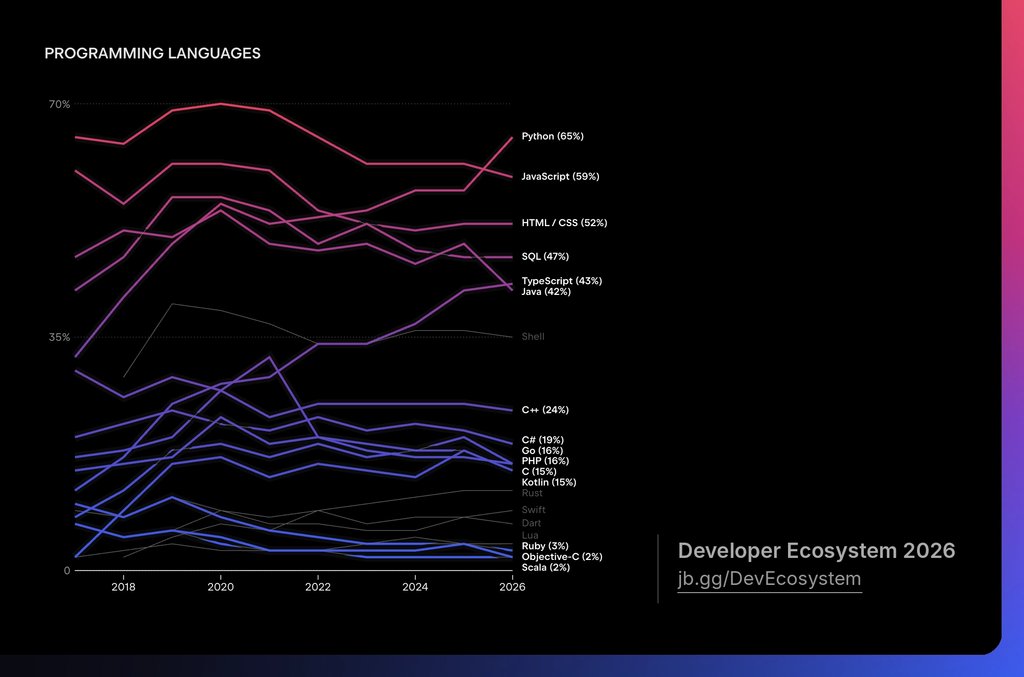
In the 2026 State of Developer Ecosystem report, 65% of respondents reported using Python, putting it ahead of JavaScript at 59%. It is the first time Python has led the survey since the series began in 2017.
JavaScript remains central to interactive websites and browser-based applications. Python, meanwhile, supports work in artificial intelligence and data processing, as well as general-purpose software development.
Other widely used technologies include HTML/CSS at 52%, SQL at 47%, and Java at 42%. Python also leads November’s TIOBE and PYPL rankings.
TypeScript leads languages with the strongest growth potential
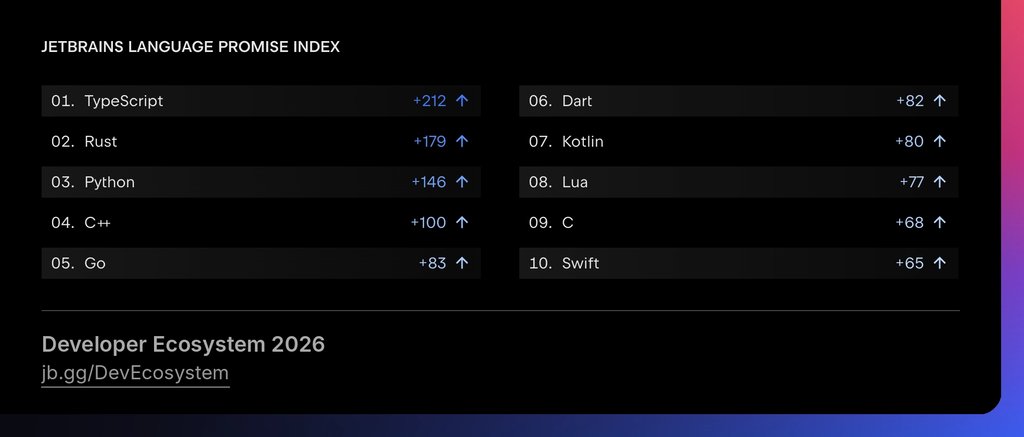
A score of 212 puts TypeScript first in JetBrains’ 2026 Language Promise Index, ahead of Rust at 179 and Python at 146.
Used by 43% of respondents in 2026, TypeScript builds on JavaScript with type checking that can catch certain coding errors before applications run. Developers can also introduce it into existing JavaScript projects without replacing the entire codebase.
Now in its third year, this index combines five-year growth trends with developers’ adoption intentions and existing users’ willingness to continue using a language. Its scores indicate relative growth potential..
Rust leads adoption plans ahead of Go
Rust ranks first among languages developers intend to adopt within the next six months, attracting 10% of respondents. Go follows at 8%, while Python places third at 5%.
Rust offers memory safety and low-level performance, making it suitable for systems software where certain programming errors can create security vulnerabilities. Its design reflects growing attention to memory-safe programming languages.
Go serves different development needs, specifically back-end services and cloud infrastructure. Its built-in support for concurrency helps applications handle multiple operations efficiently, while straightforward deployment makes it practical for server-side software.
Both languages also rank among the highest-paid programming language skills in the 2026 report, giving them another distinction alongside developers’ interest in adoption.
What a decade of language trends suggests for 2027
Looking further back reveals a different pattern.
JavaScript, HTML/CSS, SQL, and Java reached their reported usage peaks around 2019–2020 and have since gradually declined. TypeScript, meanwhile, has more than tripled its usage since 2017, while Python has also expanded considerably.
Growing interest in newer languages does not necessarily mean established technologies are being replaced. Businesses still depend on software written years ago, and newer projects may introduce different languages to meet requirements that existing tools cannot address as effectively. A rising ranking alone provides little reason to rewrite an application that continues to work well.
For development managers preparing for 2027, a useful starting point is the software their teams already maintain. Reviewing existing skills and technical debt can help identify where another language might improve reliability or reduce maintenance work. Testing an alternative on a smaller project before committing to a major migration could reveal whether its benefits justify the investment.
Developers deciding what to learn next face a similar choice. A language attracting attention may be worth exploring, but practical experience on a real project offers more useful information than its position in a ranking.
As another year approaches, the more telling development will be which languages turn growing interest into sustained use.
Related reading: Our GitHub Octoverse 2026 report examines TypeScript’s lead, Rust’s rapid growth, and the growing role of AI coding agents in software development.