


Objective-C may be older than Swift, but developers are still searching for lessons in it.
Apple’s older programming language ranks fifth in November 2026’s PYPL Index, ahead of Swift in tenth. Python leads with 52.04% of the index’s measured tutorial-search interest.
The PYPL PopularitY of Programming Language Index compares Google searches for language tutorials using normalized Google Trends data smoothed over six months. For development managers reviewing training needs, it offers a signal of learning interest—not a measure of production use or hiring demand.
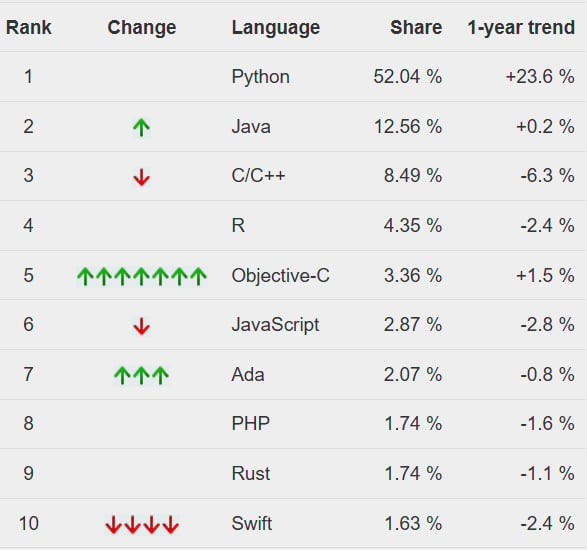
Python’s share exceeds the combined total of the other 29 ranked entries.
Java ranks second at 12.56%, followed by C/C++ at 8.49% and R at 4.35%.
Objective-C ranks above Swift
Objective-C ranks fifth at 3.36%, more than twice the share of Swift, which places tenth at 1.63%.
JavaScript ranks sixth at 2.87%, followed by Ada at 2.07%. PHP and Rust occupy eighth and ninth, respectively, both displaying rounded shares of 1.74%.
C# sits just outside the top 10, ranking 11th at 1.54%.
Separate research puts Python’s appeal in context
Separate research helps explain why developers choose Python, although it does not establish what caused PYPL’s rankings. A JetBrains analysis of its 2025 Developer Ecosystem survey, based on 8,837 responses, identified Java as Python’s main source of incoming developers switching their main language. Library availability and ecosystem support were among Python’s attractions.
AI development offers another reason to learn the language. Another 2026 JetBrains survey found that 51% of surveyed Python developers worked on AI or AI tools, while 27% were involved in data science and machine learning.
Objective-C’s position contrasts with Apple’s continued migration of older code to Swift. In its WWDC26 “What’s new in Swift” session, Apple described replacing older Objective-C implementations in Foundation with Swift. Its migration documentation details how existing applications can be updated gradually while allowing both languages to work together.
What to check before changing training or migration plans
Tutorial-search rankings can help development managers identify subjects worth investigating. Training and migration decisions still need to reflect the applications a team maintains, its upcoming projects, and gaps in its existing expertise.
For teams supporting older iPhone and Mac applications, review:
- Code ownership: Which Objective-C components remain in use, and who understands them?
- Dependencies: Which libraries and interfaces connect Objective-C and Swift code?
- Migration scope: Which components have a clear reason to change, such as maintenance difficulty or a planned feature?
- Testing: What checks will confirm that behavior remains consistent after migration?
Apple’s documentation describes migrating incrementally, one class at a time. That gives teams a way to scope and test changes without treating an entire application rewrite as the starting point.
For Python training, begin with the intended workload—automation, data analysis, AI development, or application services. Identify the libraries and deployment skills the project requires, then choose training that addresses those needs.
Before approving spending, define a measurable outcome: fewer manual tasks, broader maintenance coverage, or delivery of a specific feature. A higher ranking alone cannot establish whether a language change will improve an application or justify its cost.
Related reading: Our November 2026 TIOBE Index report covers the biggest programming language movements, from Go’s return to the top 10 to Java’s rise.