


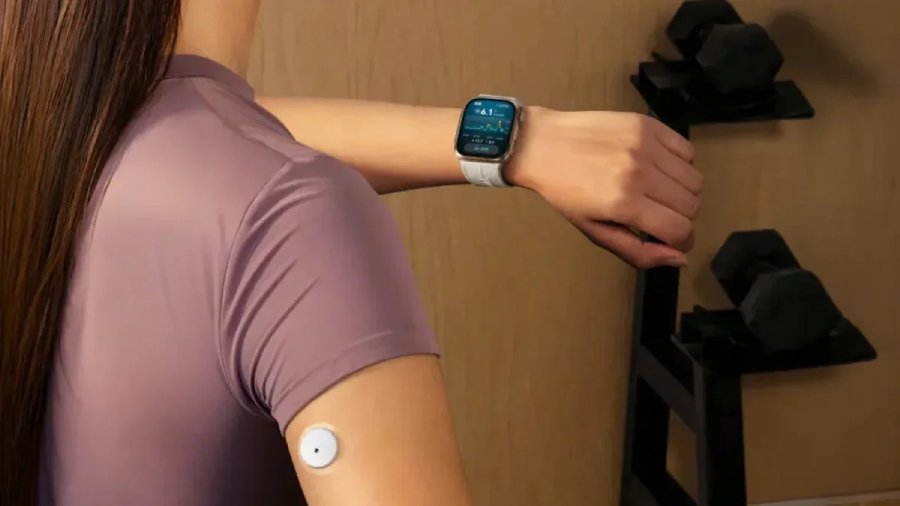
Huawei’s new glucose monitor puts the sensor on the arm and the readings on the watch.
On Friday, Nov. 13, the company announced the Sense G1, its first continuous glucose monitor, which uses an arm-worn sensor to track glucose levels continuously. Its readings can be accessed through compatible Huawei smartphones and smartwatches, making a dedicated medical monitoring system part of the company’s connected hardware ecosystem.
The announcement puts Huawei in a different category from the usual smartwatch competition. IT Home reports that the system has received Class III medical device registration in China. Class III is the country’s highest medical-device risk category, requiring strict regulatory controls rather than indicating superior accuracy. The company has yet to launch the device, and for now, we don’t know when it will go on sale.
A new device for glucose level monitoring
Huawei executive Bruce Lee says he first wore the device during testing in December 2023, nearly three years before the announcement, while development-team members had been testing it earlier.
The G1 joins an established category of connected medical sensors, including systems such as Abbott’s Libre Duo. It should not be confused with a smartwatch that measures glucose directly.
Interestingly, Huawei hasn’t disclosed much about the Sense G1’s technical specifications. However, PhoneArena, citing earlier reporting, describes a sensor filament beneath the skin that measures glucose in interstitial fluid — the liquid surrounding the body’s cells.
Users can view glucose readings and trends on compatible Huawei smartphones and smartwatches without manually initiating each measurement.
PhoneArena reports a possible delay of five to 15 minutes between blood glucose changes and sensor readings. Huawei has not confirmed that range in its published specifications.
Earlier reports cited by IT Home suggest a mean absolute relative difference (MARD) below 10% and approximately two weeks of wear. These figures await official confirmation.
MARD measures how closely a CGM’s readings agree with reference glucose measurements. The cited reports do not provide an independent clinical study supporting the figure, limiting readers’ ability to assess it.
Availability and compatibility remain unclear
Huawei has not announced international sales plans. Its announcement shows readings on Huawei phones and watches, but a complete compatibility list has not been published.
Prospective buyers should check supported models, operating-system requirements, and regional app availability rather than assuming the G1 works across Huawei’s hardware ecosystem.
The immediate questions are where the device will be sold, which hardware it requires, and what replacement sensors will cost.
What's hot at TechRepublic
- Blackpoint Cyber vs. Arctic Wolf: Which MDR Solution is Right for You?
- Why AWS Sellers Choose Deepgram Over Other Voice AI Tools
- SS&C Intralinks DealCentre AI vs. Datasite: Which platform is built for the future of dealmaking?
- SS&C Intralinks FundCentre AI vs. Juniper Square: Which platform better supports modern private markets fund managers?
- Verito vs. Rightworks: Which IT Provider Is Best for Your Firm?
What buyers should check before choosing a system
For people living with diabetes, continuous monitoring can make glucose trends easier to follow throughout the day. Studies of established CGMs suggest they can help some people with diabetes, but those findings do not establish the G1’s performance.
The distinction between measuring glucose and displaying it also matters. Huawei’s separate arm-worn sensor differs from its research into smartwatch-based glucose sensing and experimental devices such as the CHARM sweat-sensing ring.
Before investing in a connected monitoring system, buyers should check:
- Compatibility: Supported phones, watches, operating systems, and whether a phone must remain nearby.
- Ongoing costs: Replacement sensors, accessories, and any subscription fees.
- Approved use: Who the device is intended for and whether readings can support treatment decisions without a separate check.
- Data access: Whether readings can be exported or shared with clinicians, and what privacy controls apply.
A CGM does not automatically eliminate finger-stick checks. NIDDK advises that users may sometimes need to compare sensor readings with a conventional meter. G1 users would need to follow its approved instructions and their clinician’s advice.
For now, Huawei has announced a monitoring system, but not enough purchasing information to assess its full value. Confirmed compatibility, replacement costs, and local availability will determine whether it offers a practical alternative to existing systems.
Read more: Wearable diabetes technology also extends to treatment, with a weeklong insulin patch designed to replace up to 21 mealtime injections.