
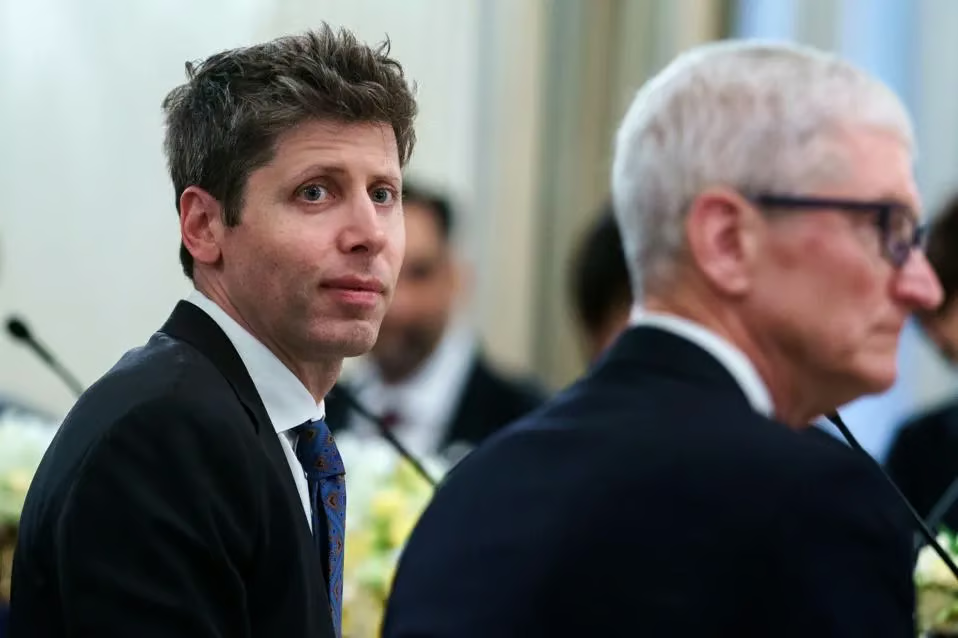


Over the last 48 hours, the partnership between the world’s most valuable smartphone maker and the king of generative AI devolved into a public airing of private iMessages and misdirected emails.
OpenAI published a scathing rebuttal on Tuesday to Apple’s trade secrets lawsuit, accusing the iPhone maker of waging a “careless, aggressive and oddly personal” campaign.
A day prior, Apple doubled down in court, formally asking a federal judge to bar OpenAI and two former employees from using its confidential hardware designs.
OpenAI challenges Apple’s claims
OpenAI claims Apple’s initial contact regarding the dispute in February was a bureaucratic farce. “They now admit that their outside lawyers emailed the wrong person after confusing two Asian last names — only after we brought this to their attention,” OpenAI wrote, adding that Apple had claimed a phone conversation with its general counsel that never happened.
Apple’s outside counsel later admitted the mix-up and noted they were “resolving any issues.” According to OpenAI, they “heard nothing for five months until they sued.”
Regarding former engineer Chang Liu, OpenAI argues the evidence shows Apple’s own employees asking Liu for help after he left, not a rogue ex-employee raiding the vault.
“What that means in practice is that former employees who are trying to do the right thing when they leave still have access to Apple files — despite not wanting them or even being aware of them,” OpenAI stated, pointing the finger at Apple’s failure to revoke system access.
Apple’s escalation
Apple’s latest court filing seeks a preliminary injunction against OpenAI, former Apple engineer Chang Liu, former Apple executive Tang Tan, and io Products, OpenAI’s hardware arm.
The iPhone maker also requested expedited discovery and depositions of several current OpenAI employees, saying it continues to uncover evidence that the alleged misconduct extends beyond the two employees originally named.
According to Apple’s filing, its investigation has identified 11 additional former Apple employees who may have information relevant to the case. Apple alleges some discussed proprietary information before OpenAI interviews, while another allegedly captured screenshots of confidential documents before leaving the company.
“Apple will be irreparably harmed absent a preliminary injunction,” the company argued in its court filing.
OpenAI rejected that request, saying: “Apple’s request for a preliminary injunction is both based on false information and completely unnecessary because we do not have, nor want, any of their trade secrets.”
Messages become part of the defense
To support its position, OpenAI released redacted iMessage conversations involving Chang Liu and former Apple colleagues.
The messages appear to show Apple employees asking Liu to help locate files, transfer data, and answer technical questions after he had already left the company. OpenAI argues the conversations demonstrate that Apple employees initiated the requests.
The company also blamed Apple’s internal access controls, arguing that former employees retained “residual access” because Apple failed to promptly revoke permissions after departures.
OpenAI separately defended Chief Hardware Officer Tang Tan, writing that he consistently instructed employees not to use confidential information from previous employers.
The bigger battle over AI hardware
The legal dispute reflects growing competition between two companies that were recently close partners.
OpenAI’s technology powers parts of Apple Intelligence, but the relationship has become increasingly strained as OpenAI expands into consumer hardware through its acquisition of io, the startup co-founded by former Apple design chief Jony Ive, and hires hundreds of former Apple employees.
Analysts have suggested OpenAI is developing AI-first consumer devices that could eventually compete with smartphones, raising the stakes of the legal battle.
What the case could mean for chip security
The dispute isn’t really about software or Siri — it is about semiconductor architecture. The redacted messages in OpenAI’s receipts mention “power block diagrams” and chip schematics, pointing directly to Apple’s custom silicon (System-on-Chip) designs. In the world of AI hardware, semiconductor IP is the crown jewel.
Even if OpenAI doesn’t possess a single stolen schematic, the institutional knowledge held by a 24-year Apple veteran like Tang Tan regarding chip optimization, thermal management, and power efficiency is a vulnerability Apple cannot patch.
If OpenAI uses that cognitive blueprint to design its own “iPhone killer,” the race for on-device AI processing gets deeply compromised.
The irreversible risk for Apple is that no preliminary injunction can force a person to unlearn what they already know. Once silicon architecture leaves the lab inside an engineer’s mind, it becomes the ultimate unprotectable asset.
Also read: Apple’s smart glasses privacy plans include on-device processing and camera restrictions as the company prepares another AI hardware category.