
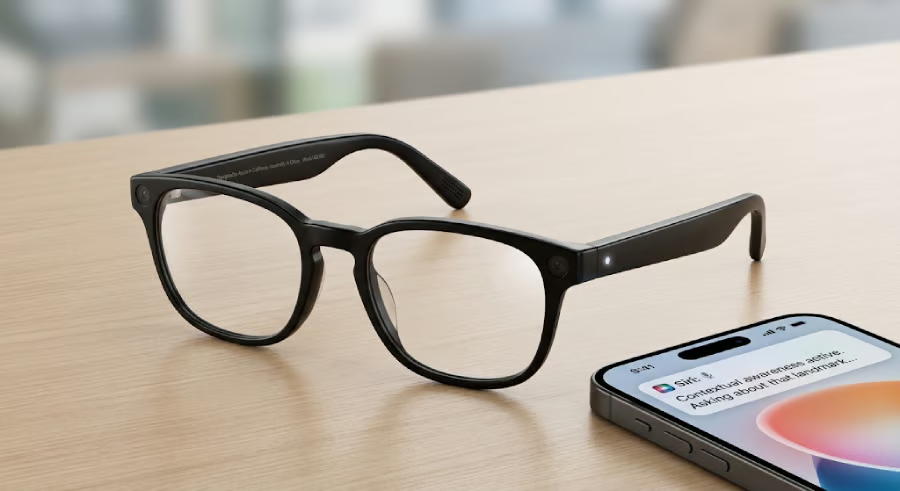


Apple’s next big wearable may look less like a computer strapped to your face and more like an ordinary pair of glasses.
The company is reportedly aiming to launch its first smart glasses in late 2027 while separately exploring a dramatically redesigned Vision headset that could arrive in late 2028 or early 2029, according to Bloomberg’s Mark Gurman, as reported by AppleInsider. Apple has not announced either product or confirmed those timelines.
The two projects suggest Apple may be taking a two-track approach to head-worn computing: lightweight AI glasses designed for everyday use and a more powerful mixed-reality headset for immersive computing. That could put Apple into increasingly direct competition with Meta and other companies betting that glasses will become a major computing platform.
Apple’s first smart glasses may skip the display
Apple’s first glasses are expected to be considerably simpler than the Vision Pro.
Rather than placing digital graphics directly in front of the wearer’s eyes, the initial model is reportedly expected to resemble Meta’s Ray-Ban smart glasses, combining cameras, microphones, speakers, and AI capabilities without a built-in visual display.
Gurman reportedly said Apple is aiming to release the product in late 2027. That broadly aligns with other recent reporting around Apple’s wearable roadmap, although the expected timing has shifted before and should not be treated as a firm launch date.
TechRepublic previously reported that Apple is developing AI-powered smart glasses alongside other wearable devices, including camera-equipped AirPods and an AI pendant.
The glasses could effectively give Siri and Apple Intelligence “eyes.” Previous reporting indicates Apple is developing the device around cameras, Siri, computer vision, and tight iPhone integration, potentially allowing Apple Intelligence to use visual context from the wearer’s surroundings.
Apple is also reportedly investigating longer-term health and fitness features for smart glasses, although those capabilities are not expected to be central to the first generation.
That approach would put Apple directly into a smart-glasses market where Meta has already established an early foothold. Meta has continued to expand its Ray-Ban lineup, including models specifically aimed at prescription-glasses users.
Apple is exploring four ideas for its next Vision headset
Smart glasses do not necessarily mean Apple is finished with immersive headsets.
Apple’s Vision Products Group is also reportedly working on a completely revamped headset under the codename N224. According to Gurman’s reporting, engineers are considering about four concepts rather than simply preparing an incremental Vision Pro refresh.
One option would move some of the computing hardware out of the headset and into a separate device, reducing the amount of hardware worn on a user’s face.
It is a strategy other manufacturers are exploring as well. Meta’s recently unveiled VR Glasses use a separate compute puck containing the battery and main processor, allowing more of the computing hardware to sit away from the wearer’s face.
Apple may not follow the same path.
According to the report, senior Apple decision-makers view the external-puck approach as a poor user experience and want the company to stick with something closer to an all-in-one design. Apple already uses an external battery with Vision Pro, and moving additional components outside the headset would introduce another design trade-off.
Apple is also looking for ways to make the headset lighter and cheaper while keeping the design closer to an all-in-one device.
Must-read Apple coverage
- Nearly 7 in 10 iPhone Owners Plan iPhone 17 Upgrade
- Apple Prepares AI-Powered Siri Upgrade With Google Search Integration
- Apple’s Xcode 26 Beta Now Supports GPT-5 and Claude
- Apple’s Vision Pro Adoption Stalled As Content Released ‘Drip by Drip’
A new Vision headset is far from guaranteed
The most important caveat is that Apple’s reported N224 headset is still an experimental project.
Gurman described the work as being on “life support” as Apple directs more attention toward smart glasses. There is reportedly no guarantee that N224 will become a commercial product. If development continues, a release is not expected before late 2028 or early 2029.
That uncertainty fits Apple’s shifting Vision roadmap.
Apple has explored multiple approaches to lighter headsets and augmented-reality glasses over the years, and some projects have been canceled or redirected before reaching consumers. TechRepublic previously reported that Apple had scrapped an earlier augmented-reality glasses project that attempted to pair lightweight eyewear with an iPhone and later a Mac.
More recently, Apple’s broader hardware roadmap has again pointed toward glasses, AI wearables, and other new form factors. TechRepublic reported earlier this month that the company is considering smart glasses and other devices as part of a broader hardware push.
That makes the late-2027 glasses target worth watching, but not to be treated as a firm release date.
What Apple’s wearable plans could mean for you
For Apple users, the reported roadmap points toward two very different ways of moving computing beyond the phone.
The smart glasses appear to be the more accessible concept. Instead of recreating the Vision Pro experience in smaller hardware, Apple could use cameras, microphones, speakers, Siri, and computer vision to provide contextual assistance through audio without putting a display in front of your eyes. Previous reports have suggested the glasses could rely on close integration with the iPhone.
A future Vision device would serve a different purpose. Its displays and spatial interface could continue supporting immersive entertainment, virtual workspaces, and other experiences that display-free glasses cannot reproduce.
For anyone considering Apple’s next generation of wearables, the biggest reason to wait is uncertainty. Apple has not announced either device, and reported specifications, designs, and launch windows could change substantially before anything reaches stores.
Still, the roadmap offers an early look at where Apple may be headed after the current Vision Pro. Apple appears to be exploring two paths: display-free smart glasses built around AI and contextual awareness, and a lighter Vision headset capable of immersive experiences that display-free glasses cannot provide.
Also read: Apple’s wearable ambitions may extend well beyond smart glasses, with the company also exploring screenless devices and major changes to the Apple Watch.