
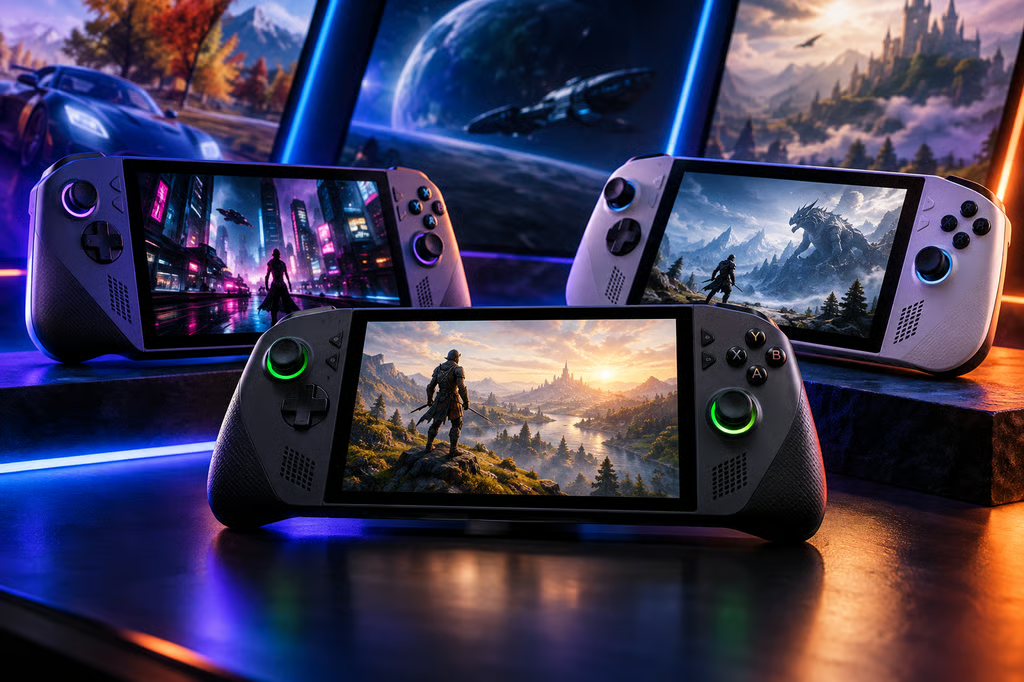


Steam Deck OLED is still one of the easiest handheld gaming PCs to recommend, but there are good reasons to look elsewhere.
Windows handhelds give you easier access to Game Pass and other PC launchers, while Lenovo offers SteamOS on hardware of its own. Higher-end alternatives can also deliver substantially more gaming performance.
Valve raised Steam Deck OLED prices on May 27. The 512GB model now costs $789, while the 1TB version costs $949.
| Handheld | Current official price | OS | Best for | Main tradeoff |
|---|---|---|---|---|
| ROG Xbox Ally X (2025) | $999.99 | Windows 11 | Best overall | IPS rather than OLED |
| Lenovo Legion Go S | $1,099.99 | SteamOS | Best SteamOS alternative | Smaller 55.5Wh battery |
| MSI Claw 8 EX AI+ | $1,799 | Windows 11 | Best performance | Very expensive; no OLED |
Pricing as of Sept. 18, 2026. Prices and promotions can change.
How we chose the best Steam Deck alternatives
To qualify, a handheld had to be a current US product with an active purchase path from its manufacturer, substantial independent testing, and a clear reason to choose it over the Steam Deck OLED.
Preorder-only, unavailable, and discontinued products were excluded. Retailer inventory was not used to keep a product on the list when manufacturer status did not support its inclusion.
The three finalists were compared across six areas:
- Gaming performance: Processor and graphics hardware, power modes, memory, and independent game testing.
- Software compatibility: SteamOS versus Windows, Game Pass and launcher access, and compatibility restrictions that can affect individual games.
- Battery and portability: Battery capacity, tested runtime, weight, ergonomics, and charging.
- Display and controls: Screen size, resolution, refresh rate, VRR, panel type, and controller design.
- Storage and connectivity: SSD capacity, memory, expansion options, and ports.
- Price and value: Current manufacturer price and what each handheld adds over the Steam Deck OLED.
Current pricing, specifications, and purchase availability come from official manufacturer listings. Independent reviews are used only for performance, battery life, ergonomics, and other real-world testing.
1. ROG Xbox Ally X (2025): Best overall
The ROG Xbox Ally X offers the strongest balance of Windows compatibility, gaming performance, battery capacity, and price in this group.
ASUS currently sells the ROG Xbox Ally X for $999.99. It uses AMD’s Ryzen AI Z2 Extreme processor with 24GB of LPDDR5X memory, a 1TB SSD, and an 80Wh battery.
Its 7-inch 1920-by-1080 IPS touchscreen runs at up to 120Hz and supports FreeSync Premium. The display is smaller than the 8-inch screens on the Lenovo and MSI models, but the Ally X is also lighter and easier to handle than many larger Windows handhelds.
Windows gives you direct access to PC Game Pass alongside Steam, Epic Games Store, Battle.net, and other PC launchers. Microsoft’s Xbox Full Screen Experience also provides a controller-focused interface without requiring you to spend as much time navigating the standard Windows desktop.
Tom’s Hardware praised the redesigned grips and balanced weight. Its Ryzen AI Z2 Extreme also delivered strong gaming results, including 66 fps in Red Dead Redemption 2 at 720p while unplugged.
The biggest compromise is the screen. At nearly $1,000, the Ally X still uses IPS rather than OLED.
Even so, its combination of an 80Wh battery, strong performance, broad Windows compatibility, and a $999.99 price makes it the most balanced Steam Deck alternative here.
2. Lenovo Legion Go S: Best SteamOS alternative
The Legion Go S makes the most sense if SteamOS is one of the things you like about the Steam Deck.
Lenovo currently sells the Legion Go S for $1,099.99. This SteamOS model uses AMD’s Ryzen Z1 Extreme processor and pairs it with an 8-inch 1920-by-1200 IPS touchscreen with a 120Hz refresh rate and VRR.
The handheld also has a 55.5Wh battery, dual USB4 ports, and microSD expansion.
SteamOS keeps navigation focused on a controller and provides the suspend-and-resume behavior Steam Deck owners already know. That makes the transition much smaller than moving to a conventional Windows handheld.
In Tom’s Hardware testing, the Z1 Extreme model performed strongly at 800p. Red Dead Redemption 2 lasted 2 hours and 5 minutes on battery, while BeamNG reached 2 hours and 30 minutes.
Battery capacity is its most obvious hardware weakness. The 55.5Wh pack is considerably smaller than the 80Wh batteries in the Ally X and MSI Claw.
SteamOS also carries the same basic compatibility limitations as the Steam Deck. Some games that rely on unsupported anti-cheat systems or Windows-specific software may not run as expected.
For buyers who want SteamOS with a larger 8-inch 120Hz display and Z1 Extreme hardware, the Legion Go S is the clearest alternative to Valve’s own handheld.
3. MSI Claw 8 EX AI+: Best performance
The MSI Claw 8 EX AI+ is the performance-focused option, but it comes at a steep premium.
MSI currently sells the Claw 8 EX AI+ CG3EM-024US for $1,799. The configuration includes Intel’s Arc G3 Extreme processor with Arc B390 graphics, 32GB of LPDDR5X memory, a 1TB SSD, and an 80Wh battery.
Its 8-inch 1920-by-1200 IPS touchscreen supports VRR and refresh rates up to 120Hz. Connectivity includes two Thunderbolt 4 ports and a microSD Express card reader.
Intel’s newer handheld gaming hardware is the main reason to spend this much. Tom’s Hardware found the Claw delivered class-leading results across its gaming benchmark suite.
During its Metro Exodus stress test, the Claw averaged nearly 70 fps at 800p and medium settings. The publication also recorded strong results in Cyberpunk 2077, Red Dead Redemption 2, and Shadow of the Tomb Raider.
The downside is value.
At $1,799, the Claw costs $799.01 more than the ROG Xbox Ally X, yet it still uses an IPS display instead of OLED. Its appeal is therefore narrow but clear: substantially higher-end handheld performance for buyers willing to pay for it.
Which Steam Deck alternative should you buy?
- ROG Xbox Ally X: Choose it for the best balance of Windows compatibility, gaming performance, battery capacity, and price.
- Lenovo Legion Go S: Choose it if you want SteamOS on hardware with a larger 8-inch display and a Ryzen Z1 Extreme processor.
- MSI Claw 8 EX AI+: Choose it if gaming performance matters more than its $1,799 price.
Three products are enough. Each has a current manufacturer purchase path and a distinct reason to move away from the Steam Deck OLED without padding the list with unavailable or redundant hardware.
Also read: Acer’s DualPlay Mini combines an 8-inch gaming handheld with a physical keyboard for a very different approach to portable PC gaming.